Results by title
154 books match the query 'East' and 4 start with f
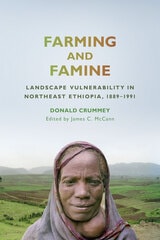
Farming and Famine
Landscape Vulnerability in Northeast Ethiopia, 1889–1991Donald E. Crummey; Edited by James C. McCann
University of Wisconsin Press, 2018
In modern times, Ethiopia has suffered three grievous famines, two of which—in 1973–74 and in 1984–85—caught the world's attention. It is often assumed that population increase drove Ethiopia's farmers to overexploit their environment and thus undermine the future of their own livelihoods, part of a larger global process of deforestation. In Farming and Famine, Donald E. Crummey explores and refutes these claims based on his research in Wallo province, an epicenter of both famines.
Crummey draws on photographs comparing identical landscapes in 1937 and 1997 as well as interviews with local farmers, among other sources. He reveals that forestation actually increased due to farmers' tree-planting initiatives. More broadly, he shows that, in the face of growing environmental stress, Ethiopian farmers have innovated and adapted. Yet the threat of famine remains because of constricted access to resources and erratic rainfall. To avoid future famines, Crummey suggests, Ethiopia's farmers must transform agricultural productivity, but they cannot achieve that on their own.
Crummey draws on photographs comparing identical landscapes in 1937 and 1997 as well as interviews with local farmers, among other sources. He reveals that forestation actually increased due to farmers' tree-planting initiatives. More broadly, he shows that, in the face of growing environmental stress, Ethiopian farmers have innovated and adapted. Yet the threat of famine remains because of constricted access to resources and erratic rainfall. To avoid future famines, Crummey suggests, Ethiopia's farmers must transform agricultural productivity, but they cannot achieve that on their own.
[more]
Fashioning Inland Communities
Trade and Popular Culture in Central East AfricaYaari Felber-Seligman
University of Wisconsin Press, 2025
When viewed from the economic centers of the Indian or Atlantic Oceans, the Ruvuma region of East Africa, crossing an area that is now southern Tanzania and northern Mozambique, would look like a periphery. But the same factors that marginalize the region historically brought distinct opportunities. In Fashioning Inland Communities, Yaari Felber-Seligman traces the long history—from the first millennium CE into the twentieth century—of Ruvuma trade practices within a changing world. Felber-Seligman argues that Ruvuma trade should be understood fundamentally as a set of voluntary choices undertaken and revised to further communities’ aspirations.
Ruvuma used fashion to build varied communities, from local to pan-regional, reflecting the dynamic relationships among inland groups. Examples of Ruvuma popular fashions reveal processes of meaning making and community building that call for us to expand our attention to the ways in which East African peoples interacted alongside, as well as beyond, trade networks that sourced prestige and commercial goods. Popular culture here emerges as a heterarchical force that shaped lasting multidirectional connections across and between Ruvuma and their neighbors. As both a subject and a strategy for analysis, the history of popular fashion shifts how we view histories of small, decentralized societies as they encounter larger economies. Felber-Seligman demonstrates that this has implications for our understanding not only of trade but of material culture, community, gender, and family.
Ruvuma used fashion to build varied communities, from local to pan-regional, reflecting the dynamic relationships among inland groups. Examples of Ruvuma popular fashions reveal processes of meaning making and community building that call for us to expand our attention to the ways in which East African peoples interacted alongside, as well as beyond, trade networks that sourced prestige and commercial goods. Popular culture here emerges as a heterarchical force that shaped lasting multidirectional connections across and between Ruvuma and their neighbors. As both a subject and a strategy for analysis, the history of popular fashion shifts how we view histories of small, decentralized societies as they encounter larger economies. Felber-Seligman demonstrates that this has implications for our understanding not only of trade but of material culture, community, gender, and family.
[more]

For Money and Elders
Ritual, Sovereignty, and the Sacred in KenyaRobert W. Blunt
University of Chicago Press, 2019
Many observers of Kenya’s complicated history see causes for concern, from the use of public office for private gain to a constitutional structure historically lopsided towards the executive branch. Yet efforts from critics and academics to diagnose the country’s problems do not often consider what these fiscal and political issues mean to ordinary Kenyans. How do Kenyans express their own political understanding, make sense of governance, and articulate what they expect from their leaders?
In For Money and Elders, Robert W. Blunt addresses these questions by turning to the political, economic, and religious signs in circulation in Kenya today. He examines how Kenyans attempt to make sense of political instability caused by the uncertainty of authority behind everything from currency to title deeds. When the symbolic order of a society is up for grabs, he shows, violence may seem like an expedient way to enforce the authority of signs. Drawing on fertile concepts of sovereignty, elderhood, counterfeiting, acephaly, and more, Blunt explores phenomena as diverse as the destabilization of ritual “oaths,” public anxieties about Satanism with the advent of democratic reform, and mistrust of official signs. The result is a fascinating glimpse into Kenya’s past and present and a penetrating reflection on meanings of violence in African politics.
In For Money and Elders, Robert W. Blunt addresses these questions by turning to the political, economic, and religious signs in circulation in Kenya today. He examines how Kenyans attempt to make sense of political instability caused by the uncertainty of authority behind everything from currency to title deeds. When the symbolic order of a society is up for grabs, he shows, violence may seem like an expedient way to enforce the authority of signs. Drawing on fertile concepts of sovereignty, elderhood, counterfeiting, acephaly, and more, Blunt explores phenomena as diverse as the destabilization of ritual “oaths,” public anxieties about Satanism with the advent of democratic reform, and mistrust of official signs. The result is a fascinating glimpse into Kenya’s past and present and a penetrating reflection on meanings of violence in African politics.
[more]

From Migrants to Refugees
The Politics of Aid along the Tanzania-Rwanda BorderJill Rosenthal
Duke University Press, 2023
In From Migrants to Refugees Jill Rosenthal tells the history of how Rwandan migrants in a Tanzanian border district became considered either citizens or refugees as nation-state boundaries solidified in the wake of decolonization. Outlining the process by which people who have long lived and circulated across the Rwanda-Tanzania border came to have a national identity, Rosenthal reveals humanitarian aid’s central role in the ideological processes of decolonization and nation building. From precolonial histories to the first Rwandan refugee camps during decolonization in the 1960s to the massive refugee camps in the 1990s, Rosenthal highlights the way that this area became a testing ground for novel forms of transnational aid to refugees that had global implications. As local and national actors, refugees, and international officials all attempted to control the lives and futures of refugee groups, they contested the authority of the nation-state and the international refugee regime. This history, Rosenthal demonstrates, illuminates how tensions between state and international actors divided people who share a common history, culture, and language across national borders.
[more]