Results by title
374 books match the query 'Economic History' and 17 start with f
Fairhope, 1894–1954
The Story of a Single Tax ColonyPaul E. Alyea and Blanche R. Alyea, With a New Introduction by Tennant McWilliams
University of Alabama Press, 2022
The remarkable and improbable story of the utopian single-tax social experiment that gave rise to one of the most unique and colorful communities along the Gulf Coast
Paul E. and Blanche R. Alyea’s Fairhope, 1894–1954, first published in 1954, is the history of this unique and improbable community and the single-tax social experiment that gave rise to it. This new edition offers an introduction by historian and Fairhope resident Tennant McWilliams, giving invaluable context and entertaining anecdotes not just regarding Fairhope’s founding but about the Alyeas themselves—all to the abiding value of their story for today’s residents and visitors.
On November 15, 1894, a small group of men and women met on a remote stretch of Mobile Bay’s eastern shore to establish a colony. It was a decidedly utopian undertaking in a period characterized by many similar social experiments and ideal communities, most of them failures. This group, which gathered at “Stapleton’s pasture” to found Fairhope, hoped to demonstrate the benefits of the single tax as a means of curing social and economic evils, making a practical test of the doctrines of economist Henry George.
Today, the wealth of parks, public and private schools, art galleries, and restaurants, combined with quaint shops and residential areas and a vibrant nautical life, all attest to Fairhope’s unique position among many older communities in the same region. Its residents represent a diverse array of interests and talents, and with a strong civic regard for individualism and creativity, Fairhope is also a haven for painters, potters, writers, and musicians.
False Dawn
The New Deal and the Promise of Recovery, 1933–1947George Selgin
University of Chicago Press, 2025
CHOSEN AS ONE OF THE WALL STREET JOURNAL’S 10 BEST BOOKS OF 2025
A definitive history of the United States’ recovery from the Great Depression—and the New Deal's true part in it.
FDR’s New Deal has long enjoyed a special place in American history and policy—both because it redefined the government’s fundamental responsibilities and because Roosevelt’s “bold experimentation” represented a type of policymaking many would like to see repeated.
But “the thing about bold experiments,” economist George Selgin reminds us, “is that they often fail.” In False Dawn Selgin draws on both contemporary sources and numerous studies by economic historians to show that, although steps taken during the Roosevelt administration’s first days raised hopes of a speedy recovery from the Great Depression, instead of fulfilling those hopes, subsequent New Deal policies proved so counterproductive that over seventeen percent of American workers—more than the peak unemployment rate during the COVID-19 crisis—were still either unemployed or on work relief six years later.
By distinguishing the New Deal’s successes from its failures, and explaining how the U.S. finally managed to lay the specter of mass unemployment to rest, Selgin draws salient lessons for dealing with future recessions.
Farm Policy and Trade Conflict
The Uruguay Round and CAP ReformAlan Swinbank and Carolyn Tanner
University of Michigan Press, 1996
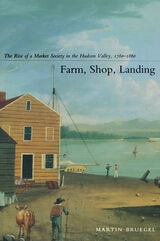
Farm, Shop, Landing
The Rise of a Market Society in the Hudson Valley, 1780–1860Martin Bruegel
Duke University Press, 2002
Combining theoretical rigor with extensive archival research, Bruegel’s account diverges from other historiographies of nineteenth-century economic development. It challenges the assumption that the coexistence of long-distance trade, private property, and entrepreneurial activity lead to one inescapable outcome: a market economy either wholeheartedly embraced or entirely rejected by its members. When Bruegel tells the story of farmer William Coventry struggling in the face of bad harvests, widow Mary Livingston battling her tenants, blacksmith Samuel Fowks perfecting the cast-iron plough, and Hannah Bushnell sending her butter to market, Bruegel shows that the social conventions of a particular community, and the real struggles and hopes of individuals, actively mold the evolving economic order. Ultimately, then, Farm, Shop, Landing suggests that the process of modernization must be understood as the result of the simultaneous and often contentious interplay of social and economic spheres.
Feeding Globalization
Madagascar and the Provisioning Trade, 1600–1800Jane Hooper
Ohio University Press, 2017
Between 1600 and 1800, the promise of fresh food attracted more than seven hundred English, French, and Dutch vessels to Madagascar. Throughout this period, European ships spent months at sea in the Atlantic and Indian Oceans, but until now scholars have not fully examined how crews were fed during these long voyages. Without sustenance from Madagascar, European traders would have struggled to transport silver to Asia and spices back to Europe. Colonies in Mozambique, Mauritius, and at the Cape relied upon frequent imports from Madagascar to feed settlers and slaves.
In Feeding Globalization, Jane Hooper draws on challenging and previously untapped sources to analyze Madagascar’s role in provisioning European trading networks within and ultimately beyond the Indian Ocean. The sale of food from the island not only shaped trade routes and colonial efforts but also encouraged political centralization and the slave trade in Madagascar. Malagasy people played an essential role in supporting European global commerce, with far-reaching effects on their communities.
Feeding Globalization reshapes our understanding of Indian Ocean and global history by insisting historians should pay attention to the role that food played in supporting other exchanges.
Fighting Financial Crises
Learning from the PastGary B. Gorton and Ellis W. Tallman
University of Chicago Press, 2018
Yet these pre-Fed banking panics, as Gary B. Gorton and Ellis W. Tallman show, bear striking similarities to our recent financial crisis. Fighting Financial Crises thus turns to the past to better understand our uncertain present, investigating how panics during the National Banking Era played out and how they were eventually quelled and prevented. The authors then consider the Fed’s and the SEC’s reactions to the recent crisis, building an informative new perspective on how the modern economy works.
Finance in America
An Unfinished StoryKevin R. Brine and Mary Poovey
University of Chicago Press, 2017
To understand finance, however, we have to learn its history, and this book fills that need. Kevin R. Brine, an industry veteran, and Mary Poovey, an acclaimed historian, show that finance as we know it today emerged gradually in the late nineteenth century and only coalesced after World War II, becoming ever more complicated—and ever more central to the American economy. The authors explain the models, regulations, and institutions at the heart of modern finance and uncover the complex and sometimes surprising origins of its critical features, such as corporate accounting standards, the Federal Reserve System, risk management practices, and American Keynesian and New Classic monetary economics. This book sees finance through its highs and lows, from pre-Depression to post-Recession, exploring the myriad ways in which the practices of finance and the realities of the economy influenced one another through the years.
A masterwork of collaboration, Finance in America lays bare the theories and practices that constitute finance, opening up the discussion of its role and risks to a broad range of scholars and citizens.
Financial Founding Fathers
The Men Who Made America RichRobert E. Wright and David J. Cowen
University of Chicago Press, 2006
Robert E. Wright and David J. Cowen here chronicle how a different group of founding fathers forged the wealth and institutions necessary to transform the American colonies from a diffuse alliance of contending business interests into one cohesive economic superpower. From Alexander Hamilton to Andrew Jackson, the authors focus on the lives of nine Americans in particular—some famous, some unknown, others misunderstood, but all among our nation’s financial founding fathers. Such men were instrumental in creating and nurturing a financial system that drove economic growth in the nascent United States because they were quick to realize that wealth was as crucial as the Constitution in securing the blessings of liberty and promoting the general welfare. The astonishing economic development made possible by our financial founding fathers was indispensable to the preservation of national unity and of support for a government that was then still a profoundly radical and delicate political experiment.
Grand in scope and vision, Financial Founding Fathers is an entertaining and inspiring history of the men who made America rich and steered her toward greatness.
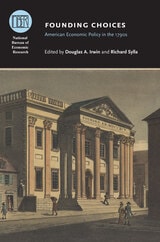
Founding Choices
American Economic Policy in the 1790sEdited by Douglas A. Irwin and Richard Sylla
University of Chicago Press, 2010
The political decisions made by the founding fathers were crucial to the success of the early republic. But the economic decisions they made were just as pivotal, ensuring the general welfare and common defense of the United States for decades to come. Founding Choices explores these economic choices and their profound influence on American life, westward expansion, and influence abroad. Among the topics covered are finance, trade, and monetary and banking policy, with a focus on the factors guiding those policies and their end result.
This book redresses the relative neglect of the economic achievements of the founders. It will be essential reading for historians and economists alike.
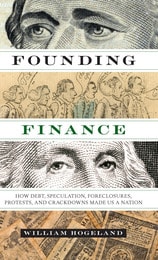
Founding Finance
How Debt, Speculation, Foreclosures, Protests, and Crackdowns Made Us a NationBy William Hogeland
University of Texas Press, 2014
Recent movements such as the Tea Party and anti-tax “constitutional conservatism” lay claim to the finance and taxation ideas of America’s founders, but how much do we really know about the dramatic clashes over finance and economics that marked the founding of America? Dissenting from both right-wing claims and certain liberal preconceptions, Founding Finance brings to life the violent conflicts over economics, class, and finance that played directly, and in many ways ironically, into the hardball politics of forming the nation and ratifying the Constitution—conflicts that still continue to affect our politics, legislation, and debate today.
Mixing lively narrative with fresh views of America’s founders, William Hogeland offers a new perspective on America’s economic infancy: foreclosure crises that make our current one look mild; investment bubbles in land and securities that drove rich men to high-risk borrowing and mad displays of ostentation before dropping them into debtors’ prisons; depressions longer and deeper than the great one of the twentieth century; crony mercantilism, war profiteering, and government corruption that undermine any nostalgia for a virtuous early republic; and predatory lending of scarce cash at exorbitant, unregulated rates, which forced people into bankruptcy, landlessness, and working in the factories and on the commercial farms of their creditors. This story exposes and corrects a perpetual historical denial—by movements across the political spectrum—of America’s all-important founding economic clashes, a denial that weakens and cheapens public discourse on American finance just when we need it most.
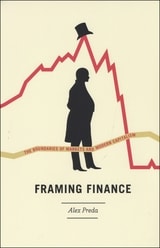
Framing Finance
The Boundaries of Markets and Modern CapitalismAlex Preda
University of Chicago Press, 2009
As Preda discovers through extensive research, the public was once much more skeptical. For investing to become accepted, a deep-seated prejudice against speculation had to be overcome, and Preda reveals that over the course of the eighteenth and nineteenth centuries groups associated with stock exchanges in New York, London, and Paris managed to redefine finance as a scientific pursuit grounded in observational technology. But Preda also notes that as the financial data in which they trafficked became ever more difficult to understand, charismatic speculators emerged whose manipulations of the market undermined the benefits of widespread investment. And so, Framing Finance ends with an eye on the future, proposing a system of public financial education to counter the irrational elements that still animate the appeal of finance.
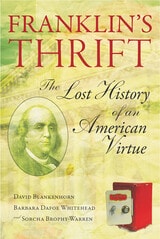
Franklin's Thrift
The Lost History of an American VirtueDavid Blankenhorn
Templeton Press, 2009
Americans today often think of thrift as a negative value—a miserly hoarding of resources and a denial of pleasure. Even more telling, many Americans don’t even think of thrift at all anymore. Franklin’s Thrift challenges this state of mind by recovering the rich history of thrift as a quintessentially American virtue.
The contributors to this volume trace how the idea and practice of thrift have been a vital part of the American vision of economic freedom and social abundance. For Benjamin Franklin, who personified and promoted the idea, thrift meant working productively, consuming wisely, saving proportionally, and giving generously. Franklin’s thrift became the cornerstone of a new kind of secular faith in the ordinary person’s capacity to shape his lot and fortune in life. Later chapters document how thrift moved into new domains in the nineteenth and twentieth centuries. It became the animating idea behind social movements to promote children’s school savings, create mutual savings banks and credit unions for working men and women, establish a federal savings bond program, and galvanize the nation to conserve resources during two world wars.
Historians, enthusiasts of Americana or traditional American virtues, and anyone interested in resolving our society’s current financial woes will find much to treasure in this diverse collection, with topics ranging from the inspirational lessons we can learn from the film It’s a Wonderful Life to a history of the roles played by mutual savings banks, credit unions, and thrift stores in America’s national thrift movement. It also includes actual policy recommendations for our present situation.
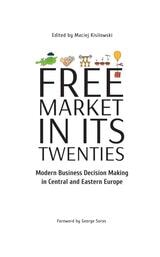
Free Market in Its Twenties
Modern Business Decision Making in Central and Eastern EuropeGeorge Soros
Central European University Press, 2014

Friends of the Unrighteous Mammon
Northern Christians and Market Capitalism, 1815-1860Stewart Davenport
University of Chicago Press, 2008
Drawing on diverse primary sources, Davenport identifies three distinct Christian responses to market capitalism: assurance from clerical economists who believed in the righteousness of economic development; opposition from contrarians who resisted the changes around them; and adaptation by the pastoral moralists who modified their faith to meet the ethical challenges of the changing economy. Delving into the minds of antebellum Christians as they considered themselves, their God, and their developing American economy, Friends of the Unrighteous Mammon is an ambitious intellectual history of an important development in American religious and economic life.
From Liberty to Democracy
The Transformation of American GovernmentRandall G. Holcombe
University of Michigan Press, 2002
The government's activities during two world wars and the Great Depression greatly increased its involvement in people's economic affairs, and by the time of Lyndon Johnson's Great Society, the transformation was complete. By the end of the twentieth century, the fundamental principle underlying American government had been transformed to democracy, and public policy was designed to further the will of the majority. The result has been a government that is larger and broader in scope.
From Liberty to Democracy examines American political history using the framework of public choice theory to show how American government grew more democratic, and how this resulted in an increase in the size and scope of government. It should appeal to historians, political scientists, and economists who are interested in the evolution of American government but does not assume any specialized training and can be read by anyone interested in American political history.
Randall G. Holcombe is DeVoe Moore Professor of Economics, Florida State University

From Old Regime to Industrial State
A History of German Industrialization from the Eighteenth Century to World War IRichard H. Tilly and Michael Kopsidis
University of Chicago Press, 2020
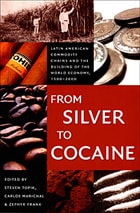
From Silver to Cocaine
Latin American Commodity Chains and the Building of the World Economy, 1500-2000Steven Topik, Carlos Marichal, and Zephyr Frank, eds.
Duke University Press, 2006
By focusing on changing patterns of production and consumption over time, the contributors reconstruct complex webs of relationships and economic processes, highlighting Latin America’s central and interactive place in the world economy. They show how changes in coffee consumption habits, clothing fashions, drug usage, or tire technologies in Europe, Asia, and the Americas reverberate through Latin American commodity chains in profound ways. The social and economic outcomes of the continent’s export experience have been mixed. By analyzing the dynamics of a wide range of commodities over a five-hundred-year period, From Silver to Cocaine highlights this diversity at the same time that it provides a basis for comparison and points to new ways of doing global history.
Contributors. Marcelo Bucheli, Horacio Crespo, Zephyr Frank, Paul Gootenberg, Robert Greenhill, Mary Ann Mahony, Carlos Marichal, David McCreery, Rory Miller, Aldo Musacchio, Laura Nater, Ian Read, Mario Samper, Steven Topik, Allen Wells