Results by title
162 books match the query 'Economics & Trade' and 12 start with f

Fair Trade Rebels
Coffee Production and Struggles for Autonomy in ChiapasLindsay Naylor
University of Minnesota Press, 2019
Reassessing interpretations of development with a new approach to fair trade
Is fair trade really fair? Who is it for, and who gets to decide? Fair Trade Rebels addresses such questions in a new way by shifting the focus from the abstract concept of fair trade—and whether it is “working”—to the perspectives of small farmers. It examines the everyday experiences of resistance and agricultural practice among the campesinos/as of Chiapas, Mexico, who struggle for dignified livelihoods in self-declared autonomous communities in the highlands, confronting inequalities locally in what is really a global corporate agricultural chain.
Based on extensive fieldwork, Fair Trade Rebels draws on stories from Chiapas that have emerged from the farmers’ interaction with both the fair-trade–certified marketplace and state violence. Here Lindsay Naylor discusses the racialized and historical backdrop of coffee production and rebel autonomy in the highlands, underscores the divergence of movements for fairer trade and the so-called alternative certified market, traces the network of such movements from the highlands and into the United States, and evaluates existing food sovereignty and diverse economic exchanges.
Putting decolonial thinking in conversation with diverse economies theory, Fair Trade Rebels evaluates fair trade not by the measure of its success or failure but through a unique, place-based approach that expands our understanding of the relationship between fair trade, autonomy, and economic development.
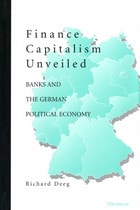
Finance Capitalism Unveiled
Banks and the German Political EconomyRichard Deeg
University of Michigan Press, 1999
Financial Deregulation and Integration in East Asia
Edited by Takatoshi Ito and Anne O. Krueger
University of Chicago Press, 1996
In these thirteen essays, American and Asian scholars analyze the effects of financial deregulation and integration on East Asian markets. Topics covered include the roles of the United States and Japan in trading with Asian countries, macroeconomic policy implications of export-led growth in Korea and Taiwan, the effects of foreign direct investment in China, and the impact of financial liberalization in Japan, Korea, and Singapore.
Demonstrating the complexity of financial deregulation and the challenges it poses for policy makers, this volume provides an excellent picture of the overall status of East Asian financial markets for scholars in international finance and Asian economic development.
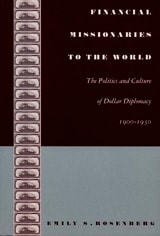
Financial Missionaries to the World
The Politics and Culture of Dollar Diplomacy, 1900-1930Emily S. Rosenberg
Duke University Press, 2003
Financial Missionaries to the World establishes the broad scope and significance of "dollar diplomacy"—the use of international lending and advising—to early-twentieth-century U.S. foreign policy. Combining diplomatic, economic, and cultural history, the distinguished historian Emily S. Rosenberg shows how private bank loans were extended to leverage the acceptance of American financial advisers by foreign governments. In an analysis striking in its relevance to contemporary debates over international loans, she reveals how a practice initially justified as a progressive means to extend “civilization” by promoting economic stability and progress became embroiled in controversy. Vocal critics at home and abroad charged that American loans and financial oversight constituted a new imperialism that fostered exploitation of less powerful nations. By the mid-1920s, Rosenberg explains, even early supporters of dollar diplomacy worried that by facilitating excessive borrowing, the practice might induce the very instability and default that it supposedly worked against.
Financial Sector Development in the Pacific Rim
Edited by Takatoshi Ito and Andrew K. Rose
University of Chicago Press, 2009
The reform in Asian financial sectors—especially in banking and stock markets—has been remarkable since the currency crisis of 1997–98. East Asia is now a major player in international finance, providing serious competition to the more traditional financial centers of London and New York. Financial Sector Development in the Pacific Rim provides a rich collection of theoretical and empirical analyses of the growing capital markets in the region.
Bringing together authors from various East Asian and Pacific nations, this volume examines the institutional factors influencing financial innovation, the consequences of financial development, widespread consolidation occurring through mergers and acquisitions, and the implementation of policy reform. Financial Sector Development in the Pacific Rim offers the comparative analysis necessary to answer broad questions about economic development and the future of Asia.

Financing Prosperity by Dealing with Debt
Edited by Christopher Harker and Amy Horton
University College London, 2022
In an era when many of us depend on debt to survive but struggle with its consequences, Financing Prosperity by Dealing with Debt draws together current thinking on how to solve debt crises and promote prosperity. By profiling existing action by credit unions and community organizations, alongside bold proposals for the future, with contributions from artists, activists, and academics, the book shows how we can rethink the validity and inevitability of many contemporary forms of debt through organizing debt audits, promoting debt cancellation, and expanding member-owned co-operatives. The authors set out legal and political methods for changing the rules of the system to provide debt relief and reshape economies for more inclusive and sustainable flourishing. The book also profiles community-based actions that are changing the role of debt in economic, social, and political life—among them, participatory art projects, radical advice networks, and ways of financing feminist green transition. This volume moves beyond critique to present a wealth of concrete ways to tackle debt and forge the prosperous communities we want for the future, making it relevant to a broad audience of academics, practitioners, activists, and policymakers.
Fiscal Institutions and Fiscal Performance
Edited by James M. Poterba and Jürgen von Hagen
University of Chicago Press, 1999
Fiscal Institutions and Fiscal Performance shifts emphasis away from narrow economic factors to more broadly defined political and institutional factors that affect government policy and national debt. This collection brings together new theoretical models, empirical evidence, and a series of in-depth case studies to analyze the effect of political institutions, fiscal regulations, and policy decisions on accumulating deficits. It provides a fascinating overview of the political and economic issues involved and highlights the role of budgetary institutions in the formation of budget deficits.
Fiscal Policy and Management in East Asia
Edited by Takatoshi Ito and Andrew K. Rose
University of Chicago Press, 2007
Fiscal Policy and Management in East Asia explores the inefficient tax systems of many developing countries, the relationship between public and private sector economic behavior, and the pressing issue of future obligations that governments have undertaken to provide pensions and health care for their citizens. Featuring both overviews and analyses of the countries discussed, this book will be of value to economists and policymakers seeking to understand fiscal policy in a global context.

Forging an Integrated Europe
Barry Eichengreen and Jeffry Frieden, Editors
University of Michigan Press, 1998

From Central Planning to the Market
Transformation of the Czech Economy 1989 – 2004Libor Zidek
Central European University Press, 2018

From Here to Free Trade
Essays in Post-Uruguay Round Trade StrategyErnest H. Preeg
University of Chicago Press, 1998
The first essay assesses U.S. interests in economic globalization, the second examines recent steps toward free trade at the multilateral and regional levels, and the next three offer an in-depth critique of U.S. regional free trade objectives in the Americas, across the Pacific, and possibly with Europe. The final essay presents a multilateral/regional synthesis for going from here to free trade over the coming decade.

Fujimori's Peru
The Political EconomyEdited by John Crabtree and Jim Thomas
University of London Press, 1998