Results by title
295 books match the query 'Ecosystems & Habitats' and 14 start with f
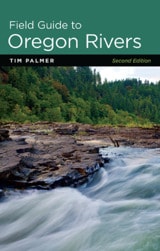
Field Guide to Oregon Rivers
Tim Palmer
Oregon State University Press, 2024
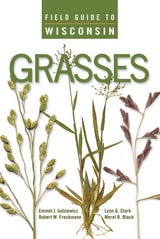
Field Guide to Wisconsin Grasses
Emmet J. Judziewicz , Robert W. Freckmann, Lynn G. Clark, Merel R. Black
University of Wisconsin Press, 2014
The book includes:
• drawings of most species
• chapters on grass morphology and grasses in natural communities
• keys to all species, including an illustrated key to genera
• a glossary of grass terminology.
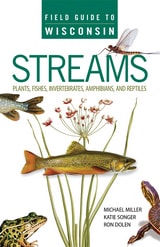
Field Guide to Wisconsin Streams
Plants, Fishes, Invertebrates, Amphibians, and ReptilesMichael A. Miller, Katie Songer, and Ron Dolen
University of Wisconsin Press, 2014
More than 1,000 images illustrate the species in this field guide. These images are augmented by detailed ecological and taxonomic notes, descriptions of look-alike species, and distribution maps. The guide identifies:
• more than 130 common plants
• all 120 fishes known to inhabit Wisconsin streams
• 8 crayfishes
• 50 mussels
• 10 amphibians
• 17 reptiles
• 70 families of insects
• other commonly found invertebrates.
Best Regional General Interest Books, selected by the American Association of School Librarians
Best Regional General Interest Books, selected by the Public Library Reviewers
Finding the River
An Environmental History of the ElwhaJeff Crane
Oregon State University Press, 2011
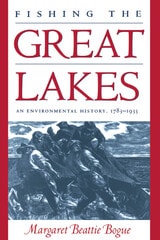
Fishing the Great Lakes
An Environmental History, 1783–1933Margaret Beattie Bogue
University of Wisconsin Press, 2000
Fishing the Great Lakes is a sweeping history of the destruction of the once-abundant fisheries of the great "inland seas" that lie between the United States and Canada. Though lake trout, whitefish, freshwater herring, and sturgeon were still teeming as late as 1850, Margaret Bogue documents here how overfishing, pollution, political squabbling, poor public policies, and commercial exploitation combined to damage the fish populations even before the voracious sea lamprey invaded the lakes and decimated the lake trout population in the 1940s.
From the earliest records of fishing by native peoples, through the era of European exploration and settlement, to the growth and collapse of the commercial fishing industry, Fishing the Great Lakes traces the changing relationships between the fish resources and the people of the Great Lakes region. Bogue focuses in particular on the period from 1783, when Great Britain and the United States first politically severed the geographic unity of the Great Lakes, through 1933, when the commercial fishing industry had passed from its heyday in the late nineteenth century into very serious decline. She shows how fishermen, entrepreneurial fish dealers, the monopolistic A. Booth and Company (which distributed and marketed much of the Great Lakes catch), and policy makers at all levels of government played their parts in the debacle. So, too, did underfunded scientists and early conservationists unable to spark the interest of an indifferent public. Concern with the quality of lake habitat and the abundance of fish increasingly took a backseat to the interests of agriculture, lumbering, mining, commerce, manufacturing, and urban development in the Great Lakes region. Offering more than a regional history, Bogue also places the problems of Great Lakes fishing in the context of past and current worldwide fishery concerns.
Flow
The Life and Times of Philadelphia's Schuylkill RiverBeth Kephart
Temple University Press, 2014
For Love of Lakes
Darby Nelson
Michigan State University Press, 2011
America has more than 130,000 lakes of significant size. Ninety percent of all Americans live within fifty miles of a lake, and our 1.8 billion trips to watery places make them our top vacation choice. Yet despite this striking popularity, more than 45 percent of surveyed lakes and 80 percent of urban lakes do not meet water quality standards. For Love of Lakes weaves a delightful tapestry of history, science, emotion, and poetry for all who love lakes or enjoy nature writing. For Love of Lakes is an affectionate account documenting our species’ long relationship with lakes—their glacial origins, Thoreau and his environmental message, and the major perceptual shifts and advances in our understanding of lake ecology. This is a necessary and thoughtful book that addresses the stewardship void while providing improved understanding of our most treasured natural feature.
For the Love of Rivers
A Scientist's JourneyKurt D. Fausch
Oregon State University Press, 2015
In For the Love of Rivers, stream ecologist Kurt Fausch draws readers across the reflective surface of streams to view and ponder what is beneath, and how they work. While celebrating their beauty and mystery, he uses his many years of experience as a field biologist to explain the underlying science connecting these aquatic ecosystems to their streamside forests and the organisms found there—including humans.
For the Love of Rivers introduces readers to the life and work of Shigeru Nakano, a pioneering river ecologist who inspired other scientists around the world with his innovative research on stream-forest connections. Fausch takes readers along as he journeys to Japan, where he awakens to an unfamiliar culture, to Nakano, and his research.
Nakano’s life was abruptly ended in a tragic field accident, and his death was deeply mourned. Fausch joins Japanese and American colleagues to continue Nakano’s research legacy, learn everything they can about the effects that humans have on rivers, fish, and their intricate links with riparian zones, and share this knowledge with others.
More than a book about stream ecology, For the Love of Rivers is a celebration of the interconnectedness of life. It is an authoritative and accessible look at the science of rivers and streams, but it also ponders the larger questions of why rivers are important to humans, why it is in our nature to want to be near them, and what we can do now to ensure the future of these essential ecosystems.
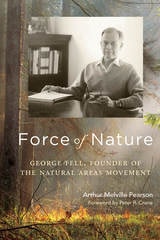
Force of Nature
George Fell, Founder of the Natural Areas MovementArthur Melville Pearson
University of Wisconsin Press, 2020
Force of Nature reveals how a failed civil servant, with few assets apart from his tenacity and vision, initiated the natural areas movement. In the boom years following World War II, as undeveloped lands were being mined, drained, or bulldozed, Fell transformed a loose band of ecologists into The Nature Conservancy, drove the passage of the influential Illinois Nature Preserves Act, and helped spark allied local and national conservation organizations in the United States and beyond.
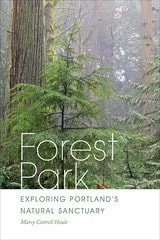
Forest Park
Exploring Portland's Natural SanctuaryMarcy Cottrell Houle
Oregon State University Press, 2023
Situated in the rugged hills west of downtown Portland, Forest Park is the nation’s premier urban natural sanctuary. It supports essential habitat for hundreds of native plants and animals, including species at risk, and is one of the largest city parks in the world. While extending critical ecosystem services to the region, it offers miles of outstanding hiking trails, all within minutes of the downtown core.
Forest Park: Exploring Portland’s Natural Sanctuary showcases this treasure in new light, offering a compendium of the most up-to-date and comprehensive information available. Twenty-one hikes covering 75 miles bring a full awareness of the park’s outstanding attributes. Hikes are grouped by theme to encourage people to explore Forest Park’s watersheds; geology; lichens and mosses; vegetation; amphibians and reptiles; pollinators; native wildlife; and wildlife corridors. Beautiful photographs and full-color maps accompany each trail description.
Forest Park is a shining example of the Pacific Northwest western hemlock community--an ecosystem unique among all temperate forests of the world. It is also an exciting model for a future Urban Biodiversity Reserve, a concept under development recognizing the park’s scientific, natural, and cultural qualities. Forest Park: Exploring Portland’s Natural Sanctuary will help all visitors discover the beauty and wonders of this extraordinary natural resource.
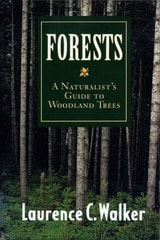
Forests
A Naturalist’s Guide to Woodland TreesBy Laurence C. Walker
University of Texas Press, 1997
First published in 1990, Forests explores the ecological, economic, and human influences on over thirty significant types of woodlands. Laurence Walker focuses especially on the effects of site factors—climate, physiography, biology, and soils—upon the growth of various kinds of trees. Projects for amateur naturalists, reading lists, and a glossary make this the perfect introduction for general readers.
Foundations of Stream and River Ecology
A Guide to the Classic LiteratureEdited by Wyatt F. Cross, Jonathan P. Benstead, Amy M. Marcarelli, and Ryan A. Sponseller
University of Chicago Press, 2024
The study of streams and rivers combines ecology, chemistry, hydrology, and geology to reveal the factors that control the biological diversity and functioning of these unique ecosystems. Although stream ecology is a relatively young discipline, foundational papers published over the past half century have shaped our current understanding of these ecosystems and have informed our efforts to manage and protect them. Organized by topics such as the physical template, community structure, food webs, ecosystem energetics, and nutrient dynamics, the chapters of this book offer summaries of the key literature, historical and contextual information, and insightful discussions of how past research has influenced present studies and may shape future work.

Freshwater Marshes
Ecology and Wildlife ManagementMilton W. Weller
University of Minnesota Press, 1994
Freshwater Marshes was first published in 1994. Minnesota Archive Editions uses digital technology to make long-unavailable books once again accessible, and are published unaltered from the original University of Minnesota Press editions.
Prairie potholes, wetland edges of lakes and rivers, and other freshwater marshes play a vital role in maintaining a clean and plentiful water supply for wildlife and human use. These wetland areas provide habitat for spawning fish, feed waterfowl, purify and retain water, and control erosion. In this updated third edition, Milton W. Weller describes the components of the freshwater marsh: its annual and seasonal dynamics as affected by rainfall cycles and the plant and animal population's response to such changes. Weller discusses how such wetland areas are managed for wildlife populations and diversity, and how such processes can be used in wetland conservation and restoration. He considers the impact society has on wetlands and offers conservation goals for freshwater wetland complexes.
Weller broadens the third edition to include an analysis of how prairie wetlands compare in water dynamics with swamps, tidal marshes, and other wetlands. He also expands the discussion of wetland classification, evaluation, mitigation, and restoration, and introduces a new glossary of current wetland terminology.Freshwater Marshes is Volume 1 of Wildlife Habitats.
Milton W. Weller is professor emeritus and former Kleberg Chair in Wildlife Ecology, at Texas A&M University.
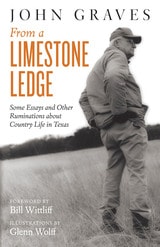
From a Limestone Ledge
Some Essays and Other Ruminations about Country Life in TexasBy John Graves<br>Foreword by Bill Wittliff<br>Illustrations by Glenn Wolff
University of Texas Press, 2016
“Another fine, reflective, anecdotal look at rural Texas.” —New Yorker
“Graves writes eloquently about a countryman’s concerns. There's not a false note in the book.” —Boston Globe
“Like the unmortared stone fences of Graves’s native hill country, From a Limestone Ledge is constructed of bits and pieces never designed to fit together, yet made to achieve a unity that is more enduring than the sum of its individual parts by the hands of a master craftsman.” —Southwestern Historical Quarterly
“The beauty of his work endures, and there is a greater pride in Texans’ hearts for their home, I think, than there would be if he hadn’t written the books he did.” —Rick Bass, Garden & Gun
“In describing the particulars of his surroundings, Graves often was describing the world in microcosm and the place and plight of humankind in it.” —Bryan Woolley, Dallas Morning News