Results by title
64 books match the query 'Ecuador' and 4 start with f
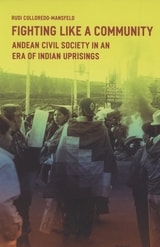
Fighting Like a Community
Andean Civil Society in an Era of Indian UprisingsRudi Colloredo-Mansfeld
University of Chicago Press, 2009
The indigenous population of the Ecuadorian Andes made substantial political gains during the 1990s in the wake of a dynamic wave of local activism. The movement renegotiated land development laws, elected indigenous candidates to national office, and successfully fought for the constitutional redefinition of Ecuador as a nation of many cultures. Fighting Like a Community argues that these remarkable achievements paradoxically grew out of the deep differences—in language, class, education, and location—that began to divide native society in the 1960s.
Drawing on fifteen years of fieldwork, Rudi Colloredo-Mansfeld explores these differences and the conflicts they engendered in a variety of communities. From protestors confronting the military during a national strike to a migrant family fighting to get a relative released from prison, Colloredo-Mansfeld recounts dramatic events and private struggles alike to demonstrate how indigenous power in Ecuador is energized by disagreements over values and priorities, eloquently contending that the plurality of Andean communities, not their unity, has been the key to their political success.
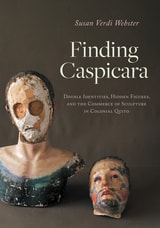
Finding Caspicara
Double Identities, Hidden Figures, and the Commerce of Sculpture in Colonial QuitoSusan Verdi Webster
University of Texas Press, 2024
2026 Eleanor Tufts Award, Society for Iberian Global Art, College Art Association
An examination of sculpture and authorship in eighteenth-century Quito that documents Caspicara as a participant in the innovative artistic production of the city’s workshops and its widespread commerce of polychrome sculptures.
Who is Caspicara? Nothing is known of Caspicara’s life, and not a single sculpture has been documented as his work. Yet traditional histories laud him as a prolific Indigenous sculptor in eighteenth-century Quito who created exquisite polychrome figures and became a national artistic icon. Drawing on extensive archival, historical, and object research, Susan Verdi Webster peels away layers of historiographical fabrication to reveal what we do and do not know about Caspicara and his work.
Rather than being a solitary master, Caspicara collaborated with other, largely Indigenous artists in Quito’s protoindustrial workshops, manufacturing sculptures now credited to him alone. The high quality of Quito sculptures produced by anonymous artists turned the city into a hub of wide-ranging commerce in religious icons. The art world and post-independence Ecuadorians have lionized the one named sculptor, Caspicara, according to the Western model of the artist-genius, amplifying the market for works bearing his name and creating a national hero on par with European masters. Lost in this process were the artists themselves. Webster returns to their world, detailing their methods and labor and, for the first time, documenting a sculpture made by Caspicara.

For Glory and Bolívar
The Remarkable Life of Manuela SáenzBy Pamela S. Murray
University of Texas Press, 2008
She was a friend, lover, and confidante of charismatic Spanish American independence hero Simón Bolívar and, after her death, a nationalist icon in her own right. Yet authors generally have chosen either to romanticize Manuela Sáenz or to discount her altogether. For Glory and Bolivar: The Remarkable of Life of Manuela Sáenz, by contrast, offers a comprehensive and clear-eyed biography of her. Based on unprecedented archival research, it paints a vivid portrait of the Quito-born "Libertadora," revealing both an exceptional figure and a flesh-and-blood person whose life broadly reflected the experiences of women during Spanish America's turbulent Age of Revolution.
Already married at the time of her meeting with the famous Liberator, Sáenz abandoned her husband in order to become not only Bolívar's romantic companion, but also his official archivist, a member of his inner circle, and one of his most loyal followers. She played a central role in Spanish South America's independence drama and eventually in developments leading to the consolidation of new nations. Pamela Murray, for the first time, closely examines Sáenz's political trajectory including her vital, often-overlooked years in exile. She exposes the myths that still surround her. She offers, in short, a nuanced and much-needed historical perspective, one that balances recognition of Sáenz's uniqueness with awareness of the broader forces that shaped this dynamic nineteenth-century woman.
From Cuenca to Queens
An Anthropological Story of Transnational MigrationBy Ann Miles
University of Texas Press, 2004
Transnational migration is a controversial and much-discussed issue in both the popular media and the social sciences, but at its heart migration is about individual people making the difficult choice to leave their families and communities in hopes of achieving greater economic prosperity. Vicente Quitasaca is one of these people. In 1995 he left his home in the Ecuadorian city of Cuenca to live and work in New York City. This anthropological story of Vicente's migration and its effects on his life and the lives of his parents and siblings adds a crucial human dimension to statistics about immigration and the macro impact of transnational migration on the global economy.
Anthropologist Ann Miles has known the Quitasacas since 1989. Her long acquaintance with the family allows her to delve deeply into the factors that eventually impelled the oldest son to make the difficult and dangerous journey to the United States as an undocumented migrant. Focusing on each family member in turn, Miles explores their varying perceptions of social inequality and racism in Ecuador and their reactions to Vicente's migration. As family members speak about Vicente's new, hard-to-imagine life in America, they reveal how transnational migration becomes a symbol of failure, hope, resignation, and promise for poor people in struggling economies. Miles frames this fascinating family biography with an analysis of the historical and structural conditions that encourage transnational migration, so that the Quitasacas' story becomes a vivid firsthand illustration of this growing global phenomenon.