Results by title
218 books match the query 'Education, Higher' and 8 start with f
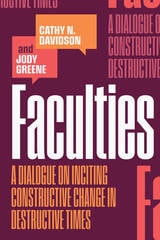
Faculties
A Dialogue on Inciting Constructive Change in Destructive TimesCathy N. Davidson and Jody Greene
Duke University Press, 2026
Failing the Future
A Dean Looks at Higher Education in the Twenty-first CenturyAnnette Kolodny
Duke University Press, 1998
In this volume Kolodny explains the reasons for the financial crisis in higher education today and boldly addresses the challenges that remain ignored, including rising birthrates, changing demographics both on campus and across the country, the accelerating globalization of higher education and advanced research, and the necessity for greater interdisciplinarity in undergraduate education. Moreover, while sensitive to the complex burdens placed on faculty today, Kolodny nonetheless reveals how the professoriate has allowed itself to become vulnerable to public misperceptions and to lampooning by the media.
Not simply a book about current problems and future challenges, Failing the Future is rich with practical solutions and workable programs for change. Among her many insights, Kolodny offers a thorough defense of the role of tenure and outlines a new set of procedures to ensure its effective implementation; she proposes a structure for an “Antifeminist Intellectual Harassment Policy”; and she provides a checklist of family-sensitive policies universities can offer their staff, faculty, and administrators. Kolodny calls on union leaders, campus communities, policymakers, and the general public to work together in unprecedented partnerships. Her goal, as she states in a closing coda, is to initiate a revitalized conversation about public education.
This book should be required reading for all those concerned with the future of higher education in this country—from college trustees to graduate students entering the professoriate, from faculty to university administrators, from officers of campus-based unions to education policymakers.
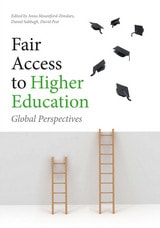
Fair Access to Higher Education
Global PerspectivesEdited by Anna Mountford-Zimdars, Daniel Sabbagh, and David Post
University of Chicago Press, 2014
Fair Access to Higher Education addresses this challenge from a broad, transnational perspective. The chapters in this volume contribute to our thinking and reflection on policy developments and also offer new empirical findings about patterns of advantage and disadvantage in higher education access. Bringing together insights drawn from a variety of fields, including philosophy, linguistics, social psychology, sociology, and public policy, the book sheds light on how “fairness” in university admissions has been articulated worldwide.
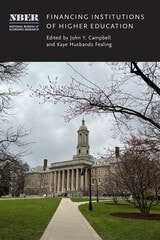
Financing Institutions of Higher Education
Edited by John Y. Campbell and Kaye Husbands Fealing
University of Chicago Press, 2026
An insightful, wide-ranging analysis of the economic hurdles facing America’s higher education system.
The US higher education sector faces numerous economic challenges, including the stagnating number of college-age domestic students, geographic mismatch between population growth and the location of colleges and universities, financial pressures, including cutbacks in government support, growing student debt burdens, sticker prices that deter prospective applicants, and the risk of low capital market returns on endowment portfolios. This volume analyzes the responses of students, families, and the financial managers of higher education institutions to these challenges. It presents new insights into the substantial disparities in the financial structure of, and the financial challenges facing, different types of institutions. The volume draws together contributions from financial economics, public finance, and industrial organization, as well as the economics of education.
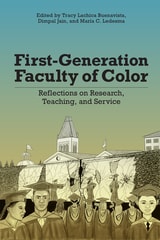
First-Generation Faculty of Color
Reflections on Research, Teaching, and ServiceTracy Lachica Buenavista
Rutgers University Press, 2023
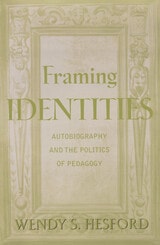
Framing Identities
Autobiography and the Politics of PedagogyWendy S. Hesford
University of Minnesota Press, 1999
A trenchant examination of the political dynamics of autobiography in education.
How do historically marginalized groups expose the partiality and presumptions of educational institutions through autobiographical acts? How are the stories we tell used to justify resistance to change or institutional complacency? These are the questions Wendy S. Hesford asks as she considers the uses of autobiography in educational settings. This book demonstrates how autobiographical acts-oral, written, performative, and visual-play out in vexed and contradictory ways and how in the academy they can become sites of cultural struggle over multicultural education, sexual harassment, institutional racism, hate speech, student activism, and commemorative practices.
Within the context of Oberlin, a small liberal arts college in Ohio, and beginning with a speak-out organized by Asian American students in 1995, this book looks at the uses of autobiographical practices in empowering groups traditionally marginalized in academic settings. Investigating the process of self-representation and the social, spatial, and discursive frames within which academic bodies and identities are constituted, Framing Identities explores the use of autobiographical acts in terms of power, influence, risks involved, and effectiveness. Hesford does not endorse autobiography as an unequivocal source of empowerment, however. Instead, she illustrates how autobiographical practices in the academy can mobilize competing and often irreconcilable interests. Hesford argues that by integrating self-reflection into cultural, rhetorical, and material analyses-and encouraging students to do the same-teachers not only will largely justify attention to the personal in the classroom, they will help their communities move beyond a naive identity politics. Framing Identities provides a model for teacher-researchers across the disciplines (education, English, composition, cultural studies, women’s studies, to name a few) to investigate the contradictory uses and consequences of autobiography at their own institutions, and to carve out new pedagogical spaces from which they and their students can emerge as social, political, and intellectual subjects.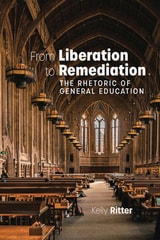
From Liberation to Remediation
The Rhetoric of General EducationKelly Ritter
Utah State University Press, 2026
Kelly Ritter addresses how lawmakers, for-profit testing companies, and even universities fuel public misconceptions of what Gen Ed can provide for our democracy and the role that a broad-based college education plays in social uplift. Tracing the history of the public rhetoric that persuades parents and students to see these courses as a set of interchangeable precollege credits to gain (or game) by any means necessary, she examines how positive and negative public responses to the curricula affected the position of core subjects in US universities, focusing on first-year writing. She also explores the role local, state, and organizational politics played in Gen Ed’s positioning, including decisions related to race, social class, and educational attainment; the impact credit-by-exemption and seamless transfer had on the quality and import of Gen Ed programming in both high schools and colleges; and the perceived use-value of the courses themselves in the face of rising college costs. Finally, she considers which student populations have benefited from the denigration of Gen Ed’s value and which have been left behind.
Drawing on archival research and case studies, From Liberation to Remediation raises important questions about equity, access, and the role of General Education in US higher education’s future and demonstrates that recovering the original post-war democratizing principles and practices of Gen Ed is critical to the continuance of a literate, empathetic, and civic-minded democracy for the twenty-first century.
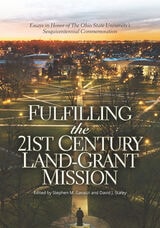
Fulfilling the 21st Century Land-Grant Mission
Essays in Honor of The Ohio State University’s Sesquicentennial CommemorationEdited by Stephen M. Gavazzi and David J. Staley
The Ohio State University Press, 2020
Gathered in honor of The Ohio State University’s sesquicentennial celebration, this collection of essays highlights the significant contributions that Ohio State continues to make as part of its twenty-first-century land-grant mission. Authors from across the university—representing fields as various as agriculture, dance, English, engineering, family science, geography, medicine, social work, and veterinary science—provide contributions that highlight the preeminent status of The Ohio State University. In addition, the perspectives of alumni, staff members, and senior administrators (both present and former) round out the picture of Ohio State as the first among equals regarding its land-grant peers. Overall, contributors draw on rich and varied institutional backgrounds to offer invaluable insights for higher education administrators and scholars across the US.