Results by title
56 books match the query 'Effect of technological innovations on' and 3 start with f

Feminist Technology
Edited by Linda L. Layne, Sharra L. Vostral, and Kate Boyer
University of Illinois Press, 2010
Is there such a thing as a "feminist technology"? If so, what makes a technology feminist? Is it in the design process, in the thing itself, in the way it is marketed, or in the way it is used by women (or by men)?
In this collection, feminist scholars trained in diverse fields consider these questions by examining a range of products, tools, and technologies that were specifically designed for and marketed to women. Evaluating the claims that such products are liberating for women, the contributors focus on case studies of menstrual-suppressing birth control pills, home pregnancy tests, tampons, breast pumps, Norplant, anti-fertility vaccines, and microbicides. In examining these various products, this volume explores ways of actively intervening to develop better tools for designing, promoting, and evaluating feminist technologies. Recognizing the different needs and desires of women and acknowledging the multiplicity of feminist approaches, Feminist Technology offers a sustained debate on existing and emergent technologies that share the goal of improving women's lives.
Contributors are Jennifer Aengst, Maia Boswell-Penc, Kate Boyer, Frances Bronet, Shirley Gorenstein, Anita Hardon, Deborah G. Johnson, Linda L. Layne, Deana McDonagh, and Sharra L. Vostral.
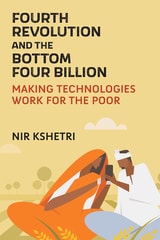
Fourth Revolution and the Bottom Four Billion
Making Technologies Work for the PoorNir Kshetri
University of Michigan Press, 2023
Products and services based on advanced technologies such as artificial intelligence and blockchain are normally considered to be for rich consumers in advanced countries. Fourth Revolution and the Bottom Four Billion demonstrates how marginalized and vulnerable groups with limited resources can also benefit from these technologies. Nir Kshetri suggests that the falling costs and the increased ease of developing and deploying applications based on these technologies are making them more accessible. He illustrates how key emerging technologies are transforming major industries and application areas such as healthcare and pandemic preparedness, agriculture, finance, banking, and insurance. The book also looks at how these transformations are affecting the lives of low-income people in low- and middle-income countries and highlights the areas needing regulatory attention to adequately protect marginalized and vulnerable groups from the abuse and misuse of these technologies. Kshetri discusses how various barriers such as the lack of data, low resource languages, underdeveloped technology infrastructures, lack of computing power and shortage of skill and talent have hindered the adoption of these technologies among marginalized and vulnerable groups. Fourth Revolution and the Bottom Four Billion suggests that it is the responsibility of diverse stakeholders—governments, NGOs, international development organizations, academic institutions, the private sector, and others—to ensure that marginal groups also benefit from these transformative innovations.

Fundamentals for the Academic Liaison
Richard Moniz
American Library Association, 2014