Results by title
78 books match the query 'Emergence' and 4 start with f

Fiery Cinema
The Emergence of an Affective Medium in China, 1915–1945Weihong Bao
University of Minnesota Press, 2015
What was cinema in modern China? It was, this book tells us, a dynamic entity, not strictly tied to one media technology, one mode of operation, or one system of aesthetic code. It was, in Weihong Bao’s term, an affective medium, a distinct notion of the medium as mediating environment with the power to stir passions, frame perception, and mold experience. In Fiery Cinema, Bao traces the permutations of this affective medium from the early through the mid-twentieth century, exploring its role in aesthetics, politics, and social institutions.
Mapping the changing identity of cinema in China in relation to Republican-era print media, theatrical performance, radio broadcasting, television, and architecture, Bao has created an archaeology of Chinese media culture. Within this context, she grounds the question of spectatorial affect and media technology in China’s experience of mechanized warfare, colonial modernity, and the shaping of the public into consumers, national citizens, and a revolutionary collective subject. Carrying on a close conversation with transnational media theory and history, she teases out the tension and affinity between vernacular, political modernist, and propagandistic articulations of mass culture in China’s varied participation in modernity.
Fiery Cinema advances a radical rethinking of affect and medium as a key insight into the relationship of cinema to the public sphere and the making of the masses. By centering media politics in her inquiry of the forgotten future of cinema, Bao makes a major intervention into the theory and history of media.

Foundation of Urology at the University of Michigan
Emergence of a Medical Specialty, 1919–1970David A. Bloom
Michigan Publishing Services, 2027
In 1919, urology came to the University of Michigan when Hugh Cabot arrived from Boston, attracted by the fulltime position of surgery chair. The celebrity urologist created a multi-specialty surgery department and, two years later, became the Dean of the Medical School. He trained Reed Nesbit who became the Chief of Urology in 1930; Nesbit made Ann Arbor an epicenter of international urological practice, education, and research until his retirement in 1967. In this history of urology at the university, David Bloom recounts Cabot and Nesbit’s careers, the introduction of hemodialysis to Michigan, and the role of the Ann Arbor Sarns corporation in worldwide hemodialysis technology.
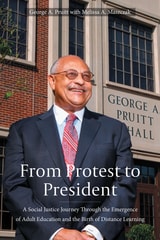
From Protest to President
A Social Justice Journey through the Emergence of Adult Education and the Birth of Distance LearningGeorge A Pruitt
Rutgers University Press, 2023
From barbershop encounters with Malcolm X to death threats at Illinois State University and gunfire at Towson State, Pruitt provides a powerful narrative poised at the intersection of social justice, higher education and politics. He recounts leadership experiences at HBCUs and public universities across the country, as he advocated for autonomy at Morgan State and fought to preserve Tennessee State University.
His steadfast activism, integrity and courage led to groundbreaking work in providing access to higher education for working adults and the military.
From his days as a student protester in high school and college to his appearances on Capitol Hill, Pruitt has earned the reputation as a candid and influential leader in higher education.