Results by title
240 books match the query 'English as a Second Language' and 7 start with f
First Day to Final Grade, Third Edition
A Graduate Student's Guide to TeachingAnne Curzan and Lisa Damour
University of Michigan Press, 2011
This new edition incorporates newer teaching and learning pedagogy. The book has been updated to reflect the role of technology both inside and outside the classroom. In addition, a new chapter has been added that discusses successfully transitioning from being a teaching assistant to being hired as a full-time instructor.

First Day to Final Grade
A Graduate Student's Guide to Teaching, Fourth EditionAnne Curzan, Lisa Damour, and Whitney Peoples
University of Michigan Press, 2027
Every year, tens of thousands of graduate students walk into a college classroom for the first time with deep subject-matter expertise but little or no formal preparation for teaching. First Day to Final Grade has guided those instructors through three successful editions, offering clear, honest, and immediately usable advice for every stage of a course—from writing a syllabus and preparing a first lecture to running discussions, grading fairly, and handling difficult moments in the classroom. This fourth edition brings that trusted guidance fully up to date with new material on creating classrooms where all students can succeed and teaching with today’s technology. Whether read cover to cover before a first assignment or consulted in the middle of a challenging semester, this book is the practical companion new college teachers need.
In this new edition of First Day to Final Grade, readers will find:
- Equity-focused and inclusive pedagogy woven throughout the text;
- New material on transparency as a core inclusive and equity-focused practice, including explicit attention to surfacing the “hidden curriculum” for first-generation students;
- Advice on AI and generative tools, including designing writing assignments that account for AI, and a section on academic integrity, plagiarism, and inappropriate use of generative AI;
- New syllabus guidance on contemporary classroom management issues, including students requesting to record class sessions;
- Updated and consolidated recommended readings that address AI in teaching, equity-based pedagogy, student belonging, student mental health, teaching writing, and teaching when English is not one’s first language;
- Prescriptive guidance that explains the reasoning behind specific recommendations to help readers understand how particular practices benefit the learning environment and the instructor-student relationship.
Flipping the Classroom
What Every ESL Teacher Should KnowRobyn Brinks Lockwood
University of Michigan Press, 2018

Flor's Journey to Independence
Barbara Vaille and Jennifer QuinnWilliams
University of Michigan Press, 2005
A modified version of this story is also available on our website, www.press.umich.edu/esl/stories.
The MICHIGAN Stories for Newcomers are original fiction written for adult English learners who wish to improve their reading and English skills
Four Point Listening and Speaking 2, Second Ed., Supplemental Audiofiles
Audio DownloadBetsy Parrish
University of Michigan Press, 2014
This audio download product is NOT an audio reproduction of all the content in the accompanying textbook (Four Point: Listening & Speaking 2, Second Edition).
The Four Point series is designed for English language learners whose primary goal is to succeed in an academic setting.The series covers the four academic skills of reading, writing, listening, and speaking while providing reinforcement and systematic recycling of key vocabulary and further exposure to grammar issues. In order to participate in academic settings, English learners need focused activities to develop and then maintain their use of vocabulary and grammar. Each book in the series focuses heavily on vocabulary in particular, highlighting between 125-150 key vocabulary items including individual words, compound words, phrasal verbs, short phrases, idioms, metaphors, collocations, and longer set lexical phrases.
Four Point Listening and Speaking 2, Second Edition (No Audio)
English for Academic PurposesBetsy Parrish
University of Michigan Press, 2018
This version has the same content as 978-0-472-03535-9; it just is not packaged with the audio. The audio (MP3) files, available for download, must be purchased separately: 978-0-472-00362-4.
This product replaces 978-0-472-03535-9.
The Four Point series is designed for English language learners whose primary goal is to succeed in an academic setting.The series covers the four academic skills of reading, writing, listening, and speaking while providing reinforcement and systematic recycling of key vocabulary and further exposure to grammar issues. In order to participate in academic settings, English learners need focused activities to develop and then maintain their use of vocabulary and grammar. Each book in the series focuses heavily on vocabulary in particular, highlighting between 125-150 key vocabulary items including individual words, compound words, phrasal verbs, short phrases, idioms, metaphors, collocations, and longer set lexical phrases.
The 2nd Edition of Listening-Speaking 2 contains six lectures on the topic within a field of academic study: applied linguistics, geology, economics, history, health sciences, and engineering. The lectures range in length from 11 to 16 minutes in length. Audio files are sold separately. The exercises practice an array of important academic listening and speaking skills, including making presentations, and also reinforce vocabulary and reading and writing skills. Each unit includes activities based on the in-class interactions students will encounter in academic settings—including making impromptu and prepared presentations, debating, participating in group discussions. Toward this end, video scenes (available on the companion website) for each unit model student behavior when working in groups and incorporate key words and phrases typically used when working in groups. By addressing the breadth and depth of listening and speaking tasks required in academic settings, students will grow confident in areas that build the fluencies needed to succeed in their academic endeavors.
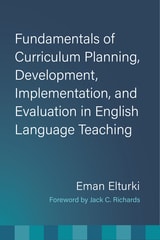
Fundamentals of Curriculum Planning, Development, Implementation, and Evaluation in English Language Teaching
Eman Elturki
University of Michigan Press, 2026
This book offers a systematic guide to navigating the different phases of the curriculum, from its inception to its evaluation. Part I explores the conceptual and theoretical foundations that shape curriculum and instruction. Part II provides practical knowledge and guidelines that programs and individual teachers can adopt or adapt to their specific educational contexts with the goal is to optimize the teaching and learning experience. Elturki draws largely on knowledge from the field of education, particularly curriculum studies, to complement what we know about L2 teaching and learning from Applied Linguistics, Second Language Acquisition, and English Language Teaching. Each chapter begins with pre-reading questions to stimulate thinking and concludes with post-reading questions for reflection, encouraging readers to connect the material to their own context.