Results by title
304 books match the query 'Entertainment & Performing Arts' and 12 start with f
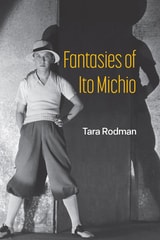
Fantasies of Ito Michio
Tara Rodman
University of Michigan Press, 2024
Winner of the 2025 Dance Studies Association Oscar Brockett Book Prize
Born in Japan and trained in Germany, dancer and choreographer Ito Michio (1893–1961) achieved prominence in London before moving to the U.S. in 1916 and building a career as an internationally acclaimed artist. During World War II, Ito was interned for two years, and then repatriated to Japan, where he contributed to imperial war efforts by creating propaganda performances and performing revues for the occupying Allied Forces in Tokyo. Throughout, Ito continually invented stories of voyages made, artists befriended, performances seen, and political activities carried out—stories later dismissed as false.
Fantasies of Ito Michio argues that these invented stories, unrealized projects, and questionable political affiliations are as fundamental to Ito’s career as his ‘real’ activities, helping us understand how he sustained himself across experiences of racialization, imperialism, war, and internment. Tara Rodman reveals a narrative of Ito’s life that foregrounds the fabricated and overlooked to highlight his involvement with Japanese artists, such as Yamada Kosaku and Ishii Baku, and global modernist movements. Rodman offers “fantasy” as a rubric for understanding how individuals such as Ito sustain themselves in periods of violent disruption and as a scholarly methodology for engaging the past.
Federico Fellini as Auteur
Seven Aspects of His FilmsJohn C. Stubbs
Southern Illinois University Press, 2006
Federico Fellini as Auteur: Seven Aspects of His Films offers a comprehensive auteurist study of the renowned Italian director. Film scholar John C. Stubbs dispenses with a traditional film-career review of the man, focusing instead on the key elements of the filmmaker’s style, the influence of Carl Jung and dreams, the autobiographical depiction of childhood and adolescence, the portrait of the artist, the filmmaker’s working relationship with his wife, Fellini’s comic strategies, and his adaptation of works by others. Each of the aspects is fully contextualized. This examination of the critical elements in Fellini films offers a better understanding of the artistry that is uniquely Fellini.
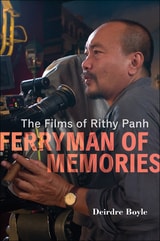
Ferryman of Memories
The Films of Rithy PanhDeirdre Boyle
Rutgers University Press, 2023
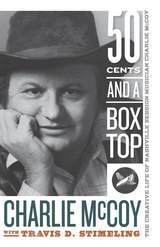
Fifty Cents and a Box Top
The Creative Life of Nashville Session Musician Charlie McCoyCharlie McCoy
West Virginia University Press, 2017
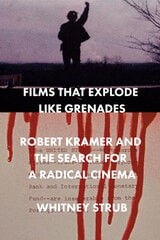
Films That Explode Like Grenades
Robert Kramer and the Search for a Radical CinemaWhitney Strub
University of Chicago Press, 2026
Robert Kramer (1939–99) was the emblematic filmmaker of the late-1960s New Left in the United States. Yet because most of his three dozen films have been out of circulation for decades, he has long been neglected by film historians and the Left. Kramer was the cofounder of the leftist documentary collective Newsreel and the director of underground films such as Ice (1970), Milestones (1975), and Route One/USA (1989). His films provide distinctive insights into how America’s political terrain has changed over time, capturing each era’s revolutionary ethos and its contradictions. Whitney Strub’s Films That Explode Like Grenades tracks the histories of leftist film and global revolutionary movements via Kramer’s life and travels. Moving among New York City, Chicago, North Vietnam, Paris, Portugal, Angola, and other crucial flashpoints, Kramer left a major and influential body of work in his wake that has fundamentally shaped the work of radical filmmakers across the globe.
For Strub, Kramer’s career is a key thread in an intimate history of the 1960s New Left, one that emphasizes the complexities of the movement’s internal tensions and its legacies. Drawing on visual analysis, extensive archival research across the United States and France, and myriad interviews with Kramer contemporaries, including Bernardine Dohrn, Tom Hayden, Jonas Mekas, and Kramer’s relatives, Strub transforms Kramer’s life story into a dynamic and engaging social history of 1960s radicalism and its generational legacies.
With detailed mapping of Robert Kramer’s many social and artistic contexts, Films That Explode Like Grenades restores him to a place of global importance in leftist cinema.
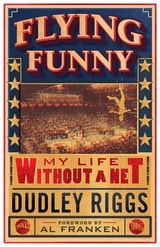
Flying Funny
My Life without a NetDudley Riggs
University of Minnesota Press, 2017
The unusual, gravity-defying first act of improvisational theater’s founding father—now in paperback
Dudley Riggs didn’t have to run away from home to join the circus: home was the circus. Son of the acclaimed aerial flyers Riggs and Riggs, he made his circus debut as a polar prince parading in a wagon pulled by a polar bear. At the age of five, he graduated to a risqué vaudeville act during the circus off- season; at eight, he outgrew his cutes (and his child stardom) and joined his high-flying parents on the trapeze. Eventually he had to learn to “fly funny” because he grew too tall to fly straight. In one way or another, Riggs has been flying ever since.
The rest, as they say, is history. And what a story it is. In Flying Funny, Riggs shares many highs and lows while describing circus life and the evolution of America’s popular entertainment during the twentieth century. From his early life in circus and vaudeville to his creation of the Brave New Workshop, we see how his show business experience and instincts helped him create in Minneapolis what became the “next wave” in American entertainment—improvisation.
As a young man, Riggs lost everything in a tornado, got an education on the fly, and sailed with the All American circus to post–war Japan. On a slow boat home and restless about his future, he developed the idea of Word Jazz—creating a script on stage as it is being performed—and shortly after he opened the Instant Theater in New York. Later, he moved to Minneapolis where he founded the Brave New Workshop, launching the careers of comic greats such as Penn and Teller, The Flying Karamazov Brothers, Louie Anderson, Peter Tolan, Pat Proft, Nancy Steen, Liz Winstead, Al Franken and many others. Today, the Brave New Workshop thrives as the longest running improvisational theater in America.
From flying funny on the trapeze to theater without a net, Dudley Riggs’s story is filled with hearty laughs and eyebrow-raising insights. With a wry sense of humor and infectious warmth, he shares the exhilaration of flying whether through the air or on the stage.
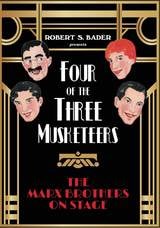
Four of the Three Musketeers
The Marx Brothers on StageRobert S. Bader
Northwestern University Press, 2022
An updated paperback version of the book heralded as “a new benchmark in Marx scholarship” by the Los Angeles Times
Before film made them international comedy legends, the Marx Brothers developed their comic skills on stage for twenty-five years. In Four of the Three Musketeers: The Marx Brothers on Stage, Robert S. Bader offers the first comprehensive history of the foursome’s hardscrabble early years honing their act in front of live audiences.
From Groucho’s debut in 1905 to their final live performances of scenes from A Night in Casablanca in 1945, the brothers’ stage career shows how their characters and routines evolved before their arrival in Hollywood. Four of the Three Musketeers draws on an unmatched array of sources, many not referenced elsewhere. Bader’s detailed portrait of the struggling young actors both brings to vivid life a typical night on the road for the Marx Brothers and illuminates the inner workings of the vaudeville business, especially during its peak in the 1920s.
As Bader traces the origins of the characters that would later come to be beloved by filmgoers, he also skillfully scrapes away the accretion of rumors and mythology perpetuated not only by fans and writers but by the Marx Brothers themselves. Revealing, vital, and entertaining, Four of the Three Musketeers has taken its place as an essential reference for this legendary American act. Now, the updated edition adds newly discovered performances—some submitted by readers—and additional information provided by descendants of long-departed vaudevillians mentioned in the book.
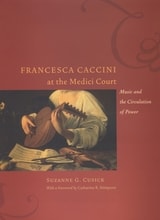
Francesca Caccini at the Medici Court
Music and the Circulation of PowerSuzanne G. Cusick
University of Chicago Press, 2009
Suzanne G. Cusick argues that Caccini’s career depended on the usefulness of her talents to the political agenda of Grand Duchess Christine de Lorraine, Tuscany’s de facto regent from 1606 to 1636. Drawing on Classical and feminist theory, Cusick shows how the music Caccini made for the Medici court sustained the culture that enabled Christine’s power, thereby also supporting the sexual and political aims of its women.
In bringing Caccini’s surprising story so vividly to life, Cusick ultimately illuminates how music making functioned in early modern Italy as a significant medium for the circulation of power.
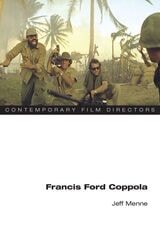
Francis Ford Coppola
Jeff Menne
University of Illinois Press, 2014
However, Jeff Menne argues that Coppola exemplifies the new breed of creative corporate person and sees the director's oeuvre as vital for reimagining the corporation in the transformation of Hollywood.
Reading auteur theory as the new American business theory, Menne reveals how Coppola's vision of a new kind of company has transformed the worker into a liberated and well-utilized artist, but has also commodified individual creativity at a level unprecedented in corporate history. Coppola negotiated the contradictory roles of shrewd businessman and creative artist by recognizing the two roles are fused in a postindustrial economy.
Analyzing films like The Godfather (1970) and the overlooked Tucker: The Man and His Dream (1988) through Coppola's use of opera, Menne illustrates how Coppola developed a defining musical aesthetic while making films that reflected the idea of a corporation as family--and how his studio American Zoetrope came to represent a new brand of auteurism and the model for post-Fordist Hollywood.
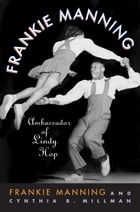
Frankie Manning
Ambassador of Lindy HopFrankie Manning
Temple University Press, 2008
In the early days of swing dancing, Frankie Manning stood out for his moves and his innovative routines; he created the "air step" in the Lindy hop, a dance that took the U.S. and then the world by storm. In this fascinating autobiography, the choreographer and Tony Award winner (Black and Blue) Frankie Manning recalls how his first years of dancing as a teenager at Harlem's Savoy Ballroom led to his becoming chief choreographer and a lead dancer for Whitey's Lindy Hoppers, a group that appeared on Broadway, in Hollywood musicals, and on stages around the globe. Manning brings the Swing Era vividly back to life with his recollections of the crowded ballrooms, and of Lindy hoppers trying to outdo each other in spectacular performances. His memories of the many headliners and film stars, as well as uncelebrated dancers with whom he shared the stage, create a unique portrait of an era in which African American performers enjoyed the spotlight if not a star's prerogatives and salary.
With collaborator Cynthia Millman, Manning traces the evolution of swing dancing from its early days in Harlem through the post-World War II period, until it was eclipsed by rock 'n' roll and then disco. When swing made a comeback, Manning's 30-year hiatus ended. He has been performing, choreographing, and teaching ever since.
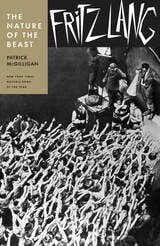
Fritz Lang
The Nature of the BeastPatrick McGilligan
University of Minnesota Press, 2013
The name of Fritz Lang—the visionary director of Metropolis, M, Fury, The Big Heat, and thirty other unforgettable films—is hallowed the world over. But what lurks behind his greatest legends and his genius as a filmmaker? Patrick McGilligan, placed among “the front rank of film biographers” by the Washington Post, spent four years in Europe and America interviewing Lang’s dying contemporaries, researching government and film archives, and investigating the intriguing life story of Fritz Lang. This critically acclaimed biography—lauded as one of the year’s best nonfiction books by Publishers Weekly—reconstructs the compelling, flawed human being behind the monster with the monocle.
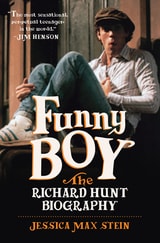
Funny Boy
The Richard Hunt BiographyJessica Max Stein
Rutgers University Press, 2024
"The most sensational, perpetual teenager in the world.” —Jim Henson
"To know him was to love him, and we do." —Mark Hamill
Funny Boy: The Richard Hunt Biography tells the life story of a gifted performer whose gleeful irreverence, sharp wit and generous spirit inspired millions. Richard Hunt was one of the original main five performers in the Muppet troupe. He brought to life an impressive range of characters on The Muppet Show, Sesame Street, Fraggle Rock and various Muppet movies, everyone from eager gofer Scooter to elderly heckler Statler, groovy girl Janice to freaked-out lab helper Beaker, even early versions of Miss Piggy and Elmo. Hunt also acted, directed and mentored the next generation of performers. His accomplishments are all the more remarkable in that he crammed them all into only 40 years.
Richard Hunt was just 18 years old when he joined Jim Henson’s company, where his edgy humor quickly helped launch the Muppets into international stardom. Hunt lived large, savoring life’s delights, amassing a vivid, disparate community of friends. Even when the AIDS epidemic wrought its devastation, claiming the love of Hunt’s life and threatening his own life, he showed an extraordinary sense of resilience, openness and joy. Hunt’s story exemplifies how to follow your passion, foster your talents, adapt to life’s surprises, genuinely connect with everyone from glitzy celebrities to gruff cab drivers – and have a hell of a lot of fun along the way.