Results by title
60 books match the query 'Environmental justice' and 5 start with f
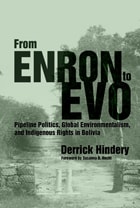
From Enron to Evo
Pipeline Politics, Global Environmentalism, and Indigenous Rights in BoliviaDerrick Hindery; Foreword by Susanna B. Hecht
University of Arizona Press, 2013
Throughout the Americas, a boom in oil, gas, and mining development has pushed the extractive frontier deeper into Indigenous territories. Centering on a long-term study of Enron and Shell’s Cuiabá pipeline, From Enron to Evo traces the struggles of Bolivia’s Indigenous peoples for self-determination over their lives and territories. In his analysis of their response to this encroaching development, author Derrick Hindery also sheds light on surprising similarities between neoliberal reform and the policies of the nation’s first Indigenous president, Evo Morales.
Drawing upon extensive interviews and document analysis, Hindery argues that many of the structural conditions created by neoliberal policies—including partial privatization of the oil and gas sector—still persist under Morales. Tactics employed by both Morales and his neoliberal predecessors utilize the rhetoric of environmental protection and Indigenous rights to justify oil, gas, mining, and road development in Indigenous territories and sensitive ecoregions.
Indigenous peoples, while mindful of gains made during Morales’s tenure, are increasingly dissatisfied with the administration’s development model, particularly when it infringes upon their right to self-determination. From Enron to Evo demonstrates their dynamic and pragmatic strategies to cope with development and adversity, while also advancing their own aims.
Offering a critique of both free-market piracy and the dilemmas of resource nationalism, this is a groundbreaking book for scholars, policy-makers, and advocates concerned with Indigenous politics, social movements, environmental justice, and resistance in an era of expanding resource development.
[more]
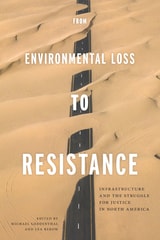
From Environmental Loss to Resistance
Infrastructure and the Struggle for Justice in North AmericaMichael Loadenthal
University of Massachusetts Press, 2020
North Americans have reached a socioenvironmental tipping point where social transformation has become necessary to secure a stable and desirable future. As hurricanes destroy coastal areas that once hosted schools and homes, petroleum refineries choke nearby communities and their parks, and pipeline construction threatens water rights for indigenous peoples, communities are left to determine how to best manage and mitigate environmental loss.
In this new collection, a range of contributors—among them researchers, practitioners, organizers, and activists—explore the ways in which people counter or cope with feelings of despair, leverage action for positive change, and formulate pathways to achieve environmental justice goals. These essays pay particular attention to issues of race, class, economic liberalization, and geography; place contemporary environmental struggles in a critical context that emphasizes justice, connection, and reconciliation; and raise important questions about the challenges and responses that concern those pursuing environmental justice.
Contributors include the volume editors, Carol J. Adams, Randall Amster, Jan Inglis, Eileen Delehanty Pearkes, Zoë Roller, and Michael Truscello.
[more]
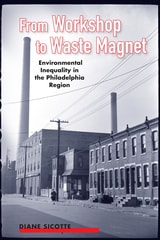
From Workshop to Waste Magnet
Environmental Inequality in the Philadelphia RegionSicotte, Diane
Rutgers University Press, 2016
Like many industrialized regions, the Philadelphia metro area contains pockets of environmental degradation: neighborhoods littered with abandoned waste sites, polluting factories, and smoke-belching incinerators. However, other neighborhoods within and around the city are relatively pristine. This eye-opening book reveals that such environmental inequalities did not occur by chance, but were instead the result of specific policy decisions that served to exacerbate endemic classism and racism.
From Workshop to Waste Magnet presents Philadelphia’s environmental history as a bracing case study in mismanagement and injustice. Sociologist Diane Sicotte digs deep into the city’s past as a titan of American manufacturing to trace how only a few communities came to host nearly all of the area’s polluting and waste disposal land uses. By examining the complex interactions among economic decline, federal regulations, local politics, and shifting ethnic demographics, she not only dissects what went wrong in Philadelphia but also identifies lessons for environmental justice activism today.
Sicotte’s research tallies both the environmental and social costs of industrial pollution, exposing the devastation that occurs when mass quantities of society’s wastes mix with toxic levels of systemic racism and economic inequality. From Workshop to Waste Magnet is a compelling read for anyone concerned with the health of America’s cities and the people who live in them.
[more]

Fruit of the Orchard
Environmental Justice in East TexasPhyllis Glazer
University of North Texas Press, 2006
[more]
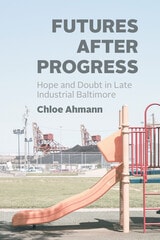
Futures after Progress
Hope and Doubt in Late Industrial BaltimoreChloe Ahmann
University of Chicago Press, 2024
A powerful ethnographic study of South Baltimore, a place haunted by toxic pasts in its pursuit of better futures.
Factory fires, chemical explosions, and aerial pollutants have inexorably shaped South Baltimore into one of the most polluted places in the country. In Futures after Progress, anthropologist Chloe Ahmann explores the rise and fall of industrial lifeways on this edge of the city and the uncertainties that linger in their wake. Writing from the community of Curtis Bay, where two hundred years of technocratic hubris have carried lethal costs, Ahmann also follows local efforts to realize a good future after industry and the rifts competing visions opened between neighbors.
Examining tensions between White and Black residents, environmental activists and industrial enthusiasts, local elders and younger generations, Ahmann shows how this community has become a battleground for competing political futures whose stakes reverberate beyond its six square miles in a present after progress has lost steam. And yet—as one young resident explains—“that’s not how the story ends.” Rigorous and moving, Futures after Progress probes the deep roots of our ecological predicament, offering insight into what lies ahead for a country beset by dreams deferred and a planet on the precipice of change.
[more]