Results by title
63 books match the query 'Environmentalists & Naturalists' and 4 start with f
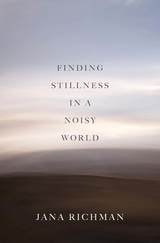
Finding Stillness in a Noisy World
Jana Richman
University of Utah Press, 2018
In these wide-ranging personal essays, Richman travels interior roads through fear, kindness, ignorance, darkness, wildness, compassion, solitude, loneliness, and more—always asking how external geography informs our internal geography. From the monsoonal rains in the carved slot canyons of the Escalante to the eroticism of dirt on skin in a remote slice of the Grand Canyon; from the defiance of academic authority to the curled, arthritic fingers of her mother and grandmothers, Richman sinks into the realities that make us human and fallible and blessed.
Inspired by masters of the traditional personal essay such as E.B. White and M.F.K. Fisher, Richman adds a unique, deeply intimate—and often humorous—voice to the concurrence of human experience. Like a desert stream, human meaning meanders before coming to rest. Richman’s authentic voice illuminates the place where internal and external landscapes merge into meaning. Time with these genuine, inclusive pieces is time well spent.
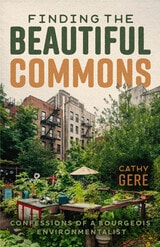
Finding the Beautiful Commons
Confessions of a Bourgeois EnvironmentalistCathy Gere
University of Chicago Press, 2027
A call to pleasurable and sustainable action that centers our shared stewardship of shared spaces.
Environmentally-conscious decision-making can seem like an exercise in self-denial: don’t fly, don’t drive, don’t eat meat. But bringing our tote bags to the grocery store will never be enough to solve the climate crisis, nor will dropping out of society. Many of us crave a collective movement that acknowledges the value of comfort, a framework for making choices that are inherently imperfect, but ones we can live with.
In Finding the Beautiful Commons, historian Cathy Gere offers a relatable and inspiring guide to environmental action in a consumerist culture. Recounting her experiences as a young activist at the Greenham Common Women’s Peace Camp in Berkshire, as an anarchist and guerrilla gardener in a New York City squat, and as an academic working to decarbonize the University of California system, Gere argues for initiatives grounded in common property—streets, libraries, parks, and other shared spaces—where our communal interests can drive sustainability. These are also sites where we can put bourgeois values like beauty and personal enjoyment to good use protecting local landscapes and resources.
Funny, wise, and honest about the contradictions of life during climate crisis, Gere shows us that the commons we already know—the everyday infrastructure of mass transit, natural reserves, and public beaches—is the very foundation for a livable future.
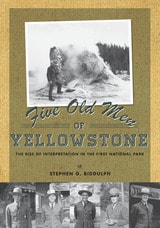
Five Old Men of Yellowstone
The Rise of Interpretation in the First NationalStephen Biddulph
University of Utah Press, 2013
Biddulph’s masterfully woven narrative—part biography, part historical narrative—offers both fascinating factual details about Yellowstone and charming colloquial story telling. The interpretive initiatives of the rangers—nature walks, campfire programs, game stalks, and auto caravans—are enlivened by the colorful personalities of the five men who conducted them. Historians will find that Five Old Men of Yellowstone provides a missing link in the park’s extensive literature, while its humor and sentiment make for an accessible book that will be enjoyed by park history buffs and curious visitors alike.
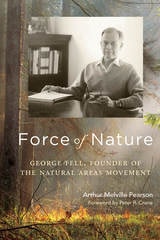
Force of Nature
George Fell, Founder of the Natural Areas MovementArthur Melville Pearson
University of Wisconsin Press, 2020
Force of Nature reveals how a failed civil servant, with few assets apart from his tenacity and vision, initiated the natural areas movement. In the boom years following World War II, as undeveloped lands were being mined, drained, or bulldozed, Fell transformed a loose band of ecologists into The Nature Conservancy, drove the passage of the influential Illinois Nature Preserves Act, and helped spark allied local and national conservation organizations in the United States and beyond.