177 books match the query 'Equality' and 5 start with f
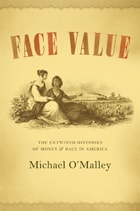
cover of Face Value: The Entwined Histories of Money and Race in America

Face Value

The Entwined Histories of Money and Race in America

Michael O'Malley

University of Chicago Press, 2012

From colonial history to the present, Americans have passionately, even violently, debated the nature and the character of money. They have painted it and sung songs about it, organized political parties around it, and imprinted it with the name of God—all the while wondering: is money a symbol of the value of human work and creativity, or a symbol of some natural, intrinsic value?

In Face Value, Michael O’Malley provides a deep history and a penetrating analysis of American thinking about money and the ways that this ambivalence unexpectedly intertwines with race. Like race, money is bound up in questions of identity and worth, each a kind of shorthand for the different values of two similar things. O’Malley illuminates how these two socially constructed hierarchies are deeply rooted in American anxieties about authenticity and difference.

In this compelling work of cultural history, O’Malley interprets a stunning array of historical sources to evaluate the comingling of ideas about monetary value and social distinctions. More than just a history, Face Value offers us a new way of thinking about the present culture of coded racism, gold fetishism, and economic uncertainty.
[more]
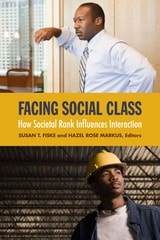
cover of Facing Social Class: How Societal Rank Influences Interaction

Facing Social Class

How Societal Rank Influences Interaction

Susan T. Fiske

Russell Sage Foundation, 2012

Many Americans, holding fast to the American Dream and the promise of equal opportunity, claim that social class doesn't matter. Yet the ways we talk and dress, our interactions with authority figures, the degree of trust we place in strangers, our religious beliefs, our achievements, our senses of morality and of ourselves—all are marked by social class, a powerful factor affecting every domain of life. In Facing Social Class, social psychologists Susan Fiske and Hazel Rose Markus, and a team of sociologists, anthropologists, linguists, and legal scholars, examine the many ways we communicate our class position to others and how social class shapes our daily, face-to-face interactions—from casual exchanges to interactions at school, work, and home. Facing Social Class exposes the contradiction between the American ideal of equal opportunity and the harsh reality of growing inequality, and it shows how this tension is reflected in cultural ideas and values, institutional practices, everyday social interactions, and psychological tendencies. Contributor Joan Williams examines cultural differences between middle- and working-class people and shows how the cultural gap between social class groups can influence everything from voting practices and political beliefs to work habits, home life, and social behaviors. In a similar vein, Annette Lareau and Jessica McCrory Calarco analyze the cultural advantages or disadvantages exhibited by different classes in institutional settings, such as those between parents and teachers. They find that middle-class parents are better able to advocate effectively for their children in school than are working-class parents, who are less likely to challenge a teacher's authority. Michael Kraus, Michelle Rheinschmidt, and Paul Piff explore the subtle ways we signal class status in social situations. Conversational style and how close one person stands to another, for example, can influence the balance of power in a business interaction. Diana Sanchez and Julie Garcia even demonstrate that markers of low socioeconomic status such as incarceration or unemployment can influence whether individuals are categorized as white or black—a finding that underscores how race and class may work in tandem to shape advantage or disadvantage in social interactions. The United States has one of the highest levels of income inequality and one of the lowest levels of social mobility among industrialized nations, yet many Americans continue to buy into the myth that theirs is a classless society. Facing Social Class faces the reality of how social class operates in our daily lives, why it is so pervasive, and what can be done to alleviate its effects.
[more]
cover of Familiar Perversions: The Racial, Sexual, and Economic Politics of LGBT Families

Familiar Perversions

The Racial, Sexual, and Economic Politics of LGBT Families

Montegary, Liz

Rutgers University Press, 2018

Winner of the 2018 Choice Outstanding Academic Title

Over the past two decades, same-sex couples raising children have become more visible within US political and popular culture. Thanks to widely circulated images of well-mannered, well-dressed, and well-off two-parent families, a select number of LGBT-identified parents have gained recognition as model American citizens. In Familiar Perversions, Liz Montegary shows how this seemingly progressive view of same-sex parenting has taken shape during a period of growing racial inequality and economic insecurity in the United States. This book evaluates the recent successes of the “family equality” movement, while asking important questions about its relationship to neoliberalism, the policing of sexual cultures, and the broader context of social justice organizing at the turn of the twenty-first century.
 
Montegary’s investigation of the politics of LGBT family life takes us on a journey that includes not only activist events and the courtrooms where landmark decisions about same-sex families were made, but also parenting workshops, cruise ships, and gay resort towns. Through its sustained historical analysis, Familiar Perversions lays critical groundwork for imagining a queer family movement that can support and strengthen the diverse networks of care, kinship, and intimacy on which our collective survival depends.
[more]
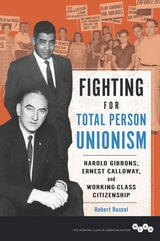
cover of Fighting for Total Person Unionism: Harold Gibbons, Ernest Calloway, and Working-Class Citizenship

Fighting for Total Person Unionism

Harold Gibbons, Ernest Calloway, and Working-Class Citizenship

Robert Bussell

University of Illinois Press, 2015
During the 1950s and 1960s, labor leaders Harold Gibbons and Ernest Calloway championed a new kind of labor movement that regarded workers as "total persons" interested in both workplace affairs and the exercise of effective citizenship in their communities. Working through Teamsters Local 688 and viewing the city of St. Louis as their laboratory, this remarkable interracial duo forged a dynamic political alliance that placed their "citizen members" on the front lines of epic battles for urban revitalization, improved public services, and the advancement of racial and economic justice. Parallel to their political partnership, Gibbons functioned as a top Teamsters Union leader and Calloway as an influential figure in St. Louis's civil rights movement. Their pioneering efforts not only altered St. Louis's social and political landscape but also raised fundamental questions about the fate of the post-industrial city, the meaning of citizenship, and the role of unions in shaping American democracy.
[more]
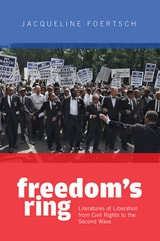
cover of Freedom’s Ring: Literatures of Liberation from Civil Rights to the Second Wave

Freedom’s Ring

Literatures of Liberation from Civil Rights to the Second Wave

Jacqueline Foertsch

Rutgers University Press, 2021

Freedom’s Ring begins with the question of how the American ideal of freedom, which so effectively defends a conservative agenda today, from globally exploitative free trade to anti-French “freedom fries” during the War in Iraq, once bolstered the progressive causes of Freedom Summer, the Free Speech Movement, and more militant Black Power and Women’s Liberation movements with equal efficacy. Focused as it is on the faring of freedom throughout the liberation era, this book also explores attempts made by rights movements to achieve the often competitive or cross-canceling American ideal of equality–economic, professional, and otherwise. Although many struggled and died for it in the civil rights era, freedoms such as the vote, integrated bus rides, and sex without consequences via the Pill, are ultimately free–costing officialdom little if anything to fully implement—while equality with respect to jobs, salaries, education, housing, and health care, will forever be the much more expensive nut to crack. Freedom’s Ring regards the politics of freedom, and politics in general, as a low-cost substitute for and engrossing distraction from substantive economic problem-solving from the liberation era to the present day.
[more]