Results by title
187 books match the query 'Essays & Travelogues' and 7 start with f
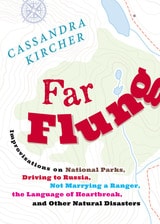
Far Flung
Improvisations on National Parks, Driving to Russia, Not Marrying a Ranger, the Language of Heartbreak, and Other Natural DisastersCassandra Kircher
West Virginia University Press, 2019
Cassandra Kircher was in her twenties when she was hired by the National Park Service, landing a life that allowed her to reinvent herself. For four years she collected entrance fees and worked in the dispatch office before being assigned as the first woman to patrol an isolated backcountry district of Colorado’s Rocky Mountain National Park. There, Kircher encountered wonder and beauty, accidents and death. Although she always suspected the mountains might captivate her, she didn’t realize that her adopted landscape would give her strength to confront where she was from—both the Midwest that Willa Cather fans will recognize, and a childhood filled with problems and secrets.
Divided and defined by geographic and psychological space, Far Flung begins in the Rockies but broadens its focus as Kircher negotiates places as distant as Alaska’s Kenai Peninsula, Russia’s Siberian valleys, and Wisconsin’s lake country, always with Colorado as a heartfelt pivot. These thirteen essays depict a woman coming to terms with her adoration for the wilds of the West and will resonate with all of us longing to better understand ourselves and our relationships to the places and people we love most.
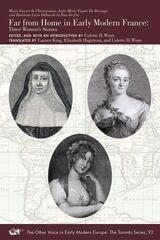
Far from Home in Early Modern France
Three Women’s StoriesMarie Guyart de l’Incarnation, Anne-Marie Fiquet du Boccage, and Henriette-Lucie Dillon de la Tour du Pin
Iter Press, 2022
This book showcases three Frenchwomen who ventured far from home at a time when such traveling was rare. In 1639, Marie de l’Incarnation embarked for New France where she founded the first Ursuline monastery in present-day Canada. In 1750, Madame du Boccage set out at the age of forty on her first “grand tour.” She visited England, the Netherlands, and Italy where she experienced firsthand the intellectual liberty offered there to educated women. As the Reign of Terror gripped France, the Marquise de la Tour du Pin fled to America with her husband and their two young children, where they ran a farm from 1794 to 1796. The writings these women left behind detailing their respective journeys abroad represent significant contributions to early modern travel literature. This book makes available to anglophone readers three texts that are rich in both historical and literary terms.
Finding England
An Auslander's Guide to Perfidious AlbionHolger Ehling
Haus Publishing, 2013
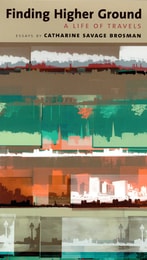
Finding Higher Ground
A Life Of TravelsCatharine Savage Brosman
University of Nevada Press, 2003
Essayist Catharine Savage Brosman explores the relationship of human beings to their environment, traveling from American deserts to dense European urban settings. Whether sipping wine in a Parisian café, partying with the jet set in Aspen, or contemplating the arid desert West that she loves, Brosman inhabits these settings, and many others, with a sense of adventure and discovery. To read these essays is to enjoy the company of a lively, thoughtful, original mind. Brosman’s "higher ground" is that place we all seek, where we can find and express our own best selves.
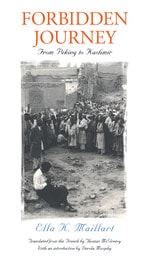
Forbidden Journey
Ella Maillart
Northwestern University Press, 2003
In 1935 Ella Maillart contemplated one of the most arduous journeys in the world: the "impossible journey" from Peking, then a part of Japanese-occupied China, through the distant province of Sinkiang (present day Tukestan), to Kashmir. Enlisting with newswriter Peter Fleming (with the caveat that his company remain tolerable), Maillart undertook a journey considered almost beyond imagination for any European and doubly so for a woman.
The trip promised hardships such as typhus and bandits, as well as the countless hazards surrounding the civil war between Chinese communists and Chiang Kai-shek's nationalists. Setting out with pockets full of Mexican money (the currency used in China at the time), Maillart encountered a way of life now lost, but one that then had gone unchanged for centuries.
Maillart describes it all with the sharp eye and unvarnished prose of a veteran reporter-the missionaries and rogues, parents binding daughters' feet with rags, the impatient Fleming lighting fires under stubborn camels. It's a hard road, not that Maillart cares. At all times she is a witty, always-enchanted guide-except when it comes to bureaucrats.
Forbidden Journey ranks among other travel narratives like Fleming's News from Tartary, (based on the same journey) and Robert Byron's The Road to Oxiana. But it is also a portrait of a fascinating woman, one of many women from the pre-WWII era who ignored convention and traveled in hidden lands. It remains a vivid account of its time and a classic of travel literature.
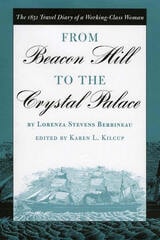
From Beacon Hill to the Crystal Palace
The 1851 Travel Diary of a Working-Class WomanLorenza Stevens Berbineau
University of Iowa Press, 2002
Because prior studies of American women’s travel writing have focused exclusively on middle-class and wealthy travelers, it has been difficult to assess the genre and its participants in a holistic fashion. One of the very few surviving working-class travel diaries, Lorenza Stevens Berbineau’s account provides readers with a unique perspective of a domestic servant in the wealthy Lowell family in Boston. Staying in luxurious hotels and caring for her young charge Eddie during her six-month grand tour, Berbineau wrote detailed and insightful entries about the people and places she saw.
Contributing to the traditions of women’s, diary, and travel literature from the perspective of a domestic servant, Berbineau's narrative reveals an arresting and intimate outlook on both her own life and the activities, places, and people she encounters. For example, she carefully records Europeans’ religious practices, working people and their behavior, and each region’s aesthetic qualities. Clearly writing in haste and with a pleasing freedom from the constraints of orthographic and stylistic convention, Berbineau offers a distinctive voice and a discerning perspective. Alert to nuances of social class, her narrative is as appealing and informative to today's readers as it no doubt was to her fellow domestics in the Lowell household.
Unobtrusively edited to retain as much as possible the individuality and texture of the author’s original manuscript, From Beacon Hill to the Crystal Palace offers readers brief framing summaries, informative endnotes, and a valuable introduction that analyzes Berbineau’s narrative in relation to gender and class issues and compares it to the published travel writing of her famous contemporary, Harriet Beecher Stowe.
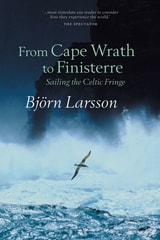
From Cape Wrath to Finisterre
Sailing the Celtic FringeBjorn Larsson
Haus Publishing, 2005