Results by title
316 books match the query 'Ethnomusicology' and 13 start with f

Fado Resounding
Affective Politics and Urban LifeLila Ellen Gray
Duke University Press, 2013

Fernando Ortiz on Music
Selected Writing on Afro-Cuban CultureRobin D. Moore
Temple University Press, 2018
Fernando Ortiz (1881–1969) is recognized as one of the most influential Latin American authors of the twentieth century. Although he helped establish the field of Afro-diasporic studies, his writings are still relatively unknown to the English-speaking world. In Fernando Ortiz on Music, accomplished ethnomusicologist Robin Moore has collected and translated an essential selection of Ortiz’s publications. These essays on Afro-Cuban expressive culture, music and dance are now available for the first time in English.
Ortiz’s writings are accompanied by an extended introduction that contextualizes the author’s life, intellectual influences, and collaborators as well as his fieldwork and interviews. Fernando Ortiz on Music also charts the writer’s changing views of black heritage through the years. This comprehensive anthology, which includes examples of his early scholarship as well as publications from the 1940s and ’50s, extends the life and legacy of this important and under-known scholar of Latin American and Caribbean music.
Contributors include: David Garcia, Sarah Lahasky, Cary Peñate, Susan Thomas, and the editor

Fiddling for Norway
Revival and IdentityChris Goertzen
University of Chicago Press, 1997
The book begins with an investigation of the people and events important to Norwegian folk fiddling, tracing the history of Norwegian folk music and the growth and diversification of the folk music revival. The narrative takes us to fiddle clubs, concerts and competitions on the local, regional, and national levels, and shows how conflicting emphases—local vs. national identity, tradition vs. aesthetic qualities—continue to transform Norwegian folk music. Goertzen utilizes a large anthology of meticulously transcribed tunes to illustrate personal and regional repertoires, aspects of performance practice, melodic gesture and form, and tune relationships. Ethnomusicologists and readers who fiddle will enjoy both the music and the stories it tells.
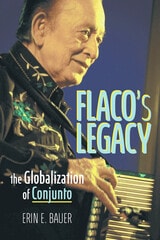
Flaco’s Legacy
The Globalization of ConjuntoErin E. Bauer
University of Illinois Press, 2023
A combination of button accordion and bajo sexto, conjunto originated in the Texas-Mexico borderlands as a popular dance music and became a powerful form of regional identity. Today, listeners and musicians around the world have embraced the genre and the work of conjunto masters like Flaco Jiménez and Mingo Saldívar.
Erin E. Bauer follows conjunto from its local origins through three processes of globalization--migration via media, hybridization, and appropriation--that boosted the music’s reach. As Bauer shows, conjunto’s encounter with globalizing forces raises fundamental questions. What is conjunto stylistically and socioculturally? Does context change how we categorize it? Do we consider the music to be conjunto based on its musical characteristics or due to its performance by Jiménez and other regional players? How do similar local genres like Tejano and norteño relate to ideas of categorization?
A rare look at a fascinating musical phenomenon, Flaco’s Legacy reveals how conjunto came to encompass new people, places, and styles.
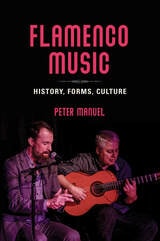
Flamenco Music
History, Forms, CulturePeter Manuel
University of Illinois Press, 2023
An iconic symbol of Spain, flamenco has become a global phenomenon. Peter Manuel offers English-language readers a rare portrait of the music’s history, styles, and cultural impact. Beginning with flamenco’s Moorish and Roma influences, Manuel follows the music’s evolution through its consolidation in the mid-1800s and on to the vibrant contemporary scene. An investigation of flamenco’s major song-types looks at rhythm and compás, guitar technique, and many other aspects of the music while Manuel’s description and analysis of the repertoire range from soleares and bulerías to tangos. His overview of contemporary flamenco culture provides insight into issues that surround the music, including globalization, gender dynamics, notions of ownership, and the ongoing debates on purity versus innovation and the relative roles played by Gitanos and non-Gitanos.
Multifaceted and entertaining, Flamenco Music is an in-depth study of the indelible art form that inspires enthusiasts and practitioners around the world.

Flip the Script
European Hip Hop and the Politics of PostcolonialityJ. Griffith Rollefson
University of Chicago Press, 2017
Through analysis of recorded music and other media, as well as interviews and fieldwork with hip hop communities, J. Griffith Rollefson shows how this music created by black Americans is deployed by Senegalese Parisians, Turkish Berliners, and South Asian Londoners to both differentiate themselves from and relate themselves to the dominant culture. By listening closely to the ways these postcolonial citizens in Europe express their solidarity with African Americans through music, Rollefson shows, we can literally hear the hybrid realities of a global double consciousness.
Folk-Songs of the South
Collected Under the Auspices of the West Virginia Folk-Lore SocietyJohn Harrington Cox
West Virginia University Press, 2016
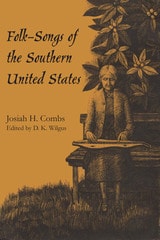
Folk-Songs of the Southern United States
By Josiah H. Combs, D.K. Wilgus
University of Texas Press, 1967
“The spirit of balladry is not dead, but slowly dying. The instincts, sentiments, and feelings which it represents are indeed as immortal as romance itself, but their mode of expression, the folksong, is fighting with its back to the wall, with the odds against it in our introspective age.” This statement by Josiah Henry Combs is that of a man who grew up among the members of a singing family in one of the last strongholds of the ballad-making tradition, the Southern Highlands of the United States.
Combs was born in 1886 in Hazard, Kentucky, the heart of the mountain feud area—a significant background for one who was to take a prominent part in the “ballad war” of the 1900s. Combs’s intimate knowledge of folk culture and his grasp of the scholarly literature enabled him to approach the ballad controversy with common sense as well as with some of the heat generated by the dispute.
Although in the early twentieth century there was probably no more controversy about the nature of the folk and folksong than there is today, it was a different kind of controversy. Many theories of the origins of folksong current at that time, such as the alleged relationship of traditional ballads to “primitive poetry,” did not take into account contemporary evidence. Combs said, “Here as elsewhere, I go directly to the folk for much of my information, allowing the songs, language, names, customs . . . of the people to help settle the problem of ancestry. . . . In brief, a conscientious study of the lore of the folk cannot be separated from the folk itself.”
Folk-Songs du Midi des États-Unis, published as a doctoral dissertation at the University of Paris in 1925, was an introduction to the study of the folksong of the Southern Appalachians, together with a selection of folksong texts collected by Combs. Folk-Songs of the Southern United States, the first publication of that work in English, is based on the French text and Combs’s English draft. To this edition is appended an annotated listing of all songs in the Josiah H. Combs Collection in the Western Kentucky Folklore Archive at the University of California, Los Angeles. The appendix also includes the texts of selected songs.
The aim of this edition is to make the contents of the original volume more readily available in English and to provide an index to the Combs Collection that may be drawn upon by students of folksong. The book also offers texts of over fifty songs of British and American origin as sung in the Southern Highlands.
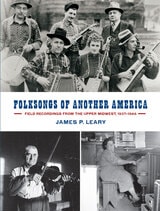
Folksongs of Another America
Field Recordings from the Upper Midwest, 1937–1946James P. Leary
University of Wisconsin Press, 2018
America's Upper Midwest is a distinctive region where many indigenous and immigrant peoples have maintained, merged, and modified their folk song traditions for more than two centuries. In the 1930s and 40s, Sidney Robertson, Alan Lomax, and Helene Stratman-Thomas—with support from the Library of Congress and armed with bulky microphones, blank disks, spare needles, and cumbersome disk-cutting machines—recorded roughly 2000 songs and tunes throughout Michigan, Minnesota, and Wisconsin. Spanning dance tunes, ballads, lyric songs, hymns, laments, versified taunts, political anthems, street cries, and recitations, these field recordings—made by people born before or shortly after 1900—were captured at a transformative moment when America was in the throes of the Great Depression, World War II was erupting, and market-driven mass entertainment media were expanding rapidly. Yet, except for a handful of Anglo-American performances, these remarkable field recordings in more than twenty-five languages have remained largely unknown, along with the lives of their mostly immigrant, indigenous, rural, and working class performers.
Since the 1970s, folklorist James P. Leary has worked steadily to bring the folk music of the Upper Midwest to a larger public. Folksongs of Another America presents 187 representative performances by more than 200 singers and musicians, carefully restored in digital form from deteriorating original formats. The accompanying book provides an introduction, full texts of all lyrics in the original languages and in English translation, extensive notes about each song and tune, biographical sketches and photographs of many of the performers, and details about Robertson, Lomax, and Stratman-Thomas and their fieldwork efforts as song collectors. These restored performances reveal with clarity and power a nearly lost sonic portrait of another America.
Available here for the first time is the remarkably diverse folk music of America's Upper Midwest, captured in field recordings by collectors for the Library of Congress from 1937 to 1946. This landmark multimedia work challenges and considerably broadens popular and scholarly understanding of folk music in American culture. Although Eastern, Southern, and Western musical traditions are familiar to fans of American roots music, the restored images and performances of Folksongs of Another America weave the songs and spirit of the Upper Midwest's peoples into the nation's folksong fabric.
187 songs and tunes, digitally restored
Songs in more than 25 languages, with full original lyrics and English translations
More than 200 performers, with biographical notes and many photographs
BOXED SET INCLUDES
Illustrated book Folksongs of Another America
300 pp. (est.), 94 black and white photographs and illustrations
CDs & DVD
CD 1 Pigtown Fling: The Sidney Robertson Recordings
Recordings of lumberjack, Finnish, Scots Gaelic, and Serbian performers captured by fieldworker Sidney Robertson in Wisconsin and Minnesota in 1937.
CD 2 The River in the Pines: The Wisconsin Lumberjacks Recordings
Performances of the acclaimed Wisconsin Lumberjacks band of Rice Lake, Wisconsin, recorded by both Sidney Robertson and Alan Lomax during National Folk Festivals in Chicago and Washington, D.C., in 1937 and 1938.
CD 3 Harps and Accordions: The Alan Lomax Recordings Alan Lomax's 1938 Michigan field recordings of lumberjack, Finnish, French Canadian, German, Irish, Lithuanian, Ojibwe, Polish, and Swedish performers.
CD 4 When the Dance is Over: Helene Stratman-Thomas Recordings, Part 1 CD 5 My Father Was a Dutchman: Helene Stratman-Thomas Recordings, Part 2 Recordings made throughout Wisconsin in 1940, 1941, and 1946, encompassing not only Finns, French Canadians, Germans, Irish, Lithuanians, Ojibwe, Poles, Scots, Serbs, and Swedes, but also African American, Austrian, Belgian, Cornish, Croatian, Czech, Danish, Dutch, Ho-Chunk, Icelandic, Italian, Luxemburger, Norwegian, Oneida, Swiss, and Welsh performers.
DVD Alan Lomax Goes North The new documentary film combines digitally restored silent color film footage, related field recordings, voice-over readings from Lomax's correspondence and field notes, and onscreen text to create an audiovisual narrative featuring the performers and scenes that captivated Alan Lomax during his 1938 Upper Midwestern foray.
Funding for this project was provided by the National Endowment for the Humanities, the Brittingham Trust, the University of Wisconsin–Madison Graduate School with funding from the Wisconsin Alumni Research Foundation, the University of Wisconsin–Madison Department of Scandinavian Studies' Birgit Baldwin professorship, and the Finlandia Foundation.
Following the Elephant
Ethnomusicologists Contemplate Their DisciplineEdited by Bruno Nettl: A collection of articles from Ethnomusicology
University of Illinois Press, 2017
Founding Mothers of the Society for Ethnomusicology
Charlotte J. Frisbie
University of Illinois Press, 2026
An enlightening eyewitness account, Founding Mothers of the Society for Ethnomusicology is an invaluable window into the work and contributions of women scholars and the obstacles they faced.
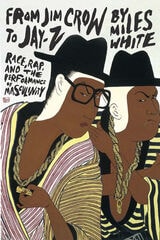
From Jim Crow to Jay-Z
Race, Rap, and the Performance of MasculinityMiles White
University of Illinois Press, 2011
From Jim Crow to Jay-Z traces black male representations to chattel slavery and American minstrelsy as early examples of fetishization and commodification of black male subjectivity. Continuing with diverse discussions including black action films, heavyweight prizefighting, Elvis Presley's performance of blackness, and white rappers such as Vanilla Ice and Eminem, White establishes a sophisticated framework for interpreting and critiquing black masculinity in hip-hop music and culture. Arguing that black music has undeniably shaped American popular culture and that hip-hop tropes have exerted a defining influence on young male aspirations and behavior, White draws a critical link between the body, musical sound, and the construction of identity.
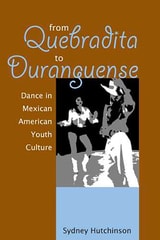
From Quebradita to Duranguense
Dance in Mexican American Youth CultureSydney Hutchinson
University of Arizona Press, 2007
Quebradita, meaning “little break,” is a modern Mexican American dance style that became hugely popular in Los Angeles and across the southwestern United States during the early to mid 1990s. Over the decade of its popularity, this dance craze offered insights into the social and cultural experience of Mexican American youth. Accompanied by banda, an energetic brass band music style, quebradita is recognizable by its western clothing, hat tricks, and daring flips. The dance’s combination of Mexican, Anglo, and African American influences represented a new sensibility that appealed to thousands of young people. Hutchinson argues that, though short-lived, the dance filled political and sociocultural functions, emerging as it did in response to the anti-immigrant and English-only legislation that was then being enacted in California. Her fieldwork and interviews yield rich personal testimony as to the inner workings of the quebradita’s aesthetic development and social significance. The emergence of pasito duranguense, a related yet distinct style originating in Chicago, marks the evolution of the Mexican American youth dance scene.
Like the quebradita before it, pasito duranguense has picked up the task of demonstrating the relevance of regional Mexican music and dance within the U.S. context.