Results by title
61 books match the query 'Expeditions & Discoveries' and 6 start with f
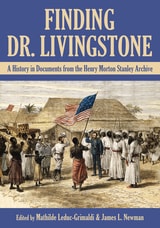
Finding Dr. Livingstone
A History in Documents from the Henry Morton Stanley ArchivesMathilde Leduc-Grimaldi
Ohio University Press, 2020
This eye-opening perspective on Stanley’s expedition reveals new details about the Victorian explorer and his African crew on the brink of the colonial Scramble for Africa.
In 1871, Welsh American journalist Henry M. Stanley traveled to Zanzibar in search of the “missing” Scottish explorer and missionary David Livingstone. A year later, Stanley emerged to announce that he had “found” and met with Livingstone on Lake Tanganyika. His alleged utterance there, “Dr. Livingstone, I presume,” was one of the most famous phrases of the nineteenth century, and Stanley’s book, How I Found Livingstone, became an international bestseller.
In this fascinating volume Mathilde Leduc-Grimaldi and James L. Newman transcribe and annotate the entirety of Stanley’s documentation, making available for the first time in print a broader narrative of Stanley’s journey that includes never-before-seen primary source documents—worker contracts, vernacular plant names, maps, ruminations on life, lines of poetry, bills of lading—all scribbled in his field notebooks.
Finding Dr. Livingstone is a crucial resource for those interested in exploration and colonization in the Victorian era, the scientific knowledge of the time, and the peoples and conditions of Tanzania prior to its colonization by Germany.
Fleur de Lys and Calumet
Being the Penicaut Narrative of French Adventure in LouisianaEdited by Richebourg McWilliams
University of Alabama Press, 1988
Andre Penicaut, a carpenter, sailed with Iberville to the French province of Louisiana in 1699 and did not return to France until 1721. The book he began in the province and finished upon his return to France is an eyewitness account of the first years of the French colony, which stretched along the Gulf Coast from Florida to Texas and in the Mississippi Valley from the Balize to the Illinois country. As a ship carpenter, Penicaut was chosen as a member of several important expeditions: he accompanied Le Sueur up the Mississippi River in 1700 to present-day Minnesota, and he went with Juchereau de St. Denis on the first journey from Mobile to the Red River and overland to the Rio Grande, to open trade with the Spaniards in Mexico. Penicaut helped to build the first post in Louisiana, at Old Biloxi, and the second post on the Mobile River.
Penicaut was at his best when describing the lives and social customs of the Indians of the region. He saw them in realistic terms, showing no prejudice toward their native habits. Neither were his French colleagues cast in heroic or villainous molds—though their accomplishments must strike modern readers as truly epic.
When first published, Fleur de Lys and Calumet was a major stimulus to scholarship in the field. This new edition will be welcomed by a new generation of scholars and readers interested in the colonial history of the Deep South and the Mississippi Valley.

Flowers, Guns, and Money
Joel Roberts Poinsett and the Paradoxes of American PatriotismLindsay Schakenbach Regele
University of Chicago Press, 2023
Joel Roberts Poinsett’s (1779–1851) brand of self-interested patriotism illuminates the paradoxes of the antebellum United States. He was a South Carolina investor and enslaver, a confidant of Andrew Jackson, and a secret agent in South America who fought surreptitiously in Chile’s War for Independence. He was an ambitious Congressman and Secretary of War who oversaw the ignominy of the Trail of Tears and orchestrated America’s longest and costliest war against Native Americans, yet also helped found the Smithsonian. In addition, he was a naturalist, after whom the poinsettia—which he appropriated while he was serving as the first US ambassador to Mexico—is now named.
As Lindsay Schakenbach Regele shows in Flowers, Guns, and Money, Poinsett personified a type of patriotism that emerged following the American Revolution, one in which statesmen served the nation by serving themselves, securing economic prosperity and military security while often prioritizing their own ambitions and financial interests. Whether waging war, opposing states’ rights yet supporting slavery, or pushing for agricultural and infrastructural improvements in his native South Carolina, Poinsett consistently acted in his own self-interest. By examining the man and his actions, Schakenbach Regele reveals an America defined by opportunity and violence, freedom and slavery, and nationalism and self-interest.
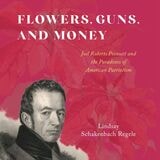
Flowers, Guns, and Money
Joel Roberts Poinsett and the Paradoxes of American PatriotismLindsay Schakenbach Regele
University of Chicago Press, 2023
A fascinating historical account of a largely forgotten statesman, who pioneered a form of patriotism that left an indelible mark on the early United States.
Joel Roberts Poinsett’s (1779–1851) brand of self-interested patriotism illuminates the paradoxes of the antebellum United States. He was a South Carolina investor and enslaver, a confidant of Andrew Jackson, and a secret agent in South America who fought surreptitiously in Chile’s War for Independence. He was an ambitious Congressman and Secretary of War who oversaw the ignominy of the Trail of Tears and orchestrated America’s longest and costliest war against Native Americans, yet also helped found the Smithsonian. In addition, he was a naturalist, after whom the poinsettia—which he appropriated while he was serving as the first US ambassador to Mexico—is now named.
As Lindsay Schakenbach Regele shows in Flowers, Guns, and Money, Poinsett personified a type of patriotism that emerged following the American Revolution, one in which statesmen served the nation by serving themselves, securing economic prosperity and military security while often prioritizing their own ambitions and financial interests. Whether waging war, opposing states’ rights yet supporting slavery, or pushing for agricultural and infrastructural improvements in his native South Carolina, Poinsett consistently acted in his own self-interest. By examining the man and his actions, Schakenbach Regele reveals an America defined by opportunity and violence, freedom and slavery, and nationalism and self-interest.
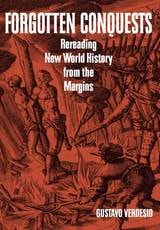
Forgotten Conquests
Rereading New World History from the MarginsGustavo Verdesio
Temple University Press, 2001
Verdesio read the key texts relating to the struggles for possession of River Plate's northern shore -- present-day Uruguay. He probes them for traces of conflicts in meaning and the agency of Amerindians, gauchos, Africans, and women -- the subjected peoples that the texts try to silence. The narrators, speaking for their culture, assume the role of knowing subject, repressing all other voices, epistemologies, and acts of resistance. Verdesio's tasks are to listen for those that the Europeans represented as an unintelligible Other, to draw them into the foreground, and to decolonize their histories.
By unpacking these texts, Verdesio shows that from the European point of view, the colonial encounter draws the New World into historical time and ushers in a new concept of knowledge. For the first time, the historian's role is to discover, to interpret eyewitness testimonies and first-hand experience, to write 'a new history of admirable things.' Even in this reconstruction of historical truth, Old World ideology drives the narratives, whose chief purpose is to justify conquest. Forgotten Conquests lays bare the discursive strategies that generated the founding texts of Latin American history and engulfed its subjected peoples in silence for 500 years.
Fremont
Explorer For A Restless NationFerol Egan
University of Nevada Press, 1985