Results by title
207 books match the query 'Feminist theory' and 43 start with f

Faking It
U.S. Hegemony in a “Post-Phallic” EraCynthia Weber
University of Minnesota Press, 1999

Families of the Heart
Surrogate Relations in the Eighteenth-Century British NovelAnn Campbell
Bucknell University Press, 2023
In this innovative analysis of canonical British novels, Campbell identifies a new literary device—the surrogate family—as a signal of cultural anxieties about young women’s changing relationship to matrimony across the long eighteenth century. By assembling chosen families rather than families of origin, Campbell convincingly argues, female protagonists in these works compensate for weak family ties, explore the world and themselves, prepare for idealized marriages, or sidestep marriage altogether. Tracing the evolution of this rich convention from the female characters in Defoe’s and Richardson’s fiction who are allowed some autonomy in choosing spouses, to the more explicitly feminist work of Haywood and Burney, in which connections between protagonists and their surrogate sisters and mothers can substitute for marriage itself, this book makes an ambitious intervention by upending a traditional trope—the model of the hierarchal family—ultimately offering a new lens through which to regard these familiar works.

Feltness
Research-Creation, Socially Engaged Art, and Affective PedagogiesStephanie Springgay
Duke University Press, 2022

Feminine Feminists
Cultural Practices in ItalyGiovanna Miceli Jeffries, Editor
University of Minnesota Press, 1994
Feminine Feminists was first published in 1994. Minnesota Archive Editions uses digital technology to make long-unavailable books once again accessible, and are published unaltered from the original University of Minnesota Press editions.
What does it mean to be a woman today in Italy, a country with the lowest birthrate in the world and the heaviest maternal stereotype? Does being a feminist exclude practices of cultural femininity? What are Italian women's cultural productions? These questions are at the center of this volume, which looks at how feminism and femininity are embedded in a broad spectrum of Italian cultural practices.
In recent years, several books have introduced the American public to Italian women's voices. This volume goes beyond others in its range of theoretical topics and modes, considering cultural practices not only in their popular, material appearance, but also in the disciplines and forms of knowledge that order information and circumscribe behavior.The essays, all by well-known scholars in Italian studies, reflect the authors' specific critical interests in cinema, fashion, literary texts, feminist theory, and popular culture, past and present. Some address the culture of everyday life, while others examine feminism and femininity in the context of philosophy, ethics, or national identity within a global culture. Some begin with the conviction that performing "femininity"—whether in appearance or in nurturing practices—can be culturally liberating. Others put this notion to the critical test. By situating the problem of femininity within the discussion of feminism, this volume takes on larger issues within feminist discourse. Its bold examination of the component of femininity within the context of women's experiences offers readers rare insight into Italian women's culture and into the multicultural possibilities of feminism.Contributors: Beverly Allen,
Serena Anderlini-D'Onofrio, Lucia Chiavola Birnbaum, Renate Holub, Carol Lazzaro-Weis, Maria Marotti, Áine O'Healy, Graziella Parati, Eugenia Paulicelli, Robin Pickering-Iazzi, Maurizio Viano.Giovanna Miceli Jeffries is a lecturer in the department of French and Italian at the University of Wisconsin, Madison.

Feminism against Cisness
Emma Heaney, editor
Duke University Press, 2024
Contributors. Cameron Awkward-Rich, Marquis Bey, Kay Gabriel, Jules Gill-Peterson, Emma Heaney, Margaux L. Kristjansson, Greta LaFleur, Grace Lavery, Durba Mitra, Beans Velocci, Joanna Wuest
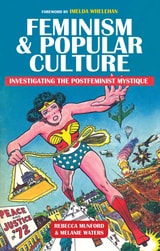
Feminism and Popular Culture
Investigating the Postfeminist MystiqueMunford, Rebecca
Rutgers University Press, 2014
In Feminism and Popular Culture, Rebecca Munford and Melanie Waters consider why the twenty-first century media landscape is so haunted by the ghosts of these traditional figures that feminism otherwise laid to rest. Why, over fifty years since Betty Friedan’s critique, does the feminine mystique exert such a strong spectral presence, and how has it been reimagined to speak to the concerns of a postfeminist audience?
To answer these questions, Munford and Waters draw from a rich array of examples from contemporary film, fiction, music, and television, from the shadowy cityscapes of Homeland to the haunted houses of American Horror Story. Alongside this comprehensive analysis of today’s popular culture, they offer a vivid portrait of feminism’s social and intellectual history, as well as an innovative application of Jacques Derrida’s theories of “hauntology.” Feminism and Popular Culture thus not only considers how contemporary media is being visited by the ghosts of feminism’s past, it raises vital questions about what this means for feminism’s future.

Feminism and Postmodernism
Margaret Ferguson and Jennifer Wicke, eds.
Duke University Press, 1994
Multidisciplinary and international in their collective focus, the essays range from a study of Madonna as an Italian American woman who is revising the cultural meanings of an ethnic feminism to a unique interview with Mairead Keane, the national head of the Women’s Department of the Irish political party Sinn Fein. Turning the prism of postmodern feminism onto such diverse cultural objects as literary and literary critical texts, contemporary film, and music, these essays intervene in debates regarding technology, sexuality, and politics. Challenging modern feminisms to articulate their inescapable relation to postmodern society, this expanded edition of a special issue of boundary 2 also explores ways in which feminism can work as the cutting edge of a global postmodernism.
Contributors. Salwa Bakr, Claire Detels, Margaret Ferguson, Carla Freccero, Marjorie Garber, Barbara Harlow, Laura E. Lyons, Anne McClintock, Toril Moi, Linda Nicholson, Mary Poovey, Andrew Ross, David Simpson, Kathyrn Bond Stockton, Jennifer Wicke
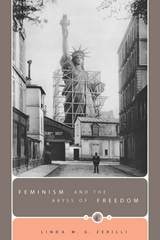
Feminism and the Abyss of Freedom
Linda M. G. Zerilli
University of Chicago Press, 2005
Offering both a discussion of feminism in its postmodern context and a critique of contemporary theory, Zerilli here challenges feminists to move away from a theory-based approach, which focuses on securing or contesting "women" as an analytic category of feminism, to one rooted in political action and judgment. She revisits the democratic problem of exclusion from participation in common affairs and elaborates a freedom-centered feminism as the political practice of beginning anew, world-building, and judging.
In a series of case studies, Zerilli draws on the political thought of Hannah Arendt to articulate a nonsovereign conception of political freedom and to explore a variety of feminist understandings of freedom in the twentieth century, including ones proposed by Judith Butler, Monique Wittig, and the Milan Women's Bookstore Collective. In so doing, Zerilli hopes to retrieve what Arendt called feminism's lost treasure: the original and radical claim to political freedom.

Feminism and the Biological Body
Birke, Lynda
Rutgers University Press, 2000
What is a body? What are our perceptions of our inner bodies? How are these perceptions influenced?
In recent years, thinking about the body has become highly fashionable. However, the renewed focus, while certainly welcome, seems to always end at the corporeal surface. While recent sociological and feminist theory has made important claims about the process of cultural inscription on the body, and about the cultural representation of the body, what actually appears in this new theory seems to be, ironically, disembodied. If this newly theorized form has interiority, it is one that is explained predominantly through psychoanalysis. The physiological processes remain a mystery to be explained, if at all, only in the esoteric language of biomedicine.
As a trained biologist, Lynda Birke was frustrated by the gap between feminist cultural analysis and her own scientific background. In this book, she seeks to bridge this gap using ideas in anatomy and physiology to develop the feminist view that the biological body is socially and culturally constructed. Birke rejects the assumption that bodily function is somehow fixed and unchanging, claiming that biology offers more than just a deterministic narrative of how nature works. Feminism and the Biological Body brings natural science and feminist theory together and suggests that we need a new politics that includes, rather than denies, our flesh.

Feminism and the Final Foucault
Edited by Dianna Taylor and Karen Vintges
University of Illinois Press, 2004
Rather than simply debating the merits or limitations of Foucault's later work, the essays in this collection examine women's historical self-practices, conceive of feminism as a shared ethos, and consider the political significance of this conceptualization in order to elucidate, experiment with, and put into practice the conceptual "tools" that Foucault offers for feminist ethics and politics. The volume illustrates the ways in which Foucault's later thinking on ethics as "care of the self" can reintroduce a number of issues and themes that feminists jettisoned in the wake of postmodernism, including consciousness raising, feminist therapy, the subject woman, identity politics, and feminist agency.
Taken as a whole, the diversity of feminist viewpoints presented provide important new insights into "the final Foucault," and thus serve as a productive intervention in current Foucault scholarship.

Feminism in Coalition
Thinking with US Women of Color FeminismLiza Taylor
Duke University Press, 2022
Feminisms at a Millennium
Edited by Judith A. Howard and Carolyn Allen
University of Chicago Press, 2001
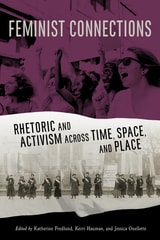
Feminist Connections
Rhetoric and Activism across Time, Space, and PlaceEdited by Katherine Fredlund, Kerri Hauman, and Jessica Ouellette
University of Alabama Press, 2020
Tracing the rhetoric of feminist activism across generations, cultures, and movements.
In 1917, Alice Paul and other suffragists famously picketed in front of the White House while holding banners with short, pithy sayings such as “Mr. President: How long must women wait for Liberty?” Their juxtaposition of this short phrase with the image of the White House (a symbol of liberty and justice) relies on the same rhetorical tactics as memes, a genre contemporary feminists use frequently to make arguments about reproductive rights, Black Lives Matter, sex-positivity, and more. Many such connections between feminists of different spaces, places, and eras have yet to be considered, let alone understood. Feminist Connections: Rhetoric and Activism across Time, Space, and Place reconsiders feminist rhetorical strategies as linked, intergenerational, and surprisingly consistent despite the emergence of new forms of media and intersectional considerations.
Contributors to this volume highlight continuities in feminist rhetorical practices that are often invisible to scholars, obscured by time, new media, and wildly different cultural, political, and social contexts. Thus, this collection takes a nonchronological approach to the study of feminist rhetoric, grouping chapters by rhetorical practice rather than time, content, or choice of media.
By connecting historical, contemporary, and future trajectories, this collection develops three feminist rhetorical frameworks: revisionary rhetorics, circulatory rhetorics, and response rhetorics. A theorization of these frameworks explains how feminist rhetorical practices (past and present) rely on similar but diverse methods to create change and fight oppression. Identifying these strategies not only helps us rethink feminist rhetoric from an academic perspective but also allows us to enact feminist activist rhetorics beyond the academy during a time in which feminist scholarship cannot afford to remain behind its hallowed yet insular walls.
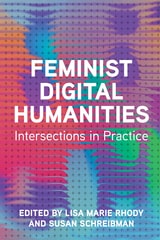
Feminist Digital Humanities
Intersections in PracticeEdited by Lisa Marie Rhody and Susan Schreibman
University of Illinois Press, 2025
The editors divide the works into three categories. In the first section, contributors offer readings that demonstrate how feminist thought can be put into operation through digital practice or via analytical approaches, methodologies, and interpretations. A second section structured around infrastructure considers how technologies of knowledge creation, publication, access, and sharing can be formed or reformed through feminist values. The final section focuses on pedagogies and proposes feminist strategies for preparing students to become critical and confident readers with and against technologies.
Aimed at readers in and out of the classroom, Feminist Digital Humanities reveals the many ways scholars have pushed beyond critique to practice digital humanities in new ways.
Contributors: Daniela Agostinho, Monika Barget, Jenny Bergenmar, Susan Brown, Tanya E Clement, Katrine Dirckinck-Holmfeld, Jaime Lee Kirtz, Cecilia Lindhé, Laura Mandell, Lisa Marie Rhody, Mark Sample, Susan Schreibman, Andie Silva, Nikki L. Stevens, Ravynn K. Stringfield, Dhanashree Thorat, Nanna Bonde Thylstrup, Kristin Veel, Astrid von Rosen, and Jacqueline Wernimont
Feminist Experiences
Foucauldian and Phenomenological InvestigationsJohanna Oksala
Northwestern University Press, 2016
Drawing on conceptual tools from the thought of Michel Foucault, but also from the tradition of phenomenology, she explores the role of experience in feminist philosophy and its relationship to language and linguistic meaning. Oksala concludes by sketching a feminist ontology of the present through a critical investigation of neoliberalism and the challenges it presents to feminist theory and politics.

Feminist Geography Unbound
Discomfort, Bodies, and Prefigured FuturesBanu Gokariksel
West Virginia University Press, 2021
Feminist Geography Unbound is a call to action—to expand imaginations and to read and travel more widely and carefully through terrains that have been cast as niche, including Indigenous and decolonial feminisms, Black geographies, and trans geographies. The original essays in this collection center three themes to unbind and enable different feminist futures: discomfort as a site where differences generate both productive and immobilizing frictions, gendered and racialized bodies as sites of political struggle, and the embodied work of building the future.
Drawing on diverse theoretical backgrounds and a range of field sites, contributors consider how race, gender, citizenship, and class often determine who feels comfort and who is tasked with producing it. They work through bodies as terrains of struggle that make claims to space and enact political change, and they ask how these politics prefigure the futures that we fear or desire. The book also champions feminist geography as practice, through interviews with feminist scholars and interludes in which feminist collectives speak to their experience inhabiting and transforming academic spaces. Feminist Geography Unbound is grounded in a feminist geography that has long forced the discipline to grapple with the production of difference, the unequal politics of knowledge production, and gender’s constitutive role in shaping social life.
Feminist Inquiry
From Political Conviction to Methodological InnovationHawkesworth, Mary
Rutgers University Press, 2006
Feminist Inquiry provides scholars and students with a comprehensive guide to methodological issues within feminist scholarship. Mary Hawkesworth presents lucid introductions to key philosophical debates about the nature of knowledge, an original account of feminist scholarship’s contributions to these debates, and a sophisticated assessment of the analytical tools that feminist scholars have created to improve understandings of the world. Drawing upon contentious debates concerning the incidence of rape, public support for reproductive rights, affirmative action, and welfare reform, Hawkesworth demonstrates how seemingly abstract questions about the nature of knowledge have palpable effects on the lives of contemporary women and men.
Feminist Inquiry makes epistemological debates—previously the exclusive preserve of philosophers—accessible to a wider audience, and demonstrates the practical and academic importance of these issues.

Feminist Locations
Global and Local, Theory and PracticeDeKoven, Marianne
Rutgers University Press, 2001
Contemporary feminist scholarship has done much to challenge the many binary constructions at the heart of Western culture: white/nonwhite, theory/practice, and, most notably, masculine/feminine. Feminist criticism has reshaped these conceptions by breaking them apart and reconfiguring them into intersecting, relational fields of difference. The contributors to this collection look to the future of feminist theory and practice, specifically in terms of their complex relationship with the global and local configurations of postmodernity.
In the first part of this book, current feminist theory is assessed for possible future directions. Part two focuses primarily on political issues and part three on questions of the body. Topics include feminist success versus social backlash, global womens human rights, postcolonial feminism, the politics of reproduction, and narratives of womens aging in postmodern culture.
Contributors: Karen Barad, Anne C. Bellows, Charlotte Bunch, Nao Bustamante, Elaine K. Chang, Marianne DeKoven, Leela Fernandes, Susan Stanford Friedman, Coco Fusco, Radha S. Hegde, Cheryl Johnson-Odim, E. Ann Kaplan, Debra J. Liebowitz, Rajeswari Sunder Rajan, Cynthia Saltzman, Lynne Segal
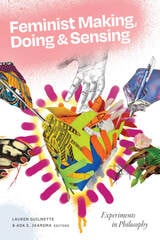
Feminist Making, Doing, and Sensing
Experiments in PhilosophyLauren Guilmette and Ada S. Jaarsma, editors
Duke University Press, 2026
Feminist Morality
Transforming Culture, Society, and PoliticsVirginia Held
University of Chicago Press, 1993
Feminist Morality makes a vital contribution to the ongoing debate in feminist theory on the importance of motherhood. For philosophers and other readers outside feminist theory, it offers a feminist moral and social critique in clear and accessible terms.
Feminist Post-Liberalism
Judith A. Baer
Temple University Press, 2020
Feminism and liberalism need each other, argues Judith Baer. Her provocative book, Feminist Post-Liberalism, refutes both conservative and radical critiques. To make her case, she rejects classical liberalism in favor of a welfare—and possibly socialist—post-liberalism that will prevent capitalism and a concentration of power that reinforces male supremacy. Together, feminism and liberalism can better elucidate controversies in American politics, law, and society.
Baer emphasizes that tolerance and self-examination are virtues, but within both feminist and liberal thought these virtues have been carried to extremes. Feminist theory needs liberalism's respect for reason, while liberal theory needs to incorporate emotion. Liberalism focuses too narrowly on the individual, while feminism needs a dose of individualism.
Feminist Post-Liberalism includes anthropological foundations of male dominance to explore topics ranging from crime to cultural appropriation. Baer develops a theory that is true to the principles of both feminist and liberal ideologies.

Feminist Reflections on Childhood
A History and Call to ActionPenny A. Weiss
Temple University Press, 2021
In Feminist Reflections on Childhood, Penny Weiss rediscovers the radically feminist tradition of advocating for the liberatory treatment of youth. Weiss looks at both historical and contemporary feminists to understand what issues surrounding the inequality experienced by both women and children were important to the authors as feminist activists and thinkers. She uses the writings of Mary Wollstonecraft, Elizabeth Cady Stanton, and Simone de Beauvoir to show early feminist arguments for the improved status and treatment of youth. Weiss also shows how Charlotte Perkins Gilman, a socialist feminist, and Emma Goldman, an anarchist feminist, differently understood and re-visioned children’s lives, as well as how children continue to show up on feminist agendas and in manifestos that demand better conditions for children’s lives.
Moving to contemporary theory, Feminist Reflections on Childhood also looks at how feminist disability theory is well-positioned to recognize the voices of children, and how queer theory provides lessons on contemporary trends that provide visions and strategies for more constructive adult-child relations. Weiss, who includes her own experiences as a mother and foster mother throughout the book, closes her distinctively feminist takes on childhood with a consideration of speculative fiction stories that offer examples of what feminists think makes childhood (un)livable.
Feminist Rhetorical Practices
New Horizons for Rhetoric, Composition, and Literacy StudiesJacqueline Jones Royster and Gesa E. Kirsch
Southern Illinois University Press, 2012
To contextualize a new and changed landscape for narratives in the history of rhetoric, Royster and Kirsch present four critical terms of engagement—critical imagination, strategic contemplation, social circulation, and globalization—as the foundation for a new analytical model for understanding, interpreting, and evaluating feminist rhetorical inquiry and the study and teaching of rhetoric in general. This model draws directly on the wealth of knowledge and understanding gained from feminist rhetorical practices, especially sensitivity toward meaningfully and respectfully rendering the work, lives, cultures, and traditions of historical and contemporary women in rhetorical scholarship.
Proposing ambitious new standards for viewing and valuing excellence in feminist rhetorical practice, Royster and Kirsch advocate an ethos of respect and humility in the analysis of communities and specific rhetorical performances neglected in rhetorical history, recasting rhetorical studies as a global phenomenon rather than a western one. They also reflect on their own personal and professional development as researchers as they highlight innovative feminist research over the past thirty years to articulate how feminist work is changing the field and pointing to the active participation of women in various discourse arenas and to the practices and genres they use.
Valuable to new and established scholars of rhetoric, Feminist Rhetorical Practice: New Horizons for Rhetoric, Composition, and Literacy Studies is essential for understanding the theoretical, methodological, and ethical impacts of feminist rhetorical studies on the wider field.
Winner, 2014 Winifred Bryan Horner Outstanding Book Award
Feminist Rhetorical Resilience
Elizabeth A. Flynn, Patricia Sotirin, and Ann Brady
Utah State University Press, 2012
Although it is well known in other fields, the concept of “resilience” has not been addressed explicitly by feminist rhetoricians. This collection develops it in readings of rhetorical situations across a range of social contexts and national cultures. Contributors demonstrate that resilience offers an important new conceptual frame for feminist rhetoric, with emphasis on agency, change, and hope in the daily lives of individuals or groups of individuals disempowered by social or material forces. Collectively, these chapters create a robust conception of resilience as a complex rhetorical process, redeeming it from its popular association with individual heroism through an important focus on relationality, community, and an ethics of connection. Resilience, in this volume, is a specifically rhetorical response to complicated forces in individual lives. Through it, Feminist Rhetorical Resilience widens the interpretive space within which rhetoricians can work.

Feminist Rhetorical Science Studies
Human Bodies, Posthumanist WorldsEdited by Amanda K. Booher and Julie Jung
Southern Illinois University Press, 2018
Each essay addresses a question: How can feminist rhetoricians of science engage responsibly with emerging theories of the posthuman? Some contributors respond with case studies in medical practice (fetal ultrasound; patient noncompliance), medical science (the neuroscience of sex differences), and health policy (drug trials of the U.S. Food and Drug Administration); others respond with a critical review of object-oriented ontology and a framework for researching women technical writers in the workplace. The contributed essays are in turn framed by a comprehensive introduction and a final chapter from the editors, who argue that a key contribution of feminist posthumanist rhetoric is that it rethinks the agencies of people, things, and practices in ways that can bring about more ethical human relations.
Individually the contributions offer as much variety as consensus on matters of methodology. Together they demonstrate how feminist posthumanist and materialist approaches to science expand our notions of what rhetoric is and does, yet they manage to do so without sacrificing what makes their inquiries distinctively rhetorical.

Feminist Sociology
Life Histories of a MovementEdited by Barbara Laslett and Barrie Thorne
Rutgers University Press, 1997

Feminist Surveillance Studies
Rachel E. Dubrofsky and Soshana Amielle Magnet, eds.
Duke University Press, 2015
Contributors. Seantel Anaïs, Mark Andrejevic, Paisley Currah, Sayantani DasGupta, Shamita Das Dasgupta, Rachel E. Dubrofsky, Rachel Hall, Lisa Jean Moore, Yasmin Jiwani, Ummni Khan, Shoshana Amielle Magnet, Kelli Moore, Lisa Nakamura, Dorothy Roberts, Andrea Smith, Kevin Walby, Megan M. Wood, Laura Hyun Yi Kang

Feminist Technical Communication
Apparent Feminisms, Slow Crisis, and the Deepwater Horizon DisasterErin A. Clark
Utah State University Press, 2023
The first book to situate feminisms and technical communication in relationship as the focal point, Feminist Technical Communication traces the thread of feminisms through technical communication’s connection to social justice studies. Clark theorizes “slow crisis,” a concept made readable to technical communicators by apparent feminisms that can help technical communicators readily recognize and address social justice problems. Clark then applies this framework to the Deepwater Horizon Disaster, an extended crisis that has been publicly framed by a traditional view of efficiency that privileges economic impact. Through rich description of apparent feminist information-gathering techniques and a layered analysis this study offers application far beyond this single disaster, making available new crisis-response possibilities that consider the economy without eliding ecological and human health concerns.
Feminist Technical Communication offers a methodological approach to the systematic interrogation of power structures that operate on hidden misogynies. This book is useful to technical communicators, scholars of technical communication and rhetoric, and readers interested in gender studies and public health and is an ideal text for graduate-level seminars focused on feminisms, social justice, and cultural studies.

Feminist Technology
Edited by Linda L. Layne, Sharra L. Vostral, and Kate Boyer
University of Illinois Press, 2010
Is there such a thing as a "feminist technology"? If so, what makes a technology feminist? Is it in the design process, in the thing itself, in the way it is marketed, or in the way it is used by women (or by men)?
In this collection, feminist scholars trained in diverse fields consider these questions by examining a range of products, tools, and technologies that were specifically designed for and marketed to women. Evaluating the claims that such products are liberating for women, the contributors focus on case studies of menstrual-suppressing birth control pills, home pregnancy tests, tampons, breast pumps, Norplant, anti-fertility vaccines, and microbicides. In examining these various products, this volume explores ways of actively intervening to develop better tools for designing, promoting, and evaluating feminist technologies. Recognizing the different needs and desires of women and acknowledging the multiplicity of feminist approaches, Feminist Technology offers a sustained debate on existing and emergent technologies that share the goal of improving women's lives.
Contributors are Jennifer Aengst, Maia Boswell-Penc, Kate Boyer, Frances Bronet, Shirley Gorenstein, Anita Hardon, Deborah G. Johnson, Linda L. Layne, Deana McDonagh, and Sharra L. Vostral.

Feminist Theory and Literary Practice
Deborah L. Madsen
Pluto Press, 2000
Feminist Theory and the Frankfurt School, Volume 17
Wendy Brown
Duke University Press, 0

Feminist Theory and the Study of Folklore
Edited by Susan Tower Hollis, Linda Pershing, and M. Jane Young
University of Illinois Press, 1994

Feminist Theory in Practice and Process
Edited by Micheline R. Malson, Jean F. O'Barr, Sarah Westphal-Wihl, and Mary Wye
University of Chicago Press, 1989

Feminist Theory
A Critique of IdeologyEdited by Nannerl Keohane, Michelle Z. Rosaldo, and Barbara C. Gelpi
University of Chicago Press, 1982
Feminist Theory: A Critique of Ideology meets that challenge. Collected from several issues of Signs–Journal of Women in Culture and Society, these essays explore the relationships between objectivity and masculinity, between psychology and political theory, and between family and state. In pursuing these critical explorations, the contributors–liberal, Marxist, socialist, and radical feminists–examine the foundations of power, of sexuality, of language, and of scientific thought.
Feminist Theory
From Margin to CenterBell Hooks
Pluto Press, 2000

Fields of Play
Constructing an Academic LifeRichardson, Laurel
Rutgers University Press, 1997
Deeply engaging, movingly written with grace, elegance, and clarity, the book stimulates readers to situate their own writing in personal, social, and political contexts.

Figures of Resistance
Essays in Feminist TheoryTeresa de Lauretis. Edited and with an Introduction by Patricia White
University of Illinois Press, 2006

Flourishing Thought
Democracy in an Age of Data HoardsRuth A. Miller
University of Michigan Press, 2016
Miller’s argument has shattering implications for the debates over the proper use and disposal of embryonic tissue, alarms about data gathering by the state and corporations, and other major ethical, social, and security issues.

Football and Manliness
An Unauthorized Feminist Account of the NFLThomas P. Oates
University of Illinois Press, 2017
Foucault and Feminist Philosophy of Disability
Shelley L. Tremain
University of Michigan Press, 2017
Fragments of Development
Nation, Gender, and the Space of ModernitySuzanne Bergeron
University of Michigan Press, 2005
---Isabella C. Bakker, York University
"Bergeron's pathbreaking analysis challenges orthodox development theories, questions current feminist economic thinking and highlights crucial new gendered challenges to globalization."
---Jane Parpart, Dalhousie University
"Cutting-edge scholarship. Bergeron deftly engages the complexity of current debates while retaining clarity, improving analyses, and illuminating alternatives."
---V. S. Peterson, University of Arizona
By tracing out the intersection between the imagined space of the national economy and the gendered construction of "expert" knowledge in development thought, Suzanne Bergeron provides a provocative analysis of development discourse and practice. By elaborating a framework of including/excluding economic subjects and activities in development economics, she provides a rich account of the role that economists have played in framing the contested political and cultural space of development.
Bergeron's account of the construction of the national economy as an object of development policy follows its shifting meanings through modernization and growth models, dependency theory, structural adjustment, and contemporary debates about globalization and highlights how intersections of nation and economy are based on gendered and colonial scripts. The author's analysis of development debates effectively demonstrates that critics of development who ignore economists' nation stories may actually bolster the formation they are attempting to subvert. Fragments of Development is essential reading for those interested in development studies, feminist economics, international political economy, and globalization studies.

From Betty Crocker to Feminist Food Studies
Critical Perspectives on Women and FoodArlene Voski Avakian
University of Massachusetts Press, 2005
Applying the insights of feminist scholarship to the study of food, the thirteen essays in this volume are arranged under four headings—the marketplace, histories, representations, and resistances. The editors open the book with a substantial introduction that traces the history of scholarly writing on food and maps the terrain of feminist food studies. In the essays that follow, contributors pay particular attention to the ways in which gender, race, ethnicity, class, colonialism, and capitalism have both shaped and been shaped by the production and consumption of food.
In the first section, four essays analyze the influence of large corporations in determining what came to be accepted as proper meals in the United States, including what mothers were expected to feed their babies. The essays in the second section explore how women have held families together by keeping them nourished, from the routines of an early nineteenth-century New Englander to the plight of women who endured the siege of Leningrad.
The essays in the third section focus on the centrality of gender and race in the formation of identities as enacted through food discourse and practices. These case studies range from the Caribbean to the San Luis Valley of Colorado. The final section documents acts of female resistance within the contexts of national or ethnic oppression. From women in colonial India to Armenian American feminists, these essays show how food has served as a means to assert independence and personal identity.
In addition to the editors, contributors include Amy Bentley, Carole M. Counihan, Darra Goldstein, Nancy Jenkins, Alice P. Julier, Leslie Land, Laura Lindenfield, Beheroze F. Shroff, Sharmila Sen, Laura Shapiro, and Jan Whitaker.

Further To Fly
Black Women and the Politics of EmpowermentSheila Radford-Hill
University of Minnesota Press, 2000
How feminism has failed African American women and why they must fight back.
Amid the longest-running economic boom in American history and despite the emergence of a significant black middle class, the lot of low-income black people in general-and black women in particular-seems more troubling than ever. Their plight, Sheila Radford-Hill argues in this book, is directly related to the diminution of black women’s traditional power as culture bearers and community builders. A cogent critique of feminist theory and practice, Further to Fly identifies the failure of feminism to connect with the social realities it should seek to explain, in particular the decline of black women’s empowerment.
Further to Fly searches out the causes and effects of this decline, describing the ways in which, since the 1960s, black women have been stripped of their traditional status as agents of change in the community-and how, as a result, the black community has faltered. Radford-Hill explores the shortcomings of second-wave black and white feminism, revealing how their theoretical underpinnings have had unintended (and often unacknowledged) negative consequences for black women’s lives and their communities.While acknowledging that African American women have made significant contributions to the black struggle for justice in America, Radford-Hill argues that more needs to be done. She combines social criticism and critical analysis to argue that black women must revive their legacy of activism and reclaim the tradition of nurturing in the black community, proposing specific tactics that can be used to revive the support networks that help determine the obligations of community members and guide how people interact on an everyday level. As a deft account of genesis and effects of black women’s diminishing power, and as a sobering analysis of the devastating blunders of feminist theory and practice, this work makes a compelling argument for an "authentic feminism," one that aggressively connects the realities of women’s experiences, needs, aspirations, and responsibilities.