Results by title
91 books match the query 'Feminists' and 10 start with f

FANNY WRIGHT
REBEL IN AMERICACelia Morris
University of Illinois Press, 1992
-- New York Times Book Review
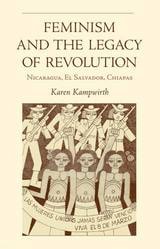
Feminism and the Legacy of Revolution
Nicaragua, El Salvador, ChiapasKaren Kampwirth
Ohio University Press, 2004
In many Latin American countries, guerrilla struggle and feminism have been linked in surprising ways. Women were mobilized by the thousands to promote revolutionary agendas that had little to do with increasing gender equality. They ended up creating a uniquely Latin American version of feminism that combined revolutionary goals of economic equality and social justice with typically feminist aims of equality, nonviolence, and reproductive rights.
Drawing on more than two hundred interviews with women in Nicaragua, El Salvador, and the Mexican state of Chiapas, Karen Kampwirth tells the story of how the guerrilla wars led to the rise of feminism, why certain women became feminists, and what sorts of feminist movements they built. Feminism and the Legacy of Revolution: Nicaragua, El Salvador, Chiapas explores how the violent politics of guerrilla struggle could be related to the peaceful politics of feminism. It considers the gains, losses, and internal conflicts within revolutionary women’s organizations.
Feminism and the Legacy of Revolution challenges old assumptions regarding revolutionary movements and the legacy of those movements for the politics of daily life. It will appeal to a broad, interdisciplinary audience in political science, sociology, anthropology, women’s studies, and Latin American studies as well as to general readers with an interest in international feminism.
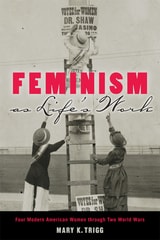
Feminism as Life's Work
Four Modern American Women through Two World WarsTrigg, Mary K
Rutgers University Press, 2014
Through these women’s intertwined stories, Mary Trigg traces the changing nature of the women’s movement across turbulent decades rent by world war, revolution, global depression, and the rise of fascism. Criticizing the standard division of feminist activism as a series of historical waves, Trigg exposes how Irwin, Beard, Stevens, and Pruette helped push the U.S. feminist movement to victory and continued to propel it forward from the 1920s to the 1960s, decades not included in the “wave” model. At a time widely viewed as the “doldrums” of feminism, the women in this book were in fact taking the cause to new sites: the National Women’s Party; sexuality and relations with men; marriage; and work and financial independence. In their utopian efforts to reshape work, sexual relations, and marriage, modern feminists ran headlong into the harsh realities of male power, the sexual double standard, the demands of motherhood, and gendered social structures.
In Feminism as Life’s Work, Irwin, Beard, Stevens, and Pruette emerge as the heirs of the suffrage movement, guardians of a long feminist tradition, and catalysts of the belief in equality and difference. Theirs is a story of courage, application, and perseverance—a story that revisits the “bleak and lonely years” of the U.S. women’s movement and emerges with a fresh perspective of the history of this pivotal era.

Feminisms
A Global HistoryLucy Delap
University of Chicago Press, 2020
Feminism’s origins have often been framed around a limited cast of mostly white and educated foremothers, but the truth is that feminism has been and continues to be a global movement. For centuries, women from all walks of life have been mobilizing for gender justice. As the last decade has reminded even the most powerful women, there is nothing “post-feminist” about our world. And there is much to be learned from the passion and protests of the past.
Historian Lucy Delap looks to the global past to give us a usable history of the movement against gender injustice—one that can help clarify questions of feminist strategy, priority and focus in the contemporary moment. Rooted in recent innovative histories, the book incorporates alternative starting points and new thinkers, challenging the presumed priority of European feminists and ranging across a global terrain of revolutions, religions, empires and anti-colonial struggles.
In Feminisms, we find familiar stories—of suffrage, of solidarity, of protest—yet there is no assumption that feminism looks the same in each place or time. Instead, Delap explores a central paradox: feminists have demanded inclusion but have persistently practiced their own exclusions. Some voices are heard and others are routinely muted. In amplifying the voices of figures at the grassroots level, Delap shows us how a rich relationship to the feminist past can help inform its future.

Feminist Accused of Sexual Harassment
Jane Gallop
Duke University Press, 1997
Comparing “still new” feminism—as she first encountered it in the early 1970s—with the more established academic discipline that women’s studies has become, Gallop makes a case for the intertwining of learning and pleasure. Refusing to acquiesce to an imperative of silence that surrounds such issues, Gallop acknowledges—and describes—her experiences with the eroticism of learning and teaching. She argues that antiharassment activism has turned away from the feminism that created it and suggests that accusations of harassment are taking aim at the inherent sexuality of professional and pedagogic activity rather than indicting discrimination based on gender—that antiharassment has been transformed into a sensationalist campaign against sexuality itself.
Feminist Accused of Sexual Harassment offers a direct and challenging perspective on the complex and charged issues surrounding the intersection of politics, sexuality, feminism, and power. Gallop’s story and her characteristically bold way of telling it will be compelling reading for anyone interested in these issues and particularly to anyone interested in the ways they pertain to the university.

Feminist Sociology
Life Histories of a MovementEdited by Barbara Laslett and Barrie Thorne
Rutgers University Press, 1997

Feminists Who Changed America, 1963-1975
Edited by Barbara J. Love: Foreword by Nancy F. Cott
University of Illinois Press, 2006
Documenting key feminists who ignited the second wave women's movement
Barbara J. Love’s Feminists Who Changed America, 1963-1975 will be the first comprehensive directory to document many of the founders and leaders (including both well-known and grassroots organizers) of the second wave women's movement. It tells the stories of more than two thousand individual women and a few notable men who together reignited the women's movement and made permanent changes to entrenched customs and laws.
The biographical entries on these pioneering feminists represent their many factions, all parts of the country, all races and ethnic groups, and all political ideologies. Nancy Cott's foreword discusses the movement in relation to the earlier first wave and presents a brief overview of the second wave in the context of other contemporaneous social movements.
Fighting for Equality
A Life of May Wright SewallRay E. Boomhower
Indiana Historical Society Press, 2007

Friends of Alice Wheeldon
Sheila Rowbotham
Pluto Press, 1986
Fuller in Her Own Time
A Biographical Chronicle of Her Life, Drawn from Recollections, Interviews, and Memoirs by Family, Friends, and AssociatesJoel Myerson
University of Iowa Press, 2008
The forty-one remembrances from Nathaniel Hawthorne, Oliver Wendell Holmes, Ralph Waldo Emerson, Thomas Carlyle, Harriet Martineau, Henry James, and twenty-four others chart Fuller’s expanding influence from schooldays in Boston, meetings at the Transcendental Club, teaching in Providence and Boston, work on the New York Tribune, publications and conversations, travels in the British Isles, and life and love in Italy before her tragic early death. Joel Myerson’s perceptive introduction assesses the pre- and postmortem building of Fuller’s reputation as well as her relationship to the prominent Transcendentalists, reformers, literati, and other personalities of her time, and his headnotes to each selection present valuable connecting contexts.
The woman who admitted that “at nineteen she was the most intolerable girl that ever took a seat in a drawing-room,” whose Woman in the Nineteenth Century is considered the first major book-length feminist call to action in America, never conformed to nineteenth-century expectations of self-effacing womanhood. The fascinating contradictions revealed by these narratives create a lively, lifelike biography of Fuller’s “rare gifts and solid acquirements . . . and unfailing intellectual sympathy.”