Results by title
64 books match the query 'Fishing' and 14 start with f
Farming, Hunting, and Fishing in the Olmec World
By Amber M. VanDerwarker
University of Texas Press, 2006
The Olmec who anciently inhabited Mexico's southern Gulf Coast organized their once-egalitarian society into chiefdoms during the Formative period (1400 BC to AD 300). This increase in political complexity coincided with the development of village agriculture, which has led scholars to theorize that agricultural surpluses gave aspiring Olmec leaders control over vital resources and thus a power base on which to build authority and exact tribute.
In this book, Amber VanDerwarker conducts the first multidisciplinary analysis of subsistence patterns at two Olmec settlements to offer a fuller understanding of how the development of political complexity was tied to both agricultural practices and environmental factors. She uses plant and animal remains, as well as isotopic data, to trace the intensification of maize agriculture during the Late Formative period. She also examines how volcanic eruptions in the region affected subsistence practices and settlement patterns. Through these multiple sets of data, VanDerwarker presents convincing evidence that Olmec and epi-Olmec lifeways of farming, hunting, and fishing were driven by both political and environmental pressures and that the rise of institutionalized leadership must be understood within the ecological context in which it occurred.
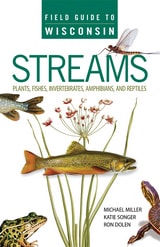
Field Guide to Wisconsin Streams
Plants, Fishes, Invertebrates, Amphibians, and ReptilesMichael A. Miller, Katie Songer, and Ron Dolen
University of Wisconsin Press, 2014
More than 1,000 images illustrate the species in this field guide. These images are augmented by detailed ecological and taxonomic notes, descriptions of look-alike species, and distribution maps. The guide identifies:
• more than 130 common plants
• all 120 fishes known to inhabit Wisconsin streams
• 8 crayfishes
• 50 mussels
• 10 amphibians
• 17 reptiles
• 70 families of insects
• other commonly found invertebrates.
Best Regional General Interest Books, selected by the American Association of School Librarians
Best Regional General Interest Books, selected by the Public Library Reviewers
Fish For All
An Oral History of Multiple Claims and Divided Sentiment on Lake MichiganMichael J. Chiarappa
Michigan State University Press, 2003
The contentious claims of groups seeking to use Lake Michigan’s fisheries resources were at the center of modern America’s emerging environmental politics in the middle of the twentieth century. Inheriting the environmental abuse, political oversights, and cultural inclinations of an earlier era, Lake Michigan’s later twentieth century fisheries stakeholders found themselves relentlessly divided by a series of disputes arising from the promotion of sport fishing over commercial fishing, policy-making positions of state government, the ecological changes wrought by nonindigenous species, and the reclamation of treaty-rights fishing by Native Americans.
Going beyond the chronicling of past events, Fish for All contextualizes the shared experiences that shape each group’s collective memory and presents their historical narratives as discourse that legitimizes their current claims to the resource. Fish for All highlights the historically charged consciousness of fishing communities and points to the evolving communication that will take place between them, fisheries historians, fisheries anthropologists, scientists, and policymakers.
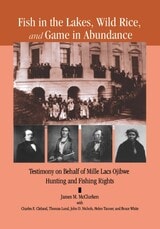
Fish in the Lakes, Wild Rice, and Game in Abundance
Testimony on Behalf of Mille Lacs Ojibwe Hunting and Fishing RightsEdited by James M. McClurken
Michigan State University Press, 2000
On 13 August 1990 members of the Mille Lacs Band of Ojibwe filed a lawsuit against the State of Minnesota for interfering with the hunting, fishing, and gathering rights that had been guaranteed to them in an 1837 treaty with the United States. In order to interpret the treaty the courts had to consider historical circumstances, the intentions of the parties, and the treaty's implementation. The Mille Lacs Band faced a mammoth challenge. How does one argue the Native side of the case when all historical documentation was written by non- Natives? The Mille Lacs selected six scholars to testify for them. Published here for the first time, Charles Cleland, James McClurken, Helen Tanner, John Nichols, Thomas Lund, and Bruce White discuss the circumstances under which the treaty was written, the personalities involved in the negotiations and the legal rhetoric of the times, as well as analyze related legal conflicts between Natives and non- Natives. Justice Sandra Day O'Connor delivered the 1999 Opinion of the [United States Supreme] Court.
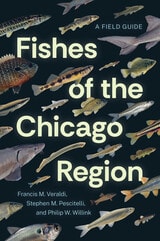
Fishes of the Chicago Region
A Field GuideFrancis M. Veraldi, Stephen M. Pescitelli, and Philip W. Willink
University of Chicago Press, 2025
“A must-have field guide for fans of Second City area fish.”—Robert Ito, The New York Times Book Review • “A treasure of hardcore fish intelligence and delightful tidbits of fish history.”—Dale Bowman, Chicago Sun-Times
Fish don’t heed state boundaries, and neither does this comprehensive, photo-filled guide to the diverse species of Chicago and beyond.
Encompassing southern Lake Michigan, northeastern Illinois, and adjacent areas of Indiana, Michigan, and Wisconsin, the Chicago Region is home to rare habitats supporting diverse fish populations. From small creeks to large rivers and from small ponds to one of the world’s largest freshwater ecosystems, Lake Michigan, these systems are home to some 164 fish species representing 31 families. In this essential field guide, the most complete and up-to-date reference for fishes in the Chicago Region, we meet them all—lampreys, sturgeon, paddlefish, gars, drum, darters, perches, sticklebacks, sculpins, and more. Written by leading local ecologists and featuring a pictorial family key, color photographs, detailed species distribution maps, and natural history observations unique to the region, this go-to guide belongs on the shelf—and in the boat—of every angler, naturalist, fisheries manager, and biologist.
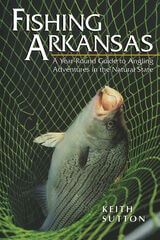
Fishing Arkansas
A Year-Round Guide to Angling Adventures in the Natural StateKeith Sutton
University of Arkansas Press, 2000
Enhanced by Sutton's excellent photographs, the guide includes twelve sections on popular game fish, such as largemouth and smallmouth bass, crappie, catfish, bluegill, and trout. It also provides an introduction to often-overlooked species like bowfin, gar, carp, paddlefish, and pickerel. Hundreds of valuable fishing tips gleaned from decades of on-the-water experience and interviews with dozens of guides, biologists, and expert anglers enhance the engaging narraive. From the glistening trout in the cold tailwaters of the White River, to feisty catfish on the muddy bayou bottoms of the Delta region, Keith Sutton has served up a tempting array of the fish that can be sought and caught on hook and line in the teeming waters of Arkansas.
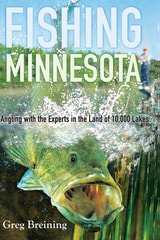
Fishing Minnesota
Angling with the Experts in the Land of 10,000 LakesGreg Breining
University of Minnesota Press, 2003
An insider’s look at the skills and thrills of fishing
Fishing is more than catching fish. It is travel, nature, adventure, friendships, and discovery. In Fishing Minnesota, Greg Breining tags along with expert anglers and reports what they have spent years learning. He fishes for Lake Superior steelhead with Shawn Perich, small-stream smallmouth bass with Tim Holschlag, stream trout with Jay Bunke, and north-country muskies with Mark Windels. Along the way, Breining comes to understand not only how they catch fish, but why they go to the trouble.
Nowhere else will you find a comprehensive how-to guide for fishing Minnesota’s many lakes and streams, full of tips from the region’s best tournament anglers, most experienced fisheries biologists, and never-fail professional guides. Breining shares their secrets on such topics as how to snell a yarn fly, where to find the biggest muskies in any lake, and how to pick the best minnows for Mille Lacs. Breining gives us that coveted experience of being in the boat with the pros.
Fishing Southern Illinois
Art Reid
Southern Illinois University Press, 1986
“Now, let’s find out where those fish are and how to catch a few,” says Art Reid in his Preface.
And that is the essence of this comprehensive guide to fishing in Southern Illinois. In the colorful language of one who has fished the waters and swapped tales over many a campfire, Reid draws upon more than 25 years of experience fishing the United States and several foreign countries.
Liberally spiced with anecdotes, this book tells not only where the fish are and how to catch them but who catches them: no history of fishing in Southern Illinois would be complete without an abundance of profiles of the colorful people who for years have been dedicated anglers. The stories are fun and related with verve, the people fascinating, and the information as complete as a fisherman could find anywhere.
Fishing a Borderless Sea
Environmental Territorialism in the North Atlantic, 1818-1910Brian J. Payne
Michigan State University Press, 2010
Over the centuries, processing and distribution of products from land and sea has stimulated the growth of a global economy. In the broad sweep of world history, it may be hard to imagine a place for the meager little herring baitfish. Yet, as Brian Payne adeptly recounts, the baitfish trade was hotly contested in the Anglo-American world throughout the nineteenth century. Politicians called for wars, navies were dispatched with guns at the ready, vessels were seized at sea, and violence erupted at sea.
Yet, the battle over baitfish was not simply a diplomatic or political affair. Fishermen from hundreds of villages along the coastline of Atlantic Canada and New England played essential roles in the construction of legal authority that granted or denied access to these profitable bait fisheries.
Fishing a Borderless Sea illustrates how everyday laborers created a complex system of environmental stewardship that enabled them to control the local resources while also allowing them access into the larger global economy.
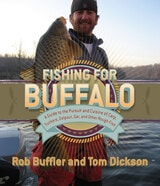
Fishing for Buffalo
A Guide to the Pursuit and Cuisine of Carp, Suckers, Eelpout, Gar, and Other Rough FishRob Buffler
University of Minnesota Press, 2009
The definitive guide to the eccentric and surprisingly popular sport of rough fishing
Is a carpsucker a carp or a sucker? Where can you find the largest eelpout in the United States? Can you catch creek chubs and fry them for supper?
These questions and more are answered within the pages of Fishing for Buffalo. Rob Buffler and Tom Dickson dispel myths and rumors about rough fish with credible biological information while also demonstrating the joy of angling for nontraditional fish. Its wealth of information qualifies this book as a fishing bible for the growing number of rough fishing enthusiasts in the United States and makes it easy to identify the rough fish you may catch. It even includes a sampling of Dickson and Buffler’s favorite recipes, such as Burbot Boulangère and Deviled Grilled Cisco.Rough fish may be a lot of things—ugly, unruly, or elusive—but they are definitely not boring.
Fishing the Great Lakes
An Environmental History, 1783–1933Margaret Beattie Bogue
University of Wisconsin Press, 2000
Fishing the Great Lakes is a sweeping history of the destruction of the once-abundant fisheries of the great "inland seas" that lie between the United States and Canada. Though lake trout, whitefish, freshwater herring, and sturgeon were still teeming as late as 1850, Margaret Bogue documents here how overfishing, pollution, political squabbling, poor public policies, and commercial exploitation combined to damage the fish populations even before the voracious sea lamprey invaded the lakes and decimated the lake trout population in the 1940s.
From the earliest records of fishing by native peoples, through the era of European exploration and settlement, to the growth and collapse of the commercial fishing industry, Fishing the Great Lakes traces the changing relationships between the fish resources and the people of the Great Lakes region. Bogue focuses in particular on the period from 1783, when Great Britain and the United States first politically severed the geographic unity of the Great Lakes, through 1933, when the commercial fishing industry had passed from its heyday in the late nineteenth century into very serious decline. She shows how fishermen, entrepreneurial fish dealers, the monopolistic A. Booth and Company (which distributed and marketed much of the Great Lakes catch), and policy makers at all levels of government played their parts in the debacle. So, too, did underfunded scientists and early conservationists unable to spark the interest of an indifferent public. Concern with the quality of lake habitat and the abundance of fish increasingly took a backseat to the interests of agriculture, lumbering, mining, commerce, manufacturing, and urban development in the Great Lakes region. Offering more than a regional history, Bogue also places the problems of Great Lakes fishing in the context of past and current worldwide fishery concerns.
Fly Fishing in Fast-Flowing Water
A Coming of Age in Michigan's Upper PeninsulaBruce C. Petersen
Michigan State University Press, 2027
With its rugged forests and swift rivers, Michigan’s Upper Peninsula offers the perfect setting for fly fishing. Following in the footsteps of Ernest Hemingway’s character Nick Adams, Bruce C. Petersen creates a unique coming-of-age memoir that departs from the typical story of growing from teen to adulthood. Instead, Petersen explores his seventh decade, chasing trout in the challenging waters of Northern Michigan while grappling with what it means to grow old. In this absorbing memoir, he relives his most memorable days as a fly fisher and offers thoughtful reflections on the healing power of nature, aging gracefully, and the unstoppable passage of time.
Fly-Fishing
Christopher Schaberg
Duke University Press, 2023
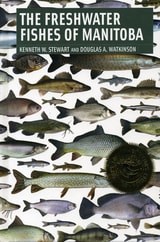
Freshwater Fishes of Manitoba
Kenneth Stewart
University of Manitoba Press, 2004