Results by title
54 books match the query 'Freedom of speech' and 6 start with f
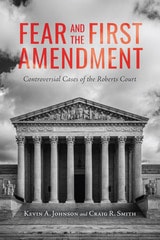
Fear and the First Amendment
Controversial Cases of the Roberts CourtKevin A. Johnson and Craig R. Smith
University of Alabama Press, 2024
DISTINGUISHED PUBLICATION AWARD FOR THE NATIONAL COMMUNICATION ASSOCIATION'S COMMUNICATION AND LAW DIVISION
The First Amendment: protected by law, threatened by fear in the Roberts Supreme Court.
In Fear and the First Amendment: Controversial Cases of the Roberts Court, Kevin A. Johnson and Craig R. Smith offer a deeply considered examination of the ways fear figures in First Amendment questions. Bringing together literature on theories of fear in rhetorical and philosophical traditions, Johnson and Smith focus on the rulings from the Roberts Court, which form a pivotal era of dramatic precedents. Each chapter analyzes one or more First Amendment cases and a variety of related fears—whether evidentiary or not—that pertain to a given case.
These cases include Morse v. Frederick, which takes up the competing fears of school administrators’ loss of authority and students’ loss of free speech rights. The authors touch on corporate funding of elections in Citizens United v. Federal Elections Commission, from the fear of corporate influence on electoral politics to corporate fears of alienating their consumers by backing political candidates. They explore religious freedom and fears of homosexuality in Christian Legal Society v. Martinez. Similarly, in Snyder v. Phelps, the authors delve further into fears of God, death, emotional distress, failing as a parent, and losing one’s reputation. Next, they investigate parents’ anxieties about violence in video games in Brown v. Entertainment Merchants Association. Finally, Johnson and Smith examine the role of fear in indecent, obscene, and graphic communication in three cases: FCC v. Fox Television Stations, Ashcroft v. American Civil Liberties Union, and United States v. Stevens.
Together these cases reveal fear to be an endemic factor in the rhetoric of First Amendment cases. This fascinating and original work will appeal to current legal practitioners and students of law, rhetoric, philosophy, and the First Amendment.
First Amendment Studies in Arkansas
The Richard S. Arnold Prize EssaysStephen Smith
University of Arkansas Press, 2016
This collection of fourteen essays written by young communication scholars at the University of Arkansas presents unique insights into how First Amendment issues have played out in the state. Rather than exploring the particular legal issues and the constitutional principles enunciated by the courts, First Amendment Studies tells the stories of actual people expressing challenged or unpopular points of view and reveals the ways that constitutional controversies arise from the actions of local officials and individual citizens.
Drawing on public documents as well as extensive interviews with participants, these essays demonstrate the dynamics of democratic dissent—on college campuses, in public schools, in churches, on the streets, in the forests and on the farms, and in legislative chambers and courtrooms.
Each essay was selected for the Richard S. Arnold Prize in First Amendment Studies, an endowed fund established in 1999 to encourage University of Arkansas graduate students in communication and the liberal arts to explore and examine questions about freedom of speech and freedom of religion.
Free Speech On Trial
Communication Perspectives on Landmark Supreme Court DecisionsEdited by Richard A. Parker
University of Alabama Press, 2008
Describes landmark free speech decisions of the Supreme Court while highlighting the issues of language, rhetoric, and communication that underlie them.
At the intersection of communication and First Amendment law reside two significant questions: What is the speech we ought to protect, and why should we protect it? The 20 scholars of legal communication whose essays are gathered in this volume propose various answers to these questions, but their essays share an abiding concern with a constitutional guarantee of free speech and its symbiotic relationship with communication practices.
Free Speech on Trial fills a gap between textbooks that summarize First Amendment law and books that analyze case law and legal theory. These essays explore questions regarding the significance of unregulated speech in a marketplace of goods and ideas, the limits of offensive language and obscenity as expression, the power of symbols, and consequences of restraint prior to publication versus the subsequent punishment of sources. As one example, Craig Smith cites Buckley vs. Valeo to examine how the context of corruption in the 1974 elections shaped the Court's view of the constitutionality of campaign contributions and expenditures.
Collectively, the essays in this volume suggest that the life of free speech law is communication. The contributors reveal how the Court's free speech opinions constitute discursive performances that fashion, deconstruct, and reformulate the contours and parameters of the Constitution’s guarantee of free expression and that, ultimately, reconstitute our government, our culture, and our society.
Free Speech and Koch Money
Manufacturing a Campus Culture WarRalph Wilson
Pluto Press, 2021
In recent years hundreds of high-profile ‘free speech’ incidents have rocked US college campuses. Milo Yiannopoulos, Ben Shapiro, Ann Coulter and other right-wing speakers have faced considerable protest, with many being disinvited from speaking. These incidents are widely circulated as examples of the academy’s intolerance towards conservative views.
But this response is not the spontaneous outrage of the liberal colleges. There is a darker element manufacturing the crisis, funded by political operatives, and designed to achieve specific political outcomes. If you follow the money, at the heart of the issue lies the infamous and ultra-libertarian Koch donor network.
Grooming extremist celebrities, funding media platforms that promote these controversies, developing legal organzations to sue universities and corrupting legislators, the influence of the Koch network runs deep. We need to abandon the ‘campus free speech’ narrative and instead follow the money if we ever want to root out this dangerous network from our universities.
Free Speech, The People's Darling Privilege
Struggles for Freedom of Expression in American HistoryMichael Kent Curtis
Duke University Press, 2000
Curtis analyzes three crucial political struggles: the controversy that surrounded the 1798 Sedition Act, which raised the question of whether criticism of elected officials would be protected speech; the battle against slavery, which raised the question of whether Americans would be free to criticize a great moral, social, and political evil; and the controversy over anti-war speech during the Civil War. Many speech issues raised by these controversies were ultimately decided outside the judicial arena—in Congress, in state legislatures, and, perhaps most importantly, in public discussion and debate. Curtis maintains that modern proposals for changing free speech doctrine can usefully be examined in the light of this often ignored history. This broader history shows the crucial effect that politicians, activists, ordinary citizens—and later the courts—have had on the American understanding of free speech.
Filling a gap in legal history, this enlightening, richly researched historical investigation will be valuable for students and scholars of law, U.S. history, and political science, as well as for general readers interested in civil liberties and free speech.
Freedom and Tenure in the Academy
William W. Van Alstyne, ed.
Duke University Press, 1993
The original 1940 Statement of Principles on Academic Freedom and Tenure, which has been influential in determining institutional practices for the last half century, has required continual redefinition since its initial declaration. The volume begins with two overview articles: the most complete examination of the 1940 Statement ever provided (shedding light on some of its most troublesome clauses) and a historical review of the extent to which academic freedom has been accepted into domestic constitutional law. Subsequent articles address a range of issues related to academic freedom: the relationship between tenure and academic freedom; tenure and labor law; ideology and faculty selection; freedom of expression and the arts on campus; the boundaries defining hate speech and offensive expression; the clash between institutional and individual claims of academic freedom; and the practices of religious colleges in the United States.
Contributors. Ralph S. Brown, Matthew W. Finkin, Jordan E. Kurland, Michael W. McConnell, Walter P. Metzger, Robert M. O'Neil, David M. Rabban, Rodney A, Smolla, Janet Sinder, Judith Jarvis Thomson, William W. Van Alstyne