252 books match the query 'Future' and 16 start with f
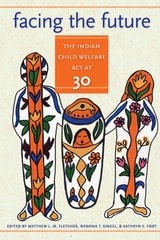
cover of Facing the Future: The Indian Child Welfare Act at 30

Facing the Future

The Indian Child Welfare Act at 30

Matthew L.M. Fletcher

Michigan State University Press, 2009

The U.S. Congress is charged with responsibility for the protection and preservation of American Indian tribes, including Indian children. In 1978, Congress enacted the Indian Child Welfare Act (ICWA), with the intent to "protect the best interests of Indian children and to promote the stability and security of Indian tribes and families." ICWA sets federal requirements that apply to state child custody proceedings involving an Indian child who is a member of or eligible for membership in a federally recognized tribe. ICWA also sets out federal requirements regarding removal of Indian children and their placement in foster or adoptive homes, and it allows the child's tribe to intervene in the case.
     The history of the Act is a tangle of legal, social, and emotional complications. Some state courts have found unusual legal arguments to avoid applying the law, while some states have gone beyond the terms of the Act to provide greater protections for Indian people. This collection brings together for the first time a multidisciplinary assessment of the law—with scholars, practitioners, lawyers, and social workers all offering perspectives on the value and importance of the Indian Child Welfare Act.

[more]
cover of Failing the Future: A Dean Looks at Higher Education in the Twenty-first Century

Failing the Future

A Dean Looks at Higher Education in the Twenty-first Century

Annette Kolodny

Duke University Press, 1998

Both revealing and compelling, Annette Kolodny’s Failing the Future: A Dean Looks at Higher Education in the Twenty-first Century is drawn from the author’s experience as a distinguished teacher, a prize-winning scholar of American literature, a feminist thinker, and an innovative administrator at a major public university. In chapters that range from the changing structure of the American family and its impact on both curriculum and university benefits policies to recommendations for overhauling the culture of decision making on campus, this former Dean of the College of Humanities at the University of Arizona explores the present state of higher education and offers a sobering view of what lies ahead.
In this volume Kolodny explains the reasons for the financial crisis in higher education today and boldly addresses the challenges that remain ignored, including rising birthrates, changing demographics both on campus and across the country, the accelerating globalization of higher education and advanced research, and the necessity for greater interdisciplinarity in undergraduate education. Moreover, while sensitive to the complex burdens placed on faculty today, Kolodny nonetheless reveals how the professoriate has allowed itself to become vulnerable to public misperceptions and to lampooning by the media.
Not simply a book about current problems and future challenges, Failing the Future is rich with practical solutions and workable programs for change. Among her many insights, Kolodny offers a thorough defense of the role of tenure and outlines a new set of procedures to ensure its effective implementation; she proposes a structure for an “Antifeminist Intellectual Harassment Policy”; and she provides a checklist of family-sensitive policies universities can offer their staff, faculty, and administrators. Kolodny calls on union leaders, campus communities, policymakers, and the general public to work together in unprecedented partnerships. Her goal, as she states in a closing coda, is to initiate a revitalized conversation about public education.
This book should be required reading for all those concerned with the future of higher education in this country—from college trustees to graduate students entering the professoriate, from faculty to university administrators, from officers of campus-based unions to education policymakers.
[more]
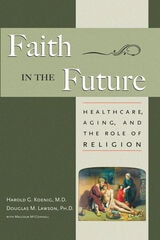
cover of Faith In The Future: Healthcare, Aging and the Role of Religion

Faith In The Future

Healthcare, Aging and the Role of Religion

Harold Koenig

Templeton Press, 2012

After an interview in Newsweek about his book Spirituality in Patient Care and his research in religion and health, Dr. Harold Koenig became the international voice on spirituality, health, and aging. In this book, Faith in the Future, he is joined by two other experts on aging and human development. They present a compelling look at one of the most severe issues in today’s society: health care in America. 

How will we provide quality healthcare to older adults needing it during the next thirty to fifty years? Who will provide this care? How will it be funded? How can we establish systems of care now to be in place as demographic and health-related economic pressures mount?

Alongside the sobering reality of our country’s challenges, there are reasons for optimism. Innovative programs created and maintained by volunteers and religious congregations are emerging as pivotal factors in meeting healthcare needs. Summarizing decades of scientific research and providing numerous inspirational examples and role models, the authors present practical steps that individuals and institutions may emulate for putting faith into action.

<
[more]
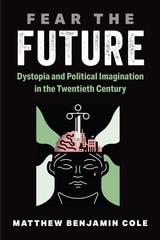
cover of Fear the Future: Dystopia and Political Imagination in the Twentieth Century

Fear the Future

Dystopia and Political Imagination in the Twentieth Century

Matthew Benjamin Cole

University of Michigan Press, 2025

After centuries of contemplating utopias, late nineteenth- and early twentieth-century writers began to warn of dystopian futures. Yet these fears extended beyond the canonical texts of dystopian fiction into postwar discourses on totalitarianism, mass society, and technology, as well as subsequent political theories of freedom and domination. Fear the Future demonstrates the centrality of dystopian thinking to twentieth century political thought, showing the pervasiveness of dystopian images, themes, and anxieties.

Offering a novel reading of major themes and thinkers, Fear the Future explores visions of the future from literary figures such as Yevgeny Zamyatin, Aldous Huxley, and George Orwell; political theorists such as Max Weber, Hannah Arendt, Herbert Marcuse, Jürgen Habermas, and Michel Foucault; and mid-century social scientists such as Erich Fromm, Max Horkheimer, Theodor Adorno, David Reisman, C. Wright Mills, and Jacques Ellul. It offers a comparative analysis of distinct intellectual and literary traditions, including modern utopianism and anti-utopianism, midcentury social science, Frankfurt School critical theory, and continental political philosophy. With detailed case studies of key thinkers from the Enlightenment to the late twentieth century, the book synthesizes secondary literature and research from a range of disciplinary areas, including in political theory, intellectual history, literary studies, and utopian studies. This wide-ranging reconstruction shows that while dystopian thinking has illustrated the dangers of domination and dehumanization, it has also illuminated new possibilities for freedom.
[more]
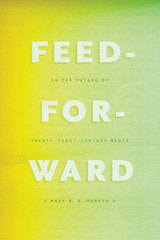
cover of Feed-Forward: On the Future of Twenty-First-Century Media

Feed-Forward

On the Future of Twenty-First-Century Media

Mark B. N. Hansen

University of Chicago Press, 2014

Even as media in myriad forms increasingly saturate our lives, we nonetheless tend to describe our relationship to it in terms from the twentieth century: we are consumers of media, choosing to engage with it. In Feed-Forward, Mark B. N. Hansen shows just how outmoded that way of thinking is: media is no longer separate from us but has become an inescapable part of our very experience of the world.

Drawing on the speculative empiricism of philosopher Alfred North Whitehead, Hansen reveals how new media call into play elements of sensibility that greatly affect human selfhood without in any way belonging to the human. From social media to data-mining to new sensor technologies, media in the twenty-first century work largely outside the realm of perceptual consciousness, yet at the same time inflect our every sensation. Understanding that paradox, Hansen shows, offers us a chance to put forward a radically new vision of human becoming, one that enables us to reground the human in a non-anthropocentric view of the world and our experience in it.

[more]
cover of Feeding the Future: School Lunch Programs as Global Social Policy

Feeding the Future

School Lunch Programs as Global Social Policy

Rutledge, Jennifer Geist

Rutgers University Press, 2016

A century ago, only local charities existed to feed children. Today 368 million children receive school lunches in 151 countries, in programs supported by state and national governments. In Feeding the Future, Jennifer Geist Rutledge investigates how and why states have assumed responsibility for feeding children, chronicling the origins and spread of school lunch programs around the world, starting with the adoption of these programs in the United States and some Western European nations, and then tracing their growth through the efforts of the World Food Program.
 
The primary focus of Feeding the Future is on social policy formation: how and why did school lunch programs emerge? Given that all countries developed education systems, why do some countries have these programs and others do not? Rutledge draws on a wealth of information—including archival resources, interviews with national policymakers in several countries, United Nations data, and agricultural statistics—to underscore the ways in which a combination of ideological and material factors led to the creation of these enduringly popular policies. She shows that, in many ways, these programs emerged largely as an unintended effect of agricultural policy that rewarded farmers for producing surpluses. School lunches provided a ready outlet for this surplus. She also describes how, in each of the cases of school lunch creation, policy entrepreneurs, motivated by a commitment to alleviate childhood malnutrition, harnessed different ideas that were relevant to their state or organization in order to funnel these agricultural surpluses into school lunch programs.  
 
The public debate over how we feed our children is becoming more and more politically charged. Feeding the Future provides vital background to these debates, illuminating the history of food policies and the ways our food system is shaped by global social policy.  
 
[more]
cover of Fiction, Fact and Future: The Essence of EU Democracy

Fiction, Fact and Future

The Essence of EU Democracy

James Elles

Haus Publishing, 2019

Since its inception, the European Union has developed to become an open and transparent system which is democratically accountable to more than five hundred million European citizens. James Elles explains how the EU functions, emphasizing the emerging role of the European Parliament in the process. Elles reviews the history of Britain’s relationship with the EU and illustrates how a reluctance to consult the British people on multiple Treaty changes led to a lack of understanding about Brussels. Looking to the future, Elles assesses the global long-term trends that lie ahead to 2030 and underlines that closer European cooperation, for example on environmental and digital policies, will help them to be more easily resolved. As the next decade unfurls, the EU with President Macron at the forefront of the debate will progress and the European Parliament will continue to develop as a platform for the voice of the European people. From the disinterest of political leaders to the ambitions of emerging nations, Fiction, Fact and Future is not only a guide to why Britain failed to make the most of its EU membership, but also an optimistic message to a younger generation to help shape their future in the 21st century.
 
[more]
cover of Fighting for the Future of Food: Activists versus Agribusiness in the Struggle over Biotechnology

Fighting for the Future of Food

Activists versus Agribusiness in the Struggle over Biotechnology

Rachel Schurman

University of Minnesota Press, 2010

When scientists working in the agricultural biotechnology industry first altered the genetic material of one organism by introducing genes from an entirely different organism, the reaction was generally enthusiastic. To many, these genetically modified organisms (GMOs) promised to solve the challenges faced by farmers and to relieve world hunger. Yet within a decade, this "gene revolution" had abruptly stalled. Widespread protests against the potential dangers of "Frankenfoods" and the patenting of seed supplies in the developing world forced the industry to change course. As a result, in the late 1990s, some of the world's largest firms reduced their investment in the agricultural sector, narrowed their focus to a few select crops, or sold off their agricultural divisions altogether.

Fighting for the Future of Food tells the story of how a small group of social activists, working together across tables, continents, and the Internet, took on the biotech industry and achieved stunning success. Rachel Schurman and William A. Munro detail how the anti-biotech movement managed to alter public perceptions about GMOs and close markets to such products. Drawing strength from an alternative worldview that sustained its members' sense of urgency and commitment, the anti-GMO movement exploited political opportunities created by the organization and culture of the biotechnology industry itself.

Fighting for the Future of Food ultimately addresses society's understanding and trust (or mistrust) of technological innovation and the complexities of the global agricultural system that provides our food.
[more]
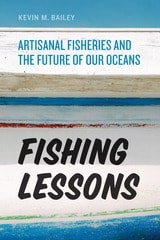
cover of Fishing Lessons: Artisanal Fisheries and the Future of Our Oceans

Fishing Lessons

Artisanal Fisheries and the Future of Our Oceans

Kevin M. Bailey

University of Chicago Press, 2018

Fish bones in the caves of East Timor reveal that humans have systematically fished the seas for at least 42,000 years. But in recent centuries, our ancient, vital relationship with the oceans has changed faster than the tides. As boats and fishing technology have evolved, traditional fishermen have been challenged both at sea and in the marketplace by large-scale fishing companies whose lower overhead and greater efficiency guarantee lower prices. In Fishing Lessons, Kevin M. Bailey captains a voyage through the deep history and present course of this sea change—a change that has seen species depleted, ecosystems devastated, and artisanal fisheries transformed into a global industry afloat with hundreds of billions of dollars per year.

Bailey knows these waters, the artisanal fisheries, and their relationship with larger ocean ecology intimately. In a series of place-based portraits, he shares stories of decline and success as told by those at the ends of the long lines and hand lines, channeling us through the changing dynamics of small-scale fisheries and the sustainability issues they face—both fiscal and ecological. We encounter Paolo Vespoli and his tiny boat, the Giovanni Padre,in the Gulf of Naples; Wenche, a sea Sámi, one of the indigenous fisherwomen of Norway; and many more. From salmon to abalone, the Bay of Fundy to Monterey and the Amazon, Bailey’s catch is no fish tale. It is a global story, casting a net across waters as vast and distinct as Puget Sound and the Chilean coast. Sailing across the world, Bailey explores the fast-shifting current of how we gather food from the sea, what we gain and what we lose with these shifts, and potential solutions for the murky passage ahead.
[more]
cover of Forging the Future of Special Collections

Forging the Future of Special Collections

Arnold Hirshon

American Library Association, 2016

[more]
cover of Founders of the Future: The Science and Industry of Spanish Modernization

Founders of the Future

The Science and Industry of Spanish Modernization

Óscar Iván Useche

Bucknell University Press, 2022
In this ambitious new interdisciplinary study, Useche proposes the metaphor of the social foundry to parse how industrialization informed and shaped cultural and national discourses in late nineteenth- and early twentieth-century Spain. Across a variety of texts, Spanish writers, scientists, educators, and politicians appropriated the new economies of industrial production—particularly its emphasis on the human capacity to transform reality through energy and work—to produce new conceptual frameworks that changed their vision of the future. These influences soon appeared in plans to enhance the nation’s productivity, justify systems of class stratification and labor exploitation, or suggest state organizational improvements. This fresh look at canonical writers such as Emilia Pardo Bazán, Concha Espina, Benito Pérez Galdós, Vicente Blasco Ibáñez, and José Echegaray as well as lesser known authors offers close readings of their work as it reflected the complexity of Spain’s process of modernization.


[more]
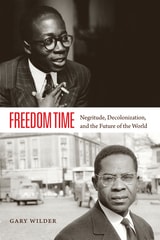
cover of Freedom Time: Negritude, Decolonization, and the Future of the World

Freedom Time

Negritude, Decolonization, and the Future of the World

Gary Wilder

Duke University Press, 2015

Freedom Time reconsiders decolonization from the perspectives of Aimé Césaire (Martinique) and Léopold Sédar Senghor (Senegal) who, beginning in 1945, promoted self-determination without state sovereignty. As politicians, public intellectuals, and poets they struggled to transform imperial France into a democratic federation, with former colonies as autonomous members of a transcontinental polity. In so doing, they revitalized past but unrealized political projects and anticipated impossible futures by acting as if they had already arrived. Refusing to reduce colonial emancipation to national independence, they regarded decolonization as an opportunity to remake the world, reconcile peoples, and realize humanity’s potential. Emphasizing the link between politics and aesthetics, Gary Wilder reads Césaire and Senghor as pragmatic utopians, situated humanists, and concrete cosmopolitans whose postwar insights can illuminate current debates about self-management, postnational politics, and planetary solidarity. Freedom Time invites scholars to decolonize intellectual history and globalize critical theory, to analyze the temporal dimensions of political life, and to question the territorialist assumptions of contemporary historiography.
[more]
cover of Furious Flower: Seeding the Future of African American Poetry

Furious Flower

Seeding the Future of African American Poetry

Edited by Joanne V. Gabbin and Lauren K. Alleyne; Foreword by Rita Dove

Northwestern University Press, 2020

Furious Flower: Seeding the Future of African American Poetry is an anthology of poems by more than one hundred award-winning poets, including Jericho Brown, Justin Philip Reed, and Tracy K. Smith, with themed essays on poetics from celebrated scholars such as Kwame Dawes, Meta DuEwa Jones, and Evie Shockley. The Furious Flower Poetry Center is the nation’s first academic center for Black poetry. In this eponymous collection, editors Joanne V. Gabbin and Lauren K. Alleyne bring together many of the paramount voices in Black poetry and poetics active today, composing an electrifying mosaic of voices, generations, and aesthetics that reveals the Black narrative in the  work of twentieth- and twenty-first-century writers. Intellectually enlightening and powerfully enlivening, Furious Flower explores and celebrates the idea of the Black poetic voice by posing the question, What’s next for Black poetic expression?
[more]
cover of Future of Art in a Digital Age: From Hellenistic to Hebraic Consciousness

Future of Art in a Digital Age

From Hellenistic to Hebraic Consciousness

Mel Alexenberg

Intellect Books, 2006

This work develops the thesis that the transition from pre-modernism to postmodernism in art of the digital age represents a paradigm shift from the Hellenistic to the Hebraic roots of Western culture.

Semiotic and morphological analysis of art and visual culture demonstrate the contemporary confluence between the deep structure of Hebraic consciousness and new directions in art that arise along the interface between scientific inquiry, digital technologies, and multicultural expressions.

Complementing these two analytic methodologies, alternative methodologies of kabbalah and halakhah provide postmodern methods for extending into digital age art forms. Exemplary artworks are described in the text and illustrated with photographs.
[more]
cover of Future of Modernism

Future of Modernism

Hugh Witemeyer, Editor

University of Michigan Press, 1997
The modernism of the future will not look like the modernism of the past. Over the past twenty years, W. B. Yeats, James Joyce, T. S. Eliot, Ezra Pound, and other major figures of the modernist movement have been subject to postmodernist critiques that have seen them as reactionary upholders of oppressive class, gender, racial, or other hierarchies; these critiques have permanently altered conceptions of the program and the canon of modernism. Today, revolutions in editing and publishing seem likely to transform them still further. The contributors to The Future of Modernism take these sea-changes into account, acknowledging and learning from the developments of recent years. Some interrogate the antithesis between modernism and postmodernism, showing that the former contains many features commonly claimed for the latter. Other essays dissociate modernism from the New Critical formalism with which it is often confused. Still others explore the modernist legacy of engagement with political and social events, challenging characterizations of modernism as an ahistorical, universalistic ideology. Together, these eleven essays by distinguished scholars contest facile dismissals of modernist writing and affirm an unshakable conviction of its continuing relevance and value. Although they project no unified vision or prophecy, the essays suggest a variety of lively trajectories into the next century.
[more]
cover of Future: A Recent History

Future

A Recent History

By Lawrence R. Samuel

University of Texas Press, 2009

The future is not a fixed idea but a highly variable one that reflects the values of those who are imagining it. By studying the ways that visionaries imagined the future—particularly that of America—in the past century, much can be learned about the cultural dynamics of the time.

In this social history, Lawrence R. Samuel examines the future visions of intellectuals, artists, scientists, businesspeople, and others to tell a chronological story about the history of the future in the past century. He defines six separate eras of future narratives from 1920 to the present day, and argues that the milestones reached during these years—especially related to air and space travel, atomic and nuclear weapons, the women's and civil rights movements, and the advent of biological and genetic engineering—sparked the possibilities of tomorrow in the public's imagination, and helped make the twentieth century the first century to be significantly more about the future than the past.

The idea of the future grew both in volume and importance as it rode the technological wave into the new millennium, and the author tracks the process by which most people, to some degree, have now become futurists as the need to anticipate tomorrow accelerates.

[more]