Results by title
167 books match the query 'Gardening' and 9 start with f
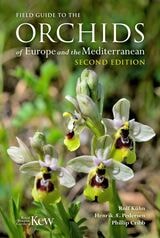
Field Guide to the Orchids of Europe and the Mediterranean
Rolf Kühn, Henrik Ærenlund Pedersen, and Phillip Cribb
Royal Botanic Gardens, Kew, 2024
Field Guide to the Orchids of Europe and the Mediterranean: Second Edition is a comprehensive photographic guide to the orchids of the region written by leading experts, who between them have decades of orchid field and research experience. The book covers orchids from Europe and the Mediterranean, extending to Turkey and the immediate near east of North Africa and Macaronesia.
Many guides to orchids of this region exist, but in this completely revised second edition, the authors have drawn on the latest scientific research to bring clarity to orchid identification and names, with an emphasis on the natural variability that exists in many wild species. This edition incorporates the latest updates in taxonomy. With over 2000 color photographs and new images, the book provides the reader with an accessible and easy-to-use identification guide to the natural variability seen in these orchids.
The book covers thirty genera and their species including Ophrys, Cypripedium, Orchis, Dactylorhiza, Epipactis, and Serapias, as well as seventy natural hybrids. Much of the confusion over identification is due to the morphological variation a species can have within a habitat and across its distribution, and therefore to simplify identification, several images accompany each species to illustrate this diversity, along with notes on distinguishing features and distribution maps. Each species is also accompanied by common names and important synonyms, as well as notes on habitat, flowering times, and distinguishing features.

Field Guide to the Wild Flowers of the Canary Islands
Chris Thorogood, Mark Carine, and Alfredo Reyes-Betancourt
Royal Botanic Gardens, Kew, 2024
Situated in the North Atlantic off the coast of northwestern Africa, the Canary Islands are a volcanic archipelago, comprising seven large and several smaller islands. The region attracts millions of visitors every year, with an abundance of ecotourists drawn by its famously rich flora. This book presents previously inaccessible information on the islands through the collaboration of British scientists and local experts.
This long-awaited field guide covers more than two thousand of the region’s exceptionally diverse and important plants, from the most common species to local endemics. Illustrated throughout with color photographs, each species profile includes nomenclature, description, dimensions, habitat, flowering times, and distribution.
With comprehensive, up-to-date coverage sorted by habitat, this is the essential guide for students, professional botanists, scientists, gardeners, and plant enthusiasts alike.
Field Guide to the Wild Flowers of the Western Alps
France, Italy and SwitzerlandChristopher Grey-Wilson
Royal Botanic Gardens, Kew, 2025
The Western Alps, a large region of dramatic scenery and varied habitats, is noted for its biodiversity and beauty. From woodlands and forests, through colorful hay meadows, to the higher alpine elevations, the region boasts one of the most diverse and colorful mountain floras found anywhere on earth. This book is a celebration of the great biological diversity found in one of the most beautiful and inviting regions of Europe.
This comprehensive guide features the fascinating flora to be found across the region in the French Alps, the Massif Central and Cevennes, the Swiss Jura Mountains and the Italian Alps east to Como and Bergamo. Illustrated throughout with over 2000 photographs, each species profile includes nomenclature, description, dimensions, habitat, flowering times, and distribution.
Field Guide to the Wildflowers of the Western Mediterranean
Chris Thorogood
Royal Botanic Gardens, Kew, 2016
Flower Chronicles
E. Buckner Hollingsworth
University of Chicago Press, 2004
A tremendously entertaining and charming book, not only for its richness of information but because Hollingsworth clearly enjoys her material, Flower Chronicles has an antiquarian feel about it-with line drawings, woodcuts, and translations from the Greek—but the text never feels dated. Out of print for nearly thirty years, Flower Chronicles reemerges as a garden literature classic.
"With humor and literary taste, Mrs. Hollingworth has compiled an astonishing amount of scholarly yet entertaining material from her studies in archaeology and mythology and her researches in ancient pharmacopeias, botanies, cookbooks, herbals, and stillroom books."-New Yorker
"Mrs. Hollingsworth writes gaily and quotes from old books, with a wonderful taste for the curious English of Elizabethan gardeners, and sharp notice of what poets and translators of talent have set down. To this she has added the excitement of discovery of forms not noticed by her predecessors."-New York Herald Tribune Book Review
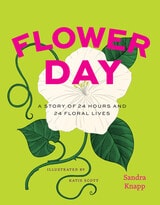
Flower Day
A Story of 24 Hours and 24 Floral LivesSandra Knapp
University of Chicago Press, 2025
Is it 4 AM or chicory o’clock? In this short book, botanist and award-winning author Sandra Knapp walks us through a day in a global garden. Each chapter of Flower Day introduces a single flower during a single hour, highlighting twenty-four different species from around the world.
Beginning at midnight in the Americas, we spot the long tubular flowers of the moonflower, Ipomoea alba; they attract a frenzy of hawk moths before the dawn arrives and the flowers wither and collapse. As day breaks, dandelions and chicory open their heads—actually made up of many individual flowers tightly packed together—and flies and bees visit to get the energy they need to lay eggs and raise their young. Later, at eight o’clock in the morning, the sun rises over the watery Amazon basin, and we meet the giant waterlily, slowly turning from white to pink and purple. Trapped inside are the beetles who feasted on the flowers during the night. That evening, at seven o’clock, we travel to the Caribbean to smell night-blooming jessamine’s powerful—some may say nauseating—sweet scent. But this member of the nightshade family isn’t just a thing of beauty—it has a reputation as both a poison and invasive species, crowding out endangered native trees.
For each hour in our flower day, celebrated artist Katie Scott has depicted these scenes with gorgeous pen-and-ink illustrations. Working closely together to narrate and illustrate these unique moments in time, Knapp and Scott have created an engaging read that is a perfect way to spend an hour or two—and a true gift for amateur botanists, gardeners, and anyone who wants to stop and appreciate the flowers.

Flower Growing in the North
A Month-by-Month GuideGeorge E. Luxton
University of Minnesota Press, 1956
Flower Growing in the North was first published in 1956. Minnesota Archive Editions uses digital technology to make long-unavailable books once again accessible, and are published unaltered from the original University of Minnesota Press editions.
Since home gardeners living in regions of very cold winters and short growing seasons find little attention paid to their special problems in most gardening books, they will welcome this month-by-month guide. It relates times of planting, needs for winter protection, and selection of plant varieties to the limitations of the northern climate. The best of George Luxton's popular gardening columns in the Minneapolis Sunday Tribune form the basis of the book. For the winter season there is advice on the care of house plants and how to grow seedlings for transplanting outdoors. For the summer gardener there is information about annuals and perennials, fertilizers and insecticides, and garden equipment. Instructions on tree, shrub, and lawn care are given, too. Also included are many of the "Grandma sayings" from Mr. Luxton's newspaper columns. These homely bits of garden lore, which stem from his recollections of his own grandmother, are as intriguing and useful today as they were a generation of two ago.

Fruitful Sites
Garden Culture in Ming Dynasty ChinaCraig Clunas
Duke University Press, 1996
Who owned Ming gardens? Who visited them? How were they represented in words, in paintings, and in visual culture generally, and what meanings did these representations hold at different levels of Chinese society? How did the discourse of gardens intersect with other discourses such as those of aesthetics, agronomy, geomancy, and botany? By examining the gardens of the city of Suzhou from a number of different angles, Craig Clunas provides a rich picture of a complex cultural phenomenon—one that was of crucial importance to the self-fashioning of the Ming elite.
Drawing on a wide range of recent work in cultural theory, the author provides for the first time a historical and materialist account of Chinese garden culture, and replaces broad generalizations and orientalist fantasy with a convincing picture of the garden’s role in social life. Fruitful Sites will appeal to all students of China’s cultural history, to students of garden history from any part of the world, to art historians, and to readers engaged in Asian and cultural studies.
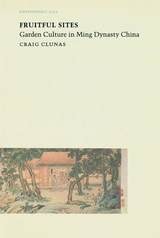
Fruitful Sites
Garden Culture in Ming Dynasty ChinaCraig Clunas
Reaktion Books, 1996
Who owned gardens? Who visited them? How were they represented in words, in paintings and in visual culture generally, and what meanings did these representations hold at different levels of Chinese society? Drawing on a wide range of recent work in cultural theory, Craig Clunas provides for the first time a historical and materialist account of Chinese garden culture, and replaces broad generalizations and orientalist fantasy with a convincing picture of the garden's role in social life.