Results by title
522 books match the query 'Gender' and 17 start with f

Faithful Translators
Authorship, Gender, and Religion in Early Modern EnglandJaime Goodrich
Northwestern University Press, 2014
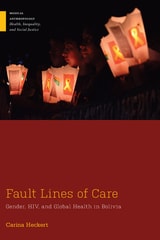
Fault Lines of Care
Gender, HIV, and Global Health in BoliviaHeckert, Carina
Rutgers University Press, 2018
The HIV epidemic in Bolivia has received little attention on a global scale in light of the country’s low HIV prevalence rate. However, by profiling the largest city in this land-locked Latin American country, Carina Heckert shows how global health-funded HIV care programs at times clash with local realities, which can have catastrophic effects for people living with HIV who must rely on global health resources to survive. These ethnographic insights, as a result, can be applied to AIDS programs across the globe.
In Fault Lines of Care, Heckert provides a detailed examination of the effects of global health and governmental policy decisions on the everyday lives of people living with HIV in Santa Cruz. She focuses on the gendered dynamics that play a role in the development and implementation of HIV care programs and shows how decisions made from above impact what happens on the ground.

Feeding Anorexia
Gender and Power at a Treatment CenterHelen Gremillion
Duke University Press, 2003
Feeding Anorexia is based on fourteen months of ethnographic research in a small inpatient unit located in a major teaching and research hospital in the western United States. Gremillion attended group, family, and individual therapy sessions and medical staff meetings; ate meals with patients; and took part in outings and recreational activities. She also conducted over one hundred interviews-with patients, parents, staff, and clinicians. Among the issues she explores are the relationship between calorie-counting and the management of consumer desire; why the "typical" anorexic patient is middle-class and white; the extent to which power differentials among clinicians, staff, and patients model "anorexic families"; and the potential of narrative therapy to constructively reframe some of the problematic assumptions underlying more mainstream treatments.

Female Gladiators
Gender, Law, and Contact Sport in AmericaSarah K. Fields
University of Illinois Press, 2004
Female Gladiators is the first book to examine legal and social battles over the right of women to participate with men in contact sports. The impetus to begin legal proceedings was the 1972 enactment of Title IX, which prohibited discrimination in educational settings, but it was the Equal Protection Clause of the U.S. Constitution and the equal rights amendments of state constitutions that ultimately opened doors. Despite court rulings, however, many in American society resisted—and continue to resist—allowing girls in dugouts and other spaces traditionally defined as male territories.
Inspired, women and girls began to demand access to the contact sports which society had previously deemed too strenuous or violent for them to play. When the leagues continued to bar girls simply because they were not boys, the girls went to court. Sarah K. Fields's Female Gladiators is the only book to examine the legal and social battles over gender and contact sport that continue to rage today.

Feminine Endings
Music, Gender, and SexualitySusan Mcclary
University of Minnesota Press, 2002

Feminine Frequencies
Gender, German Radio, and the Public Sphere 1923-1945Kate Lacey
University of Michigan Press, 1996

Filled with the Spirit
Sexuality, Gender, and Radical Inclusivity in a Black Pentecostal Church CoalitionEllen Lewin
University of Chicago Press, 2018
In Filled with the Spirit, Ellen Lewin gives us a deeply empathetic ethnography of the worship and community central to TFAM, telling the story of how the doctrine of radical inclusivity has expanded beyond those it originally sought to serve to encompass people of all races, genders, sexualities, and religious backgrounds. Lewin examines the seemingly paradoxical relationship between TFAM and traditional black churches, focusing on how congregations and individual members reclaim the worship practices of these churches and simultaneously challenge their authority. The book looks closely at how TFAM worship is legitimated and enhanced by its use of gospel music and considers the images of food and African American culture that are central to liturgical imagery, as well as how understandings of personal authenticity tie into the desire to be filled with the Holy Spirit. Throughout, Lewin takes up what has been mostly missing from our discussions of race, gender, and sexuality—close attention to spirituality and faith.

Forever Familias
Race, Gender, and Indigeneity in Peruvian MormonismJason Palmer
University of Illinois Press, 2024
Peruvian members of the Church of Jesus Christ of Latter-day Saints face the dilemma of embracing their faith while finding space to nourish their Peruvianness. Jason Palmer draws on eight years of fieldwork to provide an on-the-ground look at the relationship between Peruvian Saints and the racial and gender complexities of the contemporary Church.
Peruvian Saints discovered that the foundational ideas of kinship and religion ceased being distinct categories in their faith. At the same time, they came to see that LDS rituals and reenactments placed coloniality in opposition to the Peruvians’ indigenous roots and family against the more expansive Peruvian idea of familia. In part one, Palmer explores how Peruvian Saints resolved the first clash by creating the idea of a new pioneer indigeneity that rejected victimhood in favor of subtle engagements with power. Part two illuminates the work performed by Peruvian Saints as they stretched the Anglo Church’s model of the nuclear family to encompass familia.

Fortune Is a Woman
Gender and Politics in the Thought of Niccolo MachiavelliHanna Fenichel Pitkin
University of Chicago Press, 1999
Hanna Pitkin's provocative and enduring study of Machiavelli was the first to systematically place gender at the center of its exploration of his political thought. In this edition, Pitkin adds a new afterword, in which she discusses the book's critical reception and situates the book's arguments in the context of recent interpretations of Machiavelli's thought.
"A close and often brilliant exegesis of Machiavelli's writings."—The American Political Science Review

Fragments of Development
Nation, Gender, and the Space of ModernitySuzanne Bergeron
University of Michigan Press, 2005
---Isabella C. Bakker, York University
"Bergeron's pathbreaking analysis challenges orthodox development theories, questions current feminist economic thinking and highlights crucial new gendered challenges to globalization."
---Jane Parpart, Dalhousie University
"Cutting-edge scholarship. Bergeron deftly engages the complexity of current debates while retaining clarity, improving analyses, and illuminating alternatives."
---V. S. Peterson, University of Arizona
By tracing out the intersection between the imagined space of the national economy and the gendered construction of "expert" knowledge in development thought, Suzanne Bergeron provides a provocative analysis of development discourse and practice. By elaborating a framework of including/excluding economic subjects and activities in development economics, she provides a rich account of the role that economists have played in framing the contested political and cultural space of development.
Bergeron's account of the construction of the national economy as an object of development policy follows its shifting meanings through modernization and growth models, dependency theory, structural adjustment, and contemporary debates about globalization and highlights how intersections of nation and economy are based on gendered and colonial scripts. The author's analysis of development debates effectively demonstrates that critics of development who ignore economists' nation stories may actually bolster the formation they are attempting to subvert. Fragments of Development is essential reading for those interested in development studies, feminist economics, international political economy, and globalization studies.

Framing the Rape Victim
Gender and Agency ReconsideredMardorossian, Carine M
Rutgers University Press, 2014
In recent years, members of legal, law enforcement, media and academic circles have portrayed rape as a special kind of crime distinct from other forms of violence. In Framing the Rape Victim, Carine M. Mardorossian argues that this differential treatment of rape has exacerbated the ghettoizing of sexual violence along gendered lines and has repeatedly led to women’s being accused of triggering, if not causing, rape through immodest behavior, comportment, passivity, or weakness.
Contesting the notion that rape is the result of deviant behaviors of victims or perpetrators, Mardorossian argues that rape saturates our culture and defines masculinity’s relation to femininity, both of which are structural positions rather than biologically derived ones. Using diverse examples throughout, Mardorossian draws from Hollywood film and popular culture to contemporary women’s fiction and hospitalized birth emphasizing that the position of dominant masculinity can be occupied by men, women, or institutions, while structural femininity is a position that may define and subordinate men, minorities, and other marginalized groups just as effectively as it does women. Highlighting the legacies of the politically correct debates of the 1990s and the terrorist attacks of 9/11, the book illustrates how the framing of the term “victim” has played a fundamental role in constructing notions of agency that valorize autonomy and support exclusionary, especially masculine, models of American selfhood.
The gendering of rape, including by well-meaning, sometimes feminist, voices that claim to have victims’ best interests at heart, ultimately obscures its true role in our culture. Both a critical analysis and a call to action, Framing the Rape Victim shows that rape is not a special interest issue that pertains just to women but a pervasive one that affects our society as a whole.

Frankie and Johnny
Race, Gender, and the Work of African American Folklore in 1930s AmericaBy Stacy I. Morgan
University of Texas Press, 2017
Winner, Wayland D. Hand Prize, American Folklore Society, 2018
Originating in a homicide in St. Louis in 1899, the ballad of “Frankie and Johnny” became one of America’s most familiar songs during the first half of the twentieth century. It crossed lines of race, class, and artistic genres, taking form in such varied expressions as a folk song performed by Huddie Ledbetter (Lead Belly); a ballet choreographed by Ruth Page and Bentley Stone under New Deal sponsorship; a mural in the Missouri State Capitol by Thomas Hart Benton; a play by John Huston; a motion picture, She Done Him Wrong, that made Mae West a national celebrity; and an anti-lynching poem by Sterling Brown.
In this innovative book, Stacy I. Morgan explores why African American folklore—and “Frankie and Johnny” in particular—became prized source material for artists of diverse political and aesthetic sensibilities. He looks at a confluence of factors, including the Harlem Renaissance, the Great Depression, and resurgent nationalism, that led those creators to engage with this ubiquitous song. Morgan’s research uncovers the wide range of work that artists called upon African American folklore to perform in the 1930s, as it alternately reinforced and challenged norms of race, gender, and appropriate subjects for artistic expression. He demonstrates that the folklorists and creative artists of that generation forged a new national culture in which African American folk songs featured centrally not only in folk and popular culture but in the fine arts as well.
From High School to College
Gender, Immigrant Generation, and Race-EthnicityCharles Hirschman
Russell Sage Foundation, 2016
Today, over 75 percent of high school seniors aspire to graduate from college. However, only one-third of Americans hold a bachelor’s degree, and college graduation rates vary significantly by race/ethnicity and parental socioeconomic status. If most young adults aspire to obtain a college degree, why are these disparities so great? In From High School to College, Charles Hirschman analyzes the period between leaving high school and completing college for nearly 10,000 public and private school students across the Pacific Northwest.
Hirschman finds that although there are few gender, racial, or immigration-related disparities in students’ aspirations to attend and complete college, certain groups succeed at the highest rates. For example, he finds that women achieve better high school grades and report receiving more support and encouragement from family, peers, and educators. They tend to outperform men in terms of preparing for college, enrolling in college within a year of finishing high school, and completing a degree. Similarly, second-generation immigrants are better prepared for college than first-generation immigrants, in part because they do not have to face language barriers or learn how to navigate the American educational system.
Hirschman also documents that racial disparities in college graduation rates remain stark. In his sample, 35 percent of white students graduated from college within seven years of completing high school, compared to only 19 percent of black students and 18 percent of Hispanic students. Students’ socioeconomic origins—including parental education and employment, home ownership, and family structure—account for most of the college graduation gap between disadvantaged minorities and white students. Further, while a few Asian ethnic groups have achieved college completion rates on par with whites, such as Chinese and Koreans, others, whose socioeconomic origins more resemble those of black and Hispanic students, such as Filipinos and Cambodians, also lag behind in preparedness, enrollment, and graduation from college.
With a growing number of young adults seeking college degrees, understanding the barriers that different students encounter provides vital information for social scientists and educators. From High School to College illuminates how gender, immigration, and ethnicity influence the path to college graduation.

From Single to Serious
Relationships, Gender, and Sexuality on American Evangelical CampusesMalone, Dana M.
Rutgers University Press, 2018
In From Single to Serious, Dana M. Malone shines a light on friendship, dating, and, sexuality, in both the ideals and the practical experiences of heterosexual students at U. S. evangelical colleges. She examines the struggles they have in balancing their gendered and religious presentations of self, the expectations of their campus community, and their desire to find meaningful romantic relationships.

From a Shattered Sun
Hierarchy, Gender, and Alliance in the Tanimbar IslandsSusan Mckinnon
University of Wisconsin Press, 1991
Among a growing number of ethnographies of eastern Indonesia that deal with cosmology, exchange, and kinship, From a Shattered Sun is the first to address squarely issues originally broached by Edmund Leach and Claude Lévi-Strauss concerning the relation between hierarchy and equality in asymmetric systems of marriage.
On the basis of extensive fieldwork in the Tamimbar islands, Susan McKinnon analyzes the simultaneous presence of both closed, asymmetric cycles and open, asymmetric pathways of alliance—of both egalitarian and hierarchical configurations. In addition, Tamimbarese society is marked by the existence of multiple, differentially valued forms of marriage, affiliation, and residence. Rather than seeing these various forms as analytically separable types, McKinnon demonstrates that it is only by viewing them as integrally related—in terms of culturally specific understandings of "houses," gender, and exchange—that one can perceive the processes through which hierarchy and equality are created.

From the Nation-Building Debate to the Bolsa Família Program
Whiteness, Gender, and Poverty in BrazilBeatriz Junqueira Lage Carbone
Campus Verlag, 2023
Bolsa Familia was a social welfare program launched in Brazil in 2003 that made cash payments to poor families, provided they kept their children in school and got them vaccinated. Over time, the program became controversial, intertwined with struggles over race and gender, and President Jair Bolsonaro canceled it in 2021. This book examines the discourse around the program and its effects, illuminating conflicts over national identity and the roles of sexism and racism in Brazil.
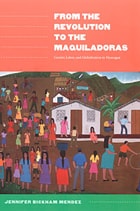
From the Revolution to the Maquiladoras
Gender, Labor, and Globalization in NicaraguaJennifer Bickham Mendez
Duke University Press, 2005
Mendez draws on interviews with leaders and program participants, including maquiladora workers; her participant observation while she worked as a volunteer within the organization; and analysis of the public statements, speeches, and texts written by mec members. She provides a sense of the day-to-day operations of the group as well as its strategies. By exploring the tension between mec and transnational feminist, labor, and solidarity networks, she illustrates how mec women’s outlooks are shaped by both their revolutionary roots within the Sandinista regime and their exposure to global discourses of human rights and citizenship. The complexities of the women’s labor movement analyzed in From the Revolution to the Maquiladoras speak to social and economic justice movements in the many locales around the world.