Results by title
156 books match the query 'Geology' and 7 start with f
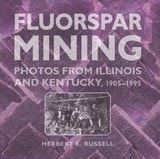
Fluorspar Mining
Photos from Illinois and Kentucky, 1905-1995Herbert K. Russell
Southern Illinois University Press, 2019
This first-ever pictorial record of the people and methods of the Illinois-Kentucky Fluorspar District from the 1900s to the 1990s covers early and modern means of extracting, hoisting, processing, and transporting the mineral from mine mouth to end user. Nearly one hundred images carefully selected by author Herbert K. Russell show early pick-and-shovel extraction and open-flame lighting as well as primitive drilling methods and transportation by barrels, buckets, barges, mule teams, and trams, in addition to the use of modern equipment and sophisticated refinement procedures such as froth flotation. Russell also provides an overview of the many industrial uses of fluorspar, from metal work by ancient Romans to the processing of uranium by scientists seeking to perfect the atomic bomb. Preserving what is known about the industry by miners, managers, and museums, this detailed and fascinating pictorial history looks both above and below ground at fluorspar mining.
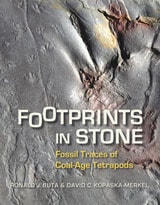
Footprints in Stone
Fossil Traces of Coal-Age TetrapodsRonald J. Buta and David C. Kopaska-Merkel
University of Alabama Press, 2016
Where ancient creatures walked—science uncovers their lasting impressions.
The Steven C. Minkin (Union Chapel) Paleozoic Footprint Site ranks among the most important fossil sites in the world today, and Footprints in Stone recounts the accidental revelation of its existence and detailed findings about its fossil record.
Currently 2,500 miles from the equator and more than 250 miles north of the Gulf of Mexico, the Minkin site was a swampy tropical forest adjacent to a tidal flat during the Coal Age or Carboniferous Period more than 300 million years ago. That fecund strand of sand and mud at the ocean’s edge teemed with the earth’s earliest reptiles as well as amphibians, fish, horseshoe crabs, spiders, jumping insects, and other fascinating organisms. Unlike dinosaurs and other large animals whose sturdy bodies left hard fossil records, most of these small, soft-bodied creatures left no concrete remains. But they did leave something else. Preserved in the site’s coal beds along with insect wings and beautifully textured patterns of primeval plants are their footprints, fossilized animal tracks from which modern paleontologists can glean many valuable insights about their physical anatomies and behaviors.
The paleontological examination of fossil tracks is now the cutting-edge of contemporary scholarship, and the Minkin site is the first and largest site of its kind in eastern North America. Discovered by a local high school science teacher, the site provides both professional and amateur paleontologists around the world with a wealth of fossil track samples along with an inspirational story for amateur explorers and collectors.
Authoritative and extensively illustrated, Footprints in Stone brings together the contributions of many geologists and paleontologists who photographed, documented, and analyzed the Minkin site’s fossil trackways. An engrossing tale of its serendipitous discovery and a detailed study of its fossil records, Footprints in Stone is a landmark publication in the history of paleontology.
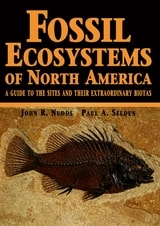
Fossil Ecosystems of North America
A Guide to the Sites and Their Extraordinary BiotasJohn R. Nudds and Paul A. Selden
University of Chicago Press, 2008
Fossil Ecosystems of North America describes these and eleven other sites that range across the continent.
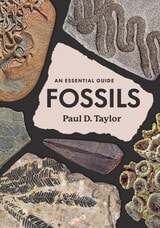
Fossils
An Essential GuidePaul D. Taylor
University of Chicago Press, 2025
Ancient Earth seems like an alien world. But the fossil record can help reveal the mysteries of the organisms that have lived on our planet since its formation some 4,600 million years ago. In this engaging and beautifully illustrated book, world-renowned paleontologist Paul D. Taylor provides a comprehensive guide to all aspects of fossils to tell the story of life on Earth.
Taylor begins with the basics: how fossils form, how they mark geological time, and what they tell us about the origins of life and major evolutionary events like the Cambrian Explosion. He then shows the oldest fossils—single-celled bacteria in amazing, three-billion-year-old microbial rock structures—before introducing the first animals in the fossil record. From fishes to amphibians, reptiles, and mammals, we meet these animal fossils in an appropriate evolutionary parade. Next, we imagine plants long past, charting the evolution of this kingdom and learning how ephemeral botanical remains can become permanent records. While comprehensive in his coverage of fossil groups and ages, Taylor pays particular attention to specimens fossil hunters are most likely to encounter, like crinoids and the iconic ammonites. Throughout, he introduces us to fascinating fossil folklore—like the idea that ammonites are the petrified remains of coiled snakes—and helps us distinguish true fossils from fakes.
With stunning color images of many original specimens from the collections of London’s Natural History Museum, Fossils is an essential introduction, connecting life on Earth today to the ancient past.
Foundations of Paleoecology
Classic Papers with CommentariesEdited by S. Kathleen Lyons, Anna K. Behrensmeyer, and Peter J. Wagner
University of Chicago Press, 2019
This book brings together forty-four classic papers published between 1924 and 1999 that trace the origins and development of paleoecology. The articles cross taxonomic groups, habitat types, geographic areas, and time and have made substantial contributions to our knowledge of the evolution of life. Encompassing the full breadth of paleoecology, the book is divided into six parts: community and ecosystem dynamics, community reconstruction, diversity dynamics, paleoenvironmental reconstruction, species interaction, and taphonomy. Each paper is also introduced by a contemporary expert who gives context and explains its importance to ongoing paleoecological research. A comprehensive introduction to the field, Foundations of Paleoecology will be an essential reference for new students and established paleoecologists alike.
From Mineralogy to Geology
The Foundations of a Science, 1650-1830Rachel Laudan
University of Chicago Press, 1987
From the Ground Up
A History of Mining in Utahedited by Colleen K. Whitley
Utah State University Press, 2025
Mining had an enormous role, only partly measurable, in the history of Utah. Its multidimensional impact continues today. Economically, it made a major long-term contribution to the wealth, employment, and tax base of the state and stimulated a seemingly endless range of secondary businesses and enterprises. It helped shape the state's social history, determining the location, distribution, and composition of many communities and bringing transportation systems and a wide variety of institutions to them. It developed cultural diversity by drawing to Utah miners and families from otherwise underrepresented ethnic and national backgrounds. It ignited strife, particularly between labor and management, but those issues often spread into or connected with other conflicts in and between communities, classes, and factions. It influenced political platforms, generated candidates, and helped decide elections. Throughout the state, mining dramatically transformed the landscape, most obviously at what has been called the world's largest open-pit mine, which removed much of a mountain on the west side of Salt Lake Valley, but at innumerable other places too.
Despite all mining has done and meant, there has not been, until now, a book that surveyed its history in Utah. From the Ground Up fills that gap in a collection of essays by leading experts, among them historians Thomas G. Alexander, Martha Sonntag Bradley-Evans, James E. Fell Jr., Laurence P. James, Brigham D. Madsen, Philip F. Notarianni, Allen Kent Powell, W. Paul Reeve, Raye C. Ringholz, and Janet Burton Seegmiller and geologists J. Wallace Gwynn and William T. Parry. The book is divided into three comprehensive parts. The first looks at "The Ground of Utah Mining": the geology that has produced extractable minerals, the economic history of the industry, "father of Utah mining" Patrick E. Connor, and the lore of mines and miners. Part II reviews the history of a handful of particularly significant mineral industries: salines, coal, uranium, and beryllium. The last part takes a region-by-region approach to survey the important, primarily for hard-rock mining, areas of the state, including places from Silver Reef to Alta, the East Tintic Range to the Uinta Basin, and Park City to Frisco.