Results by title
98 books match the query 'Government' and 7 start with f

Federal Judges
The Appointing ProcessHarold W. Chase
University of Minnesota Press, 1972
Federal Judges was first published in 1972. Minnesota Archive Editions uses digital technology to make long-unavailable books once again accessible, and are published unaltered from the original University of Minnesota Press editions.
Despite the importance of federal judges in the system of American government, relatively little scholarly attention has been directed toward the process of appointing these judges -- how it operates and what types of individuals become judges. Professor Chase analyzes and evaluates the appointing system and makes some provocative proposals for changes which he believes would improve and strengthen the federal judicial system.
The study is concerned with the appointing process as it applies to federal judges below the level of the Supreme Court who receive lifetime appointments. These are the judges who serve in what are known as Article III courts, the courts constituted by Congress in accordance with Article III of the Constitution. They include courts of appeals, district courts, the court of claims, the court of customs and patent appeals, and the customs court.
For this study the author had access to Department of Justice records, and he observed for several months the negotiations and discussions in the department involving the selection of judges by President Kennedy's administration. He conducted extensive interviews with officials in the Kennedy administration as well as with officials in the Eisenhower and Johnson administrations who played leading roles in the appointment of judges. In addition, he interviewed many judges, lawyers, newsmen, and political leaders, as well as a sampling of U.S. senators and most of the recent chairmen of the American Bar Association's Committee on Federal Judiciary.

Fifty-Eight Lonely Men
Southern Federal Judges and School DesegregationJ. W. Peltason
University of Illinois Press, 1971
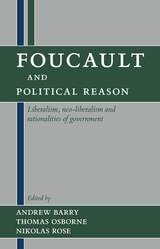
Foucault and Political Reason
Liberalism, Neo-Liberalism, and Rationalities of GovernmentEdited by Andrew Barry, Thomas Osborne, and Nikolas Rose
University of Chicago Press, 1996
These twelve essays provide a critical introduction to Foucault's work on politics, exploring its relevance to past and current thinking about liberal and neo-liberal forms of government. Moving away from the great texts of liberal political philosophy, this book looks closely at the technical means with which the ideals of liberal political rationalities have been put into practice in such areas as schools, welfare, and the insurance industry.
This fresh approach to one of the seminal thinkers of the twentieth century is essential reading for anyone interested in social and cultural theory, sociology, and politics.
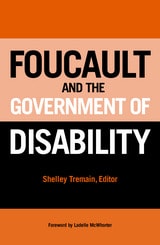
Foucault and the Government of Disability
Shelley Tremain, Editor
University of Michigan Press, 2005
Foucault and the Government of Disability is the first book-length investigation of the relevance and importance of the ideas of Michel Foucault to the field of disability studies-and vice versa. Over the last thirty years, politicized conceptions of disability have precipitated significant social change, including the landmark Americans with Disabilities Act in 1990, the redesign of urban landscapes, the appearance of closed-captioning on televisions, and the growing recognition that disabled people constitute a marginalized and disenfranchised constituency.
The provocative essays in this volume respond to Foucault's call to question what is regarded as natural, inevitable, ethical, and liberating, while they challenge established understandings of Foucault's analyses and offer fresh approaches to his work. The book's roster of distinguished international contributors represents a broad range of disciplines and perspectives, making this a timely and necessary addition to the burgeoning field of disability studies.
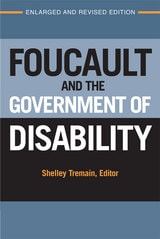
Foucault and the Government of Disability
Shelley Tremain, Editor
University of Michigan Press, 2005
“[A]n important, prescient, and necessary contribution…a kind of litmus test for the efficacy of Foucault’s concepts in the study of disability, concepts that lead to a refusal of the biological essentialism implied in the disability/impairment binary.”
—Foucault Studies
“Tremain has done an exceptional job at organizing and procuring important, rigorously argued, and entertaining essays…. This book should be a mandatory read for anyone interested in contemporary philosophical debates surrounding the experience of disability."
—Essays in Philosophy
“A beautiful exploration of how Foucault’s analytics of power and genealogies of discursive knowledges can open up new avenues for thinking critically about phenomena that many of us take to be inevitable and thus new ways of resisting and possibly at times redirecting the forces that shape our lives. Every scholar, every person with an interest in Foucault or in political theory generally, needs to read this book.”
—Ladelle McWhorter, University of Richmond
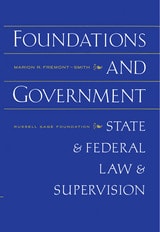
Foundations and Government
State and Federal Law SupervisionMarion R. Fremont-Smith
Russell Sage Foundation, 1965

From Guerrillas To Government
The Eritrean People’s Liberation FrontDavid Pool
Ohio University Press, 2001
In 1991 the Eritrean People’s Liberation Front (EPLF) took over Asmara and completed the liberation of Eritrea; formal independence came two years later after a referendum in May 1993. It was the climax of a thirty-year struggle, though the EPLF itself was formed only in the early 1970s.
From the beginning, Eritrean nationalism was divided. Ethiopia’s appeal to a joint Christian imperial past alienated the Muslim pastoral lowland people in the areas where Eritrean nationalism first appeared. It was not until the early 1970s that the Christian elements of the population finally joined the liberation struggle on a substantial scale.