Results by title
230 books match the query 'Government relations' and 6 start with f
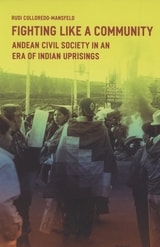
Fighting Like a Community
Andean Civil Society in an Era of Indian UprisingsRudi Colloredo-Mansfeld
University of Chicago Press, 2009
The indigenous population of the Ecuadorian Andes made substantial political gains during the 1990s in the wake of a dynamic wave of local activism. The movement renegotiated land development laws, elected indigenous candidates to national office, and successfully fought for the constitutional redefinition of Ecuador as a nation of many cultures. Fighting Like a Community argues that these remarkable achievements paradoxically grew out of the deep differences—in language, class, education, and location—that began to divide native society in the 1960s.
Drawing on fifteen years of fieldwork, Rudi Colloredo-Mansfeld explores these differences and the conflicts they engendered in a variety of communities. From protestors confronting the military during a national strike to a migrant family fighting to get a relative released from prison, Colloredo-Mansfeld recounts dramatic events and private struggles alike to demonstrate how indigenous power in Ecuador is energized by disagreements over values and priorities, eloquently contending that the plurality of Andean communities, not their unity, has been the key to their political success.

First Light
Kanaka 'Oiwi Resistance to Settler Science at Mauna a WakeaIokepa Casumbal-Salazar
University of Minnesota Press, 2025
Understanding the Hawai‘i Island summit of Mauna a Wākea as a place of ancestral connection, cultural resurgence, and political resistance for Native Hawaiians
First Light is a site-specific study of Native Hawaiian resistance to the construction of the Thirty Meter Telescope (TMT) on the summit of Mauna a Wākea, the sacred mountain on the island of Hawai‘i. Drawing on personal interviews, oral histories, archival research, participant observation, and popular, legal, scientific, and Indigenous discourses, Iokepa Casumbal-Salazar explores both the campaign to build the observatory and the movement against it. He asks how astronomers have become stewards of Mauna a Wākea while Kānaka ‘Ōiwi (Aboriginal Hawaiians), in protest, are recast as obstructing progress and clinging to ancient superstitions.
Contextualizing contemporary resistance to telescope expansion within the past 132 years of struggle against U.S. empire in Hawai‘i, Casumbal-Salazar argues the Kanaka-led efforts to protect their ancestral lands did not begin with the TMT and only become legible when understood in the broader history of resistance to U.S. settler hegemony as told through the voices and actions of kiaʻi ʻāina (land defenders). First Light explores how settler science, capital, and law have been mobilized in ways that rationalize industrial development projects like the TMT and promote a vision of “coexistence” that enables the dehumanization of Kānaka ‘Ōiwi and their alienation from ʻāina.
Challenging the assumptions and aggressions of neoliberal environmental policy, settler multiculturalism, and U.S. military occupation, First Light reinforces calls for a moratorium on new telescope development and a literacy in Kanaka ‘Ōiwi movements for life, land, and ea (independence, sovereignty).
Retail e-book files for this title are screen-reader friendly with images accompanied by short alt text and/or extended descriptions.
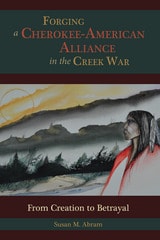
Forging a Cherokee-American Alliance in the Creek War
From Creation to BetrayalSusan M. Abram
University of Alabama Press, 2015
The Creek War of 1813–1814 is studied primarily as an event that impacted its two main antagonists, the defending Creeks in what is now the State of Alabama and the expanding young American republic. Scant attention has been paid to how the United States’ Cherokee allies contributed to the war and how the war transformed their society. In Forging a Cherokee-American Alliance in the Creek War, Susan M. Abram explains in engrossing detail the pivotal changes within Cherokee society triggered by the war that ultimately ended with the Cherokees’ forced removal by the United States in 1838.
The Creek War (also known as the Red Stick War) is generally seen as a local manifestation of the global War of 1812 and a bright footnote of military glory in the dazzling rise of Andrew Jackson. Jackson’s victory, which seems destined only in historic hindsight, was greatly aided by Cherokee fighters. Yet history has both marginalized Cherokee contributions to that conflict and overlooked the fascinating ways Cherokee society changed as it strove to accommodate, rationalize, and benefit from an alliance with the expanding American republic. Through the prism of the Creek War and evolving definitions of masculinity and community within Cherokee society, Abram delineates as has never been done before the critical transitional decades prior to the Trail of Tears.
Deeply insightful, Abram illuminates the ad hoc process of cultural, political, and sometimes spiritual transitions that took place among the Cherokees. Before the onset of hostilities, the Cherokees already faced numerous threats and divisive internal frictions. Abram concisely records the Cherokee strategies for meeting these challenges, describing how, for example, they accepted a centralized National Council and replaced the tradition of conflict-resolution through blood law with a network of “lighthorse regulators.” And while many aspects of masculine war culture remained, it too was filtered and reinterpreted through contact with the legalistic and structured American military.
Rigorously documented and persuasively argued, Abram’s award-winning Forging a Cherokee-American Alliance in the Creek War fills a critical gap in the history of the early American republic, the War of 1812, the Cherokee people, and the South.
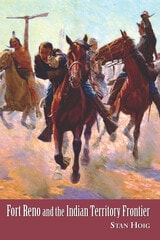
Fort Reno and the Indian Territory Frontier
Stan Hoig
University of Arkansas Press, 2005
The story of Fort Reno, as detailed here by Stan Hoig, touches on several of the most important topics of nineteenth-century Western history: the great cattle drives, Indian pacification and the Plains Wars, railroads, white settlement, and the Oklahoma land rushes. Hoig deals not only with Fort Reno, but also with Darlington agency, the Chisolm Trail, and the trading activities in Indian Territory from 1874 to approximately 1900. The author includes maps, photographs, and illustrations to enhance the narrative and guide the reader, like a scout, through a time of treacherous but fascinating events in the Old West.
From Time Immemorial
Indigenous Peoples and State SystemsBy Richard J. Perry
University of Texas Press, 1996
Around the globe, people who have lived in a place "from time immemorial" have found themselves confronted by and ultimately incorporated within larger state systems. During more than three decades of anthropological study of groups ranging from the Apache to the indigenous peoples of Kenya, Richard J. Perry has sought to understand this incorporation process and, more importantly, to identify the factors that drive it. This broadly synthetic and highly readable book chronicles his findings.
Perry delves into the relations between state systems and indigenous peoples in Canada, the United States, Mexico, and Australia. His explorations show how, despite differing historical circumstances, encounters between these state systems and native peoples generally followed a similar pattern: invasion, genocide, displacement, assimilation, and finally some measure of apparent self-determination for the indigenous people—which may, however, have its own pitfalls.
After establishing this common pattern, Perry tackles the harder question—why does it happen this way? Defining the state as a nexus of competing interest groups, Perry offers persuasive evidence that competition for resources is the crucial factor in conflicts between indigenous peoples and the powerful constituencies that drive state policies.
These findings shed new light on a historical phenomenon that is too often studied in isolated instances. This book will thus be important reading for everyone seeking to understand the new contours of our postcolonial world.

From Two Republics to One Divided
Contradictions of Postcolonial Nationmaking in Andean PeruMark Thurner
Duke University Press, 2001
Working within an innovative and panoramic historical and linguistic framework, Thurner examines the paradoxes of a resurgent Andean peasant republicanism during the mid-1800s and provides a critical revision of the meaning of republican Peru’s bloodiest peasant insurgency, the Atusparia Uprising of 1885. Displacing ahistorical and nationalist readings of Inka or Andean continuity, and undermining the long-held notion that the colonial legacy is the dominant historical force shaping contemporary Andean reality, Thurner suggests that in Peru, the postcolonial legacy of Latin America’s nation-founding nineteenth century transfigured, and ultimately reinvented, the colonial legacy in its own image.