Results by title
90 books match the query 'Growth' and 4 start with f

Fifty Years of Change on the U.S.-Mexico Border
Growth, Development, and Quality of LifeBy Joan B. Anderson and James Gerber
University of Texas Press, 2007
Winner, Book Award, Associaton for Borderland Studies, 2008
The U.S. and Mexican border regions have experienced rapid demographic and economic growth over the last fifty years. In this analysis, Joan Anderson and James Gerber offer a new perspective on the changes and tensions pulling at the border from both sides through a discussion of cross-border economic issues and thorough analytical research that examines not only the dramatic demographic and economic growth of the region, but also shifts in living standards, the changing political climate, and environmental pressures, as well as how these affect the lives of people in the border region.
Creating what they term a Border Human Development Index, the authors rank the quality of life for every U.S. county and Mexican municipio that touches the 2,000-mile border. Using data from six U.S. and Mexican censuses, the book adeptly illustrates disparities in various aspects of economic development between the two countries over the last six decades.
Anderson and Gerber make the material accessible and compelling by drawing an evocative picture of how similar the communities on either side of the border are culturally, yet how divided they are economically. The authors bring a heightened level of insight to border issues not just for academics but also for general readers. The book will be of particular value to individuals interested in how the border between the two countries shapes the debates on quality of life, industrial growth, immigration, cross-border integration, and economic and social development.
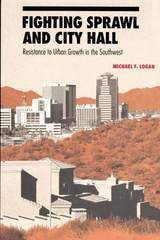
Fighting Sprawl and City Hall
Resistance to Urban Growth in the SouthwestMichael F. Logan
University of Arizona Press, 1995
Fighting Sprawl and City Hall now sets the record straight, tracing the roots of antigrowth activism in two southwestern cities, Tucson and Albuquerque, where urbanization proceeded in the face of constant protest. Logan tells how each of these cities witnessed multifaceted opposition to post-war urbanization and a rise in political activism during the 1950s. For each city, he describes the efforts by civic boosters and local government to promote development, showing how these booster-government alliances differed in effectiveness; tells how middle-class Anglos first voiced opposition to annexations and zoning reforms through standard forms of political protest such as referendums and petitions; then documents the shift to ethnic resistance as Hispanics opposed urban renewal plans that targeted barrios. Environmentalism, he reveals, was a relative latecomer to the political arena and became a focal point for otherwise disparate forms of resistance.
Logan's study enables readers to understand not only these similarities in urban activism but also important differences; for example, Tucson provides the stronger example of resistance based on valuation of the physical environment, while Albuquerque better demonstrates anti-annexation politics. For each locale, it offers a testament to grass-roots activism that will be of interest to historians as well as to citizens of its subject cities.

Financing Medicaid
Federalism and the Growth of America's Health Care Safety NetShanna Rose
University of Michigan Press, 2013
Conventional wisdom holds that programs for the poor are vulnerable to instability and retrenchment. Medicaid, however, has grown into the nation’s largest intergovernmental grant program, accounting for nearly half of all federal funding to state and local governments. Medicaid’s generous open-ended federal matching grants have given governors a powerful incentive to mobilize on behalf of its maintenance and expansion, using methods ranging from lobbying and negotiation to creative financing mechanisms and waivers to maximize federal financial assistance. Perceiving federal retrenchment efforts as a threat to states’ finances, governors, through the powerful National Governors’ Association, have repeatedly worked together in bipartisan fashion to defend the program against cutbacks.
Financing Medicaidengagingly intertwines theory, historical narrative, and case studies, drawing on sources including archival materials from the National Governors’ Association and gubernatorial and presidential libraries, Centers for Medicare and Medicaid Services data, the Congressional Record, and interviews.

Fundamentals of Tree Ring Research
James H. Speer
University of Arizona Press, 2010
This comprehensive text addresses all of the subjects that a reader who is new to the field will need to know and will be a welcome reference for practitioners at all levels. It includes a history of the discipline, biological and ecological background, principles of the field, basic scientific information on the structure and growth of trees, the complete range of dendrochronology methods, and a full description of each of the relevant subdisciplines.
Individual chapters address the composition of wood, methods of field and laboratory study, dendroarchaeology, dendroclimatology, dendroecology, dendrogeomorphology, and dendrochemistry. The book also provides thorough introductions to common computer programs and methods of statistical analysis. In the final chapter, the author describes “frontiers in dendrochronology,” with an eye toward future directions in the field. He concludes with several useful appendixes, including a listing of tree and shrub species that have been used successfully by dendrochronologists. Throughout, photographs and illustrations visually represent the state of knowledge in the field.