Results by title
64 books match the query 'Haiti' and 8 start with f
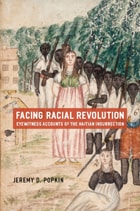
Facing Racial Revolution
Eyewitness Accounts of the Haitian InsurrectionJeremy D. Popkin
University of Chicago Press, 2008
Numerous firsthand narratives of these events survived, but their invaluable insights into the period have long languished in obscurity—until now. In Facing Racial Revolution, Jeremy D. Popkin unearths these documents and presents excerpts from more than a dozen accounts written by white colonists trying to come to grips with a world that had suddenly disintegrated. These dramatic writings give us our most direct portrayal of the actions of the revolutionaries, vividly depicting encounters with the uprising’s leaders—Toussaint Louverture, Boukman, and Jean-Jacques Dessalines—as well as putting faces on many of the anonymous participants in this epochal moment. Popkin’s expert commentary on each selection provides the necessary background about the authors and the incidents they describe, while also addressing the complex question of the witnesses’ reliability and urging the reader to consider the implications of the narrators’ perspectives.
Along with the American and French revolutions, the birth of Haiti helped shape the modern world. The powerful, moving, and sometimes troubling testimonies collected in Facing Racial Revolution significantly expand our understanding of this momentous event.
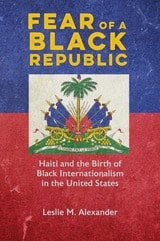
Fear of a Black Republic
Haiti and the Birth of Black Internationalism in the United StatesLeslie M. Alexander
University of Illinois Press, 2023
A bold exploration of Black internationalism’s origins, Fear of a Black Republic links the Haitian revolution to the global Black pursuit of liberation, justice, and social equality.

For the Sake of Black People and the Common Good
A Biography of Jean Price-MarsCelucien L. Joseph
Vanderbilt University Press, 2026
Jean Price-Mars (1876–1969) was a doctor, teacher, diplomat, and one of Haiti’s most visionary intellectuals. This biography offers the first comprehensive look at his writings, revealing a thinker dedicated to the transformation of Haiti, the advancement of his people, and the broader Black Diaspora.
From his rigorous education and intellectual formation to his engagement with social, political, and cultural issues, Price-Mars championed women’s empowerment, gender equality, and transformative leadership. He reinterpreted the Haitian Revolution and Dessalines’ legacy while articulating Pan-Africanist ideals that connected Haiti to the wider Black world.
A modernist scholar and pluralist, Price-Mars affirmed the validity of all religions while remaining independent of any single tradition. His humanistic spirituality and radical epistemology reimagined race, culture, and nation-building, offering a new vision for Haiti and the possibilities of Black achievement across the Americas.
This book presents a full portrait of Price-Mars as a thinker, reformer, and moral visionary, and a man whose lifelong mission was nothing less than the birth of a new people and the pursuit of the common good.

Forgotten Friendships
Yugoslavia and the Anticolonial Francophone WorldAlexandra Perišic
Amherst College Press, 2025
Forgotten Friendships: Yugoslavia and the Anticolonial Francophone World examines transnational friendships and alliances between intellectuals from Yugoslavia and the Francophone African and Caribbean world during the mid-twentieth century. The book argues that transnational political friendships helped shape major intellectual movements like Négritude, African socialism, and global socialist feminisms, which surged beyond national, regional, and even diasporic spaces. Blending archival research, literary analysis, and biography, the book fills a significant gap in our understanding of how intellectuals from the Global South and the socialist world collaborated on shared goals of decolonization, anti-racism, and socialist worldmaking.
Forgotten Friendships emphasizes the ways in which writers, intellectuals, and activists envisioned alternative futures rooted in collaboration across peripheries. Personal bonds of friendship were not mere footnotes to the anti-colonial struggle, but vital political tools for rethinking global solidarity.
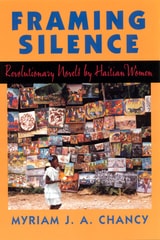
Framing Silence
Revolutionary Novels by Haitian WomenChancy, Myriam J
Rutgers University Press, 1992
Raped and colonized, coerced and silenced--this has been the position of Haitian women within their own society, as well as how they have been seen by foreign occupiers. Romanticized symbols of nationhood, they have served, however unwillingly, as a politicized site of contestation between opposing forces.
In this first book-length study in English devoted exclusively to Haitian women's literature, Myriam Chancy finds that Haitian women have their own history, traditions, and stories to tell, tales that they are unwilling to suppress or subordinate to narratives of national autonomy. Issues of race, class, color, caste, nationality, and sexuality are all central to their fiction--as is an urgent sense of the historical place of women between the two U.S. occupations of the country. Their novels interrogate women's social and political stance in Haiti from an explicitly female point of view, forcefully responding to overt sexual and political violence within the nation's ambivalent political climate. Through daring and sensitive readings, simultaneously historical, fictional and autobiographical, Chancy explores this literature, seeking to uncover answers to the current crisis facing these women today, both within their country and in exile.The writers surveyed include Anne-christine d'Adesky, Ghislaine Rey Charlier, Marie Chauvet, Jan J. Dominique, Nadine Magloire, and Edwidge Danticat, whose work has recently achieved such high acclaim.
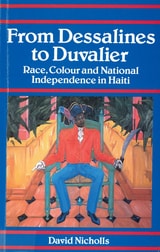
From Dessalines to Duvalier
Race, Colour and National Independence in HaitiNicholls, David
Rutgers University Press, 1996
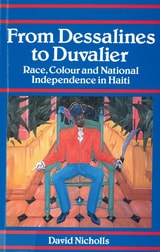
From Dessalines to Duvalier
Race, Colour and National Independence in HaitiNicholls, David
Rutgers University Press, 1996

From Spaniard to Creole
The Archaeology of Cultural Formation at Puerto Real, HaitiCharles Robin Ewen
University of Alabama Press, 1991
Tracing the archaeological origins of Creole identity in the early colonial Caribbean.
While most studies of intercultural contact focus on the impact of the intrusive power on the native culture, this book examines the effects of the colonization process on the Spaniards in the New World during the 16th century. The site of Puerto Real on the north coast of Haiti serves as a case study. Based on the results of excavations at both Puerto Real and St. Augustine, Florida, this study suggests that the introduction of New World and African cultural elements into Spanish colonial culture began almost at contact. The model of acculturative processes, developed in St. Augustine and tested at Puerto Real, can serve to guide future Spanish colonial research. It can also be applied to non-Hispanic colonial sites in the New World. Did the French and British adapt to their new environments in a manner similar to the Spanish? Work done at Puerto Real demonstrates the utility of archaeology in the study of the effects of culture contact.