Results by title
82 books match the query 'Hermeneutics' and 5 start with f
Folklore in New World Black Fiction
Writing and the Oral Traditional AestheticsChiji Akoma
The Ohio State University Press, 2007
For a while, tracing African roots in the artistic creations of blacks in the New World tended to generate much attention as if to suggest that the New World does not have profound impact on their creative spirit. In addition, few studies have tried to construct an interpretive model through which an array of works by New World writers could be meaningfully explored on the basis of their African Diasporic identity.
In Folklore in New World Black Fiction, Chiji Akọma offers an interpretive model for the reading of the African New World novel focusing on folklore, not as an ingredient, but as the basis for the narratives. The works examined do not contain folklore materials; they are folklore, constituted by the intersections of African oral narrative aesthetics, New World sensibility, and the written tradition. Specifically Akọma looks at four African Caribbean and African American novelists, Roy A.K. Heath, Wilson Harris, Toni Morrison, and Jean Toomer.
The book seeks to expand the understanding of the forms of folklore as it pertains to black texts. For one, it broadens the dimensions of folklore by looking beyond the oral world of the “simple folk” to the kinds of narrative sophistication associated with writing; it also asserts the importance of performance art in folklore analysis. The study demonstrates the durability of the black aesthetic over artistic forms.
[more]
Fragile Finitude
A Jewish Hermeneutical TheologyMichael Fishbane
University of Chicago Press, 2021
The world we engage with is a vibrant collage brought to consciousness by language and our creative imagination. It is through the symbolic forms of language that the human world of value is revealed—this is where religious scholar Michael Fishbane dwells in his latest contribution to Jewish thought.
In Fragile Finitude, Fishbane clears new ground for a theological life through a novel reinterpretation of the Book of Job. On this basis, he offers a contemporary engagement with the four classical types of Jewish Scriptural exegesis. The first focuses on worldly experience, the second on communal forms of practice and thought in the rabbinical tradition, the third on personal development, and the fourth on transcendent, cosmic orientations. Through these four modes, Fishbane manages to transform Jewish theology from within, at once reinvigorating a long tradition and moving beyond it. What he offers is nothing short of a way to reorient our lives in relation to the divine and our fellow humans. Written from within the Jewish tradition, Fragile Finitude is intended for readers across the religious spectrum.
In Fragile Finitude, Fishbane clears new ground for a theological life through a novel reinterpretation of the Book of Job. On this basis, he offers a contemporary engagement with the four classical types of Jewish Scriptural exegesis. The first focuses on worldly experience, the second on communal forms of practice and thought in the rabbinical tradition, the third on personal development, and the fourth on transcendent, cosmic orientations. Through these four modes, Fishbane manages to transform Jewish theology from within, at once reinvigorating a long tradition and moving beyond it. What he offers is nothing short of a way to reorient our lives in relation to the divine and our fellow humans. Written from within the Jewish tradition, Fragile Finitude is intended for readers across the religious spectrum.
[more]
Fragments
The Existential Situation of Our Time: Selected Essays, Volume 1David Tracy
University of Chicago Press, 2020
Two volumes of selected essays from the most important Catholic theologian in North America.
David Tracy is widely considered one of the most important religious thinkers in North America, known for his pluralistic vision and disciplinary breadth. His first books in more than twenty years, Fragments and Filaments reflect Tracy’s range and erudition, collecting essays from the 1980s to 2018 into a two-volume work.
In the first volume, Fragments, Tracy gathers his most important essays on broad theological questions, beginning with the problem of suffering across Greek tragedy, Christianity, and Buddhism. The volume goes on to address the Infinite, and the many attempts to categorize and name it by Plato, Aristotle, Rilke, Heidegger, and others. In the remaining essays, he reflects on questions of the invisible, contemplation, hermeneutics, and public theology. Throughout, Tracy evokes the potential of fragments (understood both as concepts and events) to shatter closed systems and open us to difference and Infinity. Covering science, literature, philosophy, psychoanalysis, and non-Western religious traditions, Tracy provides in Fragments a guide for any open reader to rethink our fragmenting contemporary culture.
In the first volume, Fragments, Tracy gathers his most important essays on broad theological questions, beginning with the problem of suffering across Greek tragedy, Christianity, and Buddhism. The volume goes on to address the Infinite, and the many attempts to categorize and name it by Plato, Aristotle, Rilke, Heidegger, and others. In the remaining essays, he reflects on questions of the invisible, contemplation, hermeneutics, and public theology. Throughout, Tracy evokes the potential of fragments (understood both as concepts and events) to shatter closed systems and open us to difference and Infinity. Covering science, literature, philosophy, psychoanalysis, and non-Western religious traditions, Tracy provides in Fragments a guide for any open reader to rethink our fragmenting contemporary culture.
[more]
From Text to Action
Essays in Hermeneutics, IIPaul Ricoeur
Northwestern University Press, 1991
With his writings on phenomenology, psychoanalysis, Marxism, ideology, and religion, Paul Ricoeur has single-handedly redefined and revitalized the hermeneutic tradition. From Text to Action is an essential companion to the now classic The Conflict of Interpretations. Here, Ricoeur continues and extends his project of constructing a general theory of interpretation, positioning his work in relation to its own philosophical background: Hegel, Husserl, Gadamer, and Weber. He also responds to contemporary figures like K.O. Apel and Jürgen Habermas, connecting his own theorization of ideology to their version of ideology critique.
[more]
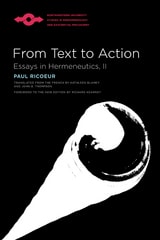
From Text to Action
Essays in Hermeneutics, IIPaul Ricoeur, Translated from the French by Kathleen Blamey and John B. Thompson, Foreword to the new edition by Richard Kearney
Northwestern University Press, 2007
Incredible originality of thought in areas as vast as phenomenology, religion, hermeneutics, psychoanalysis, intersubjectivity, language, Marxism, and structuralism has made Paul Ricoeur one of the philosophical giants of the twentieth century. The way in which Ricoeur approaches these themes makes his works relevant to the reader today: he writes with honesty and depth of insight into the core of a problem, and his ability to mark for future thought the very path of philosophical inquiry is nearly unmatched.
From Text to Action is an essential companion to the classic The Conflict of Interpretations. Here, Ricoeur continues and extends his project of constructing a general theory of interpretation, positioning his work in relation to its philosophical background: Hegel, Husserl, Gadamer, and Weber. He also responds to contemporary figures like K. O. Apel and Jürgen Habermas, connecting his own theorization of ideology to their critique of ideology.
This new edition includes a foreword by Richard Kearney. It and other new editions of Ricoeur's texts published by Northwestern University Press have joined the canon of contemporary continental philosophy and continue to contribute to emergent discussions in the twenty-first century.
[more]