Results by title
86 books match the query 'Home' and 7 start with f
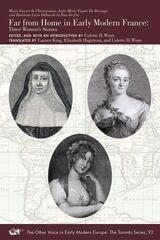
Far from Home in Early Modern France
Three Women’s StoriesMarie Guyart de l’Incarnation, Anne-Marie Fiquet du Boccage, and Henriette-Lucie Dillon de la Tour du Pin
Iter Press, 2022
This book showcases three Frenchwomen who ventured far from home at a time when such traveling was rare. In 1639, Marie de l’Incarnation embarked for New France where she founded the first Ursuline monastery in present-day Canada. In 1750, Madame du Boccage set out at the age of forty on her first “grand tour.” She visited England, the Netherlands, and Italy where she experienced firsthand the intellectual liberty offered there to educated women. As the Reign of Terror gripped France, the Marquise de la Tour du Pin fled to America with her husband and their two young children, where they ran a farm from 1794 to 1796. The writings these women left behind detailing their respective journeys abroad represent significant contributions to early modern travel literature. This book makes available to anglophone readers three texts that are rich in both historical and literary terms.
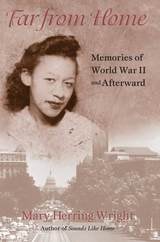
Far from Home
Memories of World War II and AfterwardMary Herring Wright
Gallaudet University Press, 2005
“She’s got no more business there than a pig has with a Bible.” That’s what her father said when Mary Herring announced that she would be moving to Washington, DC, in late 1942. Recently graduated from the North Carolina School for Black Deaf and Blind Students, Mary had been invited to the nation’s capital by a cousin to see a specialist about her hearing loss. Though nothing could be done about her deafness, Mary quickly proved her father wrong by passing the civil service examination with high marks. Far from Home: Memories of World War II and Afterward, the second installment of her autobiography, describes her life from her move to Washington to the present.
Mary soon became a valued employee for the Navy, maintaining rosters for the many servicemen in war theaters worldwide. Her remarkable gift for detail depicts Washington in meticulous layers, a sleepy Southern town force-grown into a dynamic geopolitical hub. Life as a young woman amid the capital’s Black middle class could be warm and fun, filled with visits from family and friends, and trips home to Iron Mine for tearful, joyous reunions. But the reality of the times was never far off. On many an idyllic afternoon, she and her friends found somber peace in Arlington Cemetery, next to the grave of the sole Unknown Soldier at that time. During an evening spent at the U.S.O., one hearing woman asked how people like her could dance, and Mary answered, “With our feet.” She became a pen pal to several young servicemen, but did not want to know why some of them suddenly stopped writing.
Despite the close friends and good job that she had in Washington, the emotional toll caused Mary to return to her family home in Iron Mine, NC. There, she rejoined her family and resumed her country life. She married and raised four daughters, and recounts the joys and sorrows she experienced through the years, particularly the loss of her parents. Her blend of the gradual transformation of Southern rural life with momentous events such as Hurricane Hazel creates an extraordinary narrative history. The constant in Far from Home remains the steady confidence that Mary Herring Wright has in herself, making her new memoir a perfect companion to her first.

Finish Forty and Home
The Untold World War II Story of B-24s in the PacificPhil Scearce
University of North Texas Press, 2011
For a Liberatory Politics of Home
Michele Lancione
Duke University Press, 2023
For the Sake of the Children
The Social Organization of Responsibility in the Hospital and the HomeCarol A. Heimer and Lisa R. Staffen
University of Chicago Press, 1998
Rather than treating responsibility as an ethical issue, the authors focus on how responsibility is socially produced and sustained. The authors ask: How do staff members encourage parents to take responsibility, but keep them from interfering in medical matters, and how do parents encourage staff vigilance when they are novices attempting to supervise the experts?
The authors conclude that it is not sufficient simply to be responsible individuals. Instead, we must learn how to be responsible in an organizational world, and organizations must learn how to support responsible individuals.
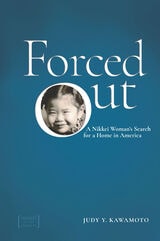
Forced Out
A Nikkei Woman's Search for a Home in AmericaJudy Y. Kawamoto
University Press of Colorado, 2020
Forced Out: A Nikkei Woman’s Search for a Home in America offers insight into “voluntary evacuation,” a little-known Japanese American experience during World War II, and the lasting effects of cultural trauma. Of the roughly 120,000 people forced from their homes by Executive Order 9066, around 5,000 were able to escape incarceration beforehand by fleeing inland. In a series of beautifully written essays, Judy Kawamoto recounts her family’s flight from their home in Washington to Wyoming, their later moves to Montana and Colorado, and the influence of those experiences on the rest of her life. Hers is a story shared by the many families who lost everything and had to start over in often suspicious and hostile environments.
Kawamoto vividly illustrates the details of her family’s daily life, the discrimination and financial hardship they experienced, and the isolation that came from experiencing the horrors of the 1940s very differently than many other Japanese Americans. Chapters address her personal and often unconscious reactions to her parents’ trauma, as well as her own subsequent travels around much of the world, exploring, learning, enjoying, but also unconsciously acting out a continual search for a home.
Showing how the impacts of traumatic events are collective and generational, Kawamoto draws
interconnections between her family’s displacement and later aspects of her life and juxtaposes the impact of her early experiences and questions of identity, culture, and assimilation. Forced Out will be of great interest to the general reader as well as students and scholars of ethnic studies, Asian American studies, history, education, and mental health.
2022 Asian/Pacific American Award for Literature, Honor Title, Adult Non-Fiction Literature
2022 Evans Handcart Award Winner
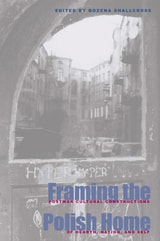
Framing the Polish Home
Postwar Cultural Constructions of Hearth, Nation, and SelfBozena Shallcross
Ohio University Press, 2002
As the subject of ideological, aesthetic, and existential manipulations, the Polish home and its representation is an ever-changing phenomenon that absorbs new tendencies and, at the same time, retains its centrality to Polish literature, whether written in Poland or abroad. Framing the Polish Home is a pioneering work that explores the idea of home as fundamental to the question of cultural and national identity within Poland's recent history and its tradition.
In this inaugural volume of the Polish and Polish-American Studies Series, the Polish home emerges in its rich verbal and visual representations and multiple material embodiments, as the discussion moves from the loss of the home during wartime to the Sovietized politics of housing and from the exilic strategies of having a home to the the idyllic evocation of the abodes of the past.
Although, as Bożena Shallcross notes in her introduction, “few concepts seem to have such universal appeal as the notion of the home,” this area of study is still seriously underdeveloped. In essays from sixteen scholars, Framing the Polish Home takes a significant step to correct that oversight, covering a broad range of issues pertinent to the discourse on the home and demonstrating the complexity of the home in Polish literature and culture.