Results by title
155 books match the query 'Indians of South America' and 6 start with f
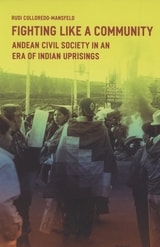
Fighting Like a Community
Andean Civil Society in an Era of Indian UprisingsRudi Colloredo-Mansfeld
University of Chicago Press, 2009
The indigenous population of the Ecuadorian Andes made substantial political gains during the 1990s in the wake of a dynamic wave of local activism. The movement renegotiated land development laws, elected indigenous candidates to national office, and successfully fought for the constitutional redefinition of Ecuador as a nation of many cultures. Fighting Like a Community argues that these remarkable achievements paradoxically grew out of the deep differences—in language, class, education, and location—that began to divide native society in the 1960s.
Drawing on fifteen years of fieldwork, Rudi Colloredo-Mansfeld explores these differences and the conflicts they engendered in a variety of communities. From protestors confronting the military during a national strike to a migrant family fighting to get a relative released from prison, Colloredo-Mansfeld recounts dramatic events and private struggles alike to demonstrate how indigenous power in Ecuador is energized by disagreements over values and priorities, eloquently contending that the plurality of Andean communities, not their unity, has been the key to their political success.
Foodways of the Ancient Andes
Transforming Diet, Cuisine, and SocietyMarta P Alfonso-Durruty
University of Arizona Press, 2023
Exploring the multiple social, ecological, cultural, and ontological dimensions of food in the Andean past, the contributors of Foodways of the Ancient Andes offer diverse theoretical perspectives and methodological approaches that reveal the richness, sophistication, and ingenuity of Andean peoples. The volume spans time periods and localities in the Andean region to reveal how food is intertwined with multiple aspects of the human experience, from production and consumption to ideology and sociopolitical organization. It illustrates the Andean peoples’ resilience in the face of challenges brought about by food scarcity and environmental change. Chapters dissect the intersection of food, power, and status in early states and empires; examine the impact of food during times of conflict and instability; and illuminate how sacred and high-status foods contributed to the building of the Inka Empire.
Featuring forty-six contributors from ten countries, the chapters employ new analytical methods, integrating different food data and interdisciplinary research to show that food can provide not only simple nutrition but also a multitude of strategies, social and political relationships, and ontologies that are otherwise invisible in the archaeological record.
Contributors
Aleksa K. Alaica
Sonia Alconini
Marta Alfonso-Durruty
Sarah I. Baitzel
Véronique Bélisle
Carolina Belmar
Carrie Anne Berryman
Matthew E. Biwer
Deborah E. Blom
Tamara L. Bray
Matthew T. Brown
Maria C. Bruno
José M. Capriles
Katherine L. Chiou
Susan D. deFrance
Lucia M. Diaz
Richard P. Evershed
Maureen E. Folk
Alexandra Greenwald
Chris Harrod
Christine A. Hastorf
Iain Kendall
Kelly J. Knudson
BrieAnna S. Langlie
Cecilia Lemp
Petrus le Roux
Marcos Martinez
Anahí Maturana-Fernández
Weston C. McCool
Melanie J. Miller
Nicole Misarti
Flavia Morello
Patricia Quiñonez Cuzcano
Omar Reyes
Arturo F. Rivera Infante
Manuel San Román
Francisca Santana-Sagredo
Beth K. Scaffidi
Augusto Tessone
Andrés Troncoso
Tiffiny A. Tung
Mauricio Uribe
Natasha P. Vang
Sadie L. Weber
Kurt M. Wilson
Michelle E. Young
Forgotten Conquests
Rereading New World History from the MarginsGustavo Verdesio
Temple University Press, 2001
Verdesio read the key texts relating to the struggles for possession of River Plate's northern shore -- present-day Uruguay. He probes them for traces of conflicts in meaning and the agency of Amerindians, gauchos, Africans, and women -- the subjected peoples that the texts try to silence. The narrators, speaking for their culture, assume the role of knowing subject, repressing all other voices, epistemologies, and acts of resistance. Verdesio's tasks are to listen for those that the Europeans represented as an unintelligible Other, to draw them into the foreground, and to decolonize their histories.
By unpacking these texts, Verdesio shows that from the European point of view, the colonial encounter draws the New World into historical time and ushers in a new concept of knowledge. For the first time, the historian's role is to discover, to interpret eyewitness testimonies and first-hand experience, to write 'a new history of admirable things.' Even in this reconstruction of historical truth, Old World ideology drives the narratives, whose chief purpose is to justify conquest. Forgotten Conquests lays bare the discursive strategies that generated the founding texts of Latin American history and engulfed its subjected peoples in silence for 500 years.
From Enron to Evo
Pipeline Politics, Global Environmentalism, and Indigenous Rights in BoliviaDerrick Hindery; Foreword by Susanna B. Hecht
University of Arizona Press, 2013
Drawing upon extensive interviews and document analysis, Hindery argues that many of the structural conditions created by neoliberal policies—including partial privatization of the oil and gas sector—still persist under Morales. Tactics employed by both Morales and his neoliberal predecessors utilize the rhetoric of environmental protection and Indigenous rights to justify oil, gas, mining, and road development in Indigenous territories and sensitive ecoregions.
Indigenous peoples, while mindful of gains made during Morales’s tenure, are increasingly dissatisfied with the administration’s development model, particularly when it infringes upon their right to self-determination. From Enron to Evo demonstrates their dynamic and pragmatic strategies to cope with development and adversity, while also advancing their own aims.
Offering a critique of both free-market piracy and the dilemmas of resource nationalism, this is a groundbreaking book for scholars, policy-makers, and advocates concerned with Indigenous politics, social movements, environmental justice, and resistance in an era of expanding resource development.

From Two Republics to One Divided
Contradictions of Postcolonial Nationmaking in Andean PeruMark Thurner
Duke University Press, 2001
Working within an innovative and panoramic historical and linguistic framework, Thurner examines the paradoxes of a resurgent Andean peasant republicanism during the mid-1800s and provides a critical revision of the meaning of republican Peru’s bloodiest peasant insurgency, the Atusparia Uprising of 1885. Displacing ahistorical and nationalist readings of Inka or Andean continuity, and undermining the long-held notion that the colonial legacy is the dominant historical force shaping contemporary Andean reality, Thurner suggests that in Peru, the postcolonial legacy of Latin America’s nation-founding nineteenth century transfigured, and ultimately reinvented, the colonial legacy in its own image.
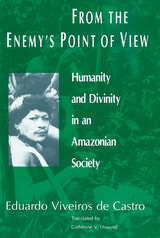
From the Enemy's Point of View
Humanity and Divinity in an Amazonian SocietyEduardo Viveiros de Castro
University of Chicago Press, 1992
Building upon ethnographic description and interpretation, Viveiros de Castro addresses the central aspect of the Arawete's concept of divinity—consumption—showing how its cannibalistic expression differs radically from traditional representations of other Amazonian societies. He situates the Araweté in contemporary anthropology as a people whose vision of the world is complex, tragic, and dynamic, and whose society commands our attention for its extraordinary openness to exteriority and transformation. For the Araweté the person is always in transition, an outlook expressed in the mythology of their gods, whose cannibalistic ways they imitate. From the Enemy's Point of View argues that current concepts of society as a discrete, bounded entity which maintains a difference between "interior" and "exterior" are wholly inappropriate in this and in many other Amazonian societies.