Results by title
468 books match the query 'Industries' and 20 start with f
Failure by Design
The California Energy Crisis and the Limits of Market PlanningGeorg Rilinger
University of Chicago Press, 2024
The Western energy crisis was one of the great financial disasters of the past century. The crisis began in April 2000, when price spikes started to rattle California’s electricity markets. Decades later, some blame economic fundamentals and ignorant politicians, while others accuse the energy sellers who raided the markets. In Failure by Design, sociologist Georg Rilinger offers a different explanation, one that focuses on the practical challenges of market design. The unique physical attributes of electricity made it exceedingly difficult to introduce markets into the coordination of the electricity system, so market designers were brought in to construct the infrastructures that coordinate how market participants interact. An exercise in social engineering, these infrastructures were intended to guide market actors toward behavior that would produce optimal market results and facilitate grid management. Yet, though these experts spent their days worrying about incentive misalignment and market manipulation, they unintentionally created a system riddled with opportunities for destructive behavior. Rilinger’s analysis not only illuminates the California energy crisis but also develops a broader theoretical framework for thinking about markets as the products of organizational planning and the limits of social engineering, contributing broadly to sociological and economic thinking about the nature of markets.
Failure by Design
The California Energy Crisis and the Limits of Market PlanningGeorg Rilinger
University of Chicago Press, 2024
A new framework for studying markets as the product of organizational planning and understanding the practical limits of market design.
The Western energy crisis was one of the great financial disasters of the past century. The crisis began in April 2000, when price spikes started to rattle California’s electricity markets. Decades later, some blame economic fundamentals and ignorant politicians, while others accuse the energy sellers who raided the markets. In Failure by Design, sociologist Georg Rilinger offers a different explanation, one that focuses on the practical challenges of market design. The unique physical attributes of electricity made it exceedingly difficult to introduce markets into the coordination of the electricity system, so market designers were brought in to construct the infrastructures that coordinate how market participants interact. An exercise in social engineering, these infrastructures were intended to guide market actors toward behavior that would produce optimal market results and facilitate grid management. Yet, though these experts spent their days worrying about incentive misalignment and market manipulation, they unintentionally created a system riddled with opportunities for destructive behavior. Rilinger’s analysis not only illuminates the California energy crisis but also develops a broader theoretical framework for thinking about markets as the products of organizational planning and the limits of social engineering, contributing broadly to sociological and economic thinking about the nature of markets.

Farm Prices
Myth and RealityWillard W. Cochrane
University of Minnesota Press, 1958
Farm Prices was first published in 1958. Minnesota Archive Editions uses digital technology to make long-unavailable books once again accessible, and are published unaltered from the original University of Minnesota Press editions.
Few domestic questions are so controversial as the farm problem, yet the average city man finds it difficult to understand the basic issues involved. In this book Professor Cochrane describes for the layman the nature and causes of the commercial farm problem and the rural poverty problem and provides the basis for making informed judgments about these problems and their possible solutions. He analyzes the economic and political forces which are at work in the farm economy, explains the organization of modern agriculture, showing the unique structure of farming, and draws a vivid picture of the revolutionary developments which have taken place in agriculture. He discusses behavior patterns of farmers and consumers as they relate to the farm economy, and the role of government in the farm industry and in the lives of farmers.
Farm prices are constantly fluctuating, and out of this price variability emerge such serious and continuing farm problems as variable incomes, low incomes over extended periods, and uncertainty in production planning. In this study Professor Cochrane seeks to get at the root of the trouble by, first, exploring and exposing what he considers a basic fallacy in our present day thinking and approach to the farm problem. This is the widely held myth of an automatically adjusting agriculture, an agriculture that is always out of balance because of an "emergency." This myth, he points out, beclouds the issues involved in the whole farm problem.
The farm price myth splits two ways in the public mind, Mr. Cochrane explains, but these divergent attitudes represent differences only in mechanics, not in principle, and they are equally effective in obscuring the real picture. One segment of the public believes that agriculture, if left alone for a while, would gravitate toward and stabilize at some desirable level and pattern of prices, production, and incomes. The other segment believes that the same result would occur if agriculture were given a temporary, helping hand by the government. Mr. Cochrane shows the fallacies inherent in both of these convictions by presenting an integrated, overall picture of farm price behavior as it really exists. On a basis of this realistic view, he presents the two alternatives or hard policy choices that he believes the American farmer faces today.
Willard W. Cochrane is Professor Emeritus of Agricultural and Applied Economics at the University of Minnesota. He is the author of a number of books, including The City Man's Guide to the Farm Problem and Farm Prices: Myth and Reality. He previously served as an economist with the Food and Agriculture Organization of the United Nations and with the U.S. Department of Agriculture. He is the co-author of Economics of American Agriculture and Economics of Consumption.

Farmers' Markets of the Heartland
Janine MacLachlan
University of Illinois Press, 2012
A visual feast of the Midwest's homegrown bounty
In this splendidly illustrated book, food writer and self-described farm groupie Janine MacLachlan embarks on a tour of seasonal markets and farmstands throughout the Midwest, sampling local flavors from Michigan, Ohio, Indiana, Illinois, Missouri, Iowa, Minnesota, and Wisconsin. She conducts delicious research as she meets farmers, tastes their food, and explores how their businesses thrive in the face of an industrial food supply. She tells the stories of a pair of farmers growing specialty crops on a few acres of northern Michigan for just a few months out of the year, an Ohio cattle farm that has raised heritage beef since 1820, and a Minnesota farmer who tirelessly champions the Jimmy Nardello sweet Italian frying pepper. Along the way, she savors vibrant red carrots, slurpy peaches, vast quantities of specialty cheeses, and some of the tastiest pie to cross anyone's lips.
Informed by debates about eating local, seasonal crops, organic farming, sanitation, and biodiversity, Farmers' Markets of the Heartland tantalizes with special recipes from farm-friendly chefs and dozens of luscious color photographs that will inspire you to harvest the homegrown flavors in your own neighborhood.

Fashion Knowledge
Theories, Methods, Practices and PoliticsEdited by Elke Gaugele and Monica Titton
Intellect Books, 2024
At a point when fashion studies are expanding and the fashion industry is at a crucial point of change, Fashion Knowledge makes a valuable contribution to the field. The book explores current issues in fashion research, with a focus on the relationship between theory and practice. This edited collection assembles academic essays and intellectual activism next to visual essays and artistic interventions, proposing a different concept for fashion research that eschews the traditional logic of academic fashion studies. It features acclaimed designers, artists, curators, and theorists whose work investigates the multi-faceted debates on the rise of practice-based research in fashion. Contributors look at new forms of fashion knowledge that are forming along with shifting practices, shedding light on the entanglement of fashion and politics in both contemporary and historical moments.

Fashion Media and Sustainability
Encouraging Ethical Consumption via Journalism and InfluencersAnastasia Denisova
University of Westminster Press, 2021
Fashion is among the biggest polluters, yet the media still promote throwaway fast fashion. The growing fashion public relations industry encourages and enables this media coverage. This policy brief identifies patterns in the way journalists and influencers cover fashion which contribute to unsustainable buying behaviours.
Recent research recommends practical steps to improve media coverage to make consumption sustainable, by changing consumers’ understanding and reducing the pressure on them to buy ‘fast’ satisfaction. Policy recommendations here suggested are based on original analysis of 1,000+ media artefacts in the UK – from magazines to newspapers, gossip weeklies to Instagram influencers.
Researcher Anastasia Denisova proposes regulation of vocabulary and of affiliated links in journalism and social media, greater discussion of the psychology of buying and a ‘paid advertisement label’. Also recommended is a more proactive approach to be taken by magazines and other media with the aim of promoting restyling advice and more sustainable coverage for readers of differing financial means.

Festivals and the City
The Contested Geographies of Urban EventsAndrew Smith, Guy Osborn, Bernadette Quinn, Andrew Smith, Guy Osborn and Bernadette Quinn
University of Westminster Press, 2022
This book explores how festivals and events affect urban places and public spaces, with a particular focus on their role in fostering inclusion. The ‘festivalisation’ of culture, politics and space in cities is often regarded as problematic, but this book examines the positive and negative ways that festivals affect cities by examining festive spaces as contested spaces. The book focuses on Western European cities, a particularly interesting context given the social and cultural pressures associated with high levels of in-migration and concerns over the commercialisation and privatisation of public spaces.
The key themes of this book are the quest for more inclusive urban spaces and the contested geographies of festival spaces and places. Festivals are often used by municipal authorities to break down symbolic barriers that restrict who uses public spaces and what those spaces are used for. However, the rise of commercial festivals and ticketed events means that they are also responsible for imposing physical and financial obstacles that reduce the accessibility of city parks, streets and squares.
Alongside addressing the contested effects of urban festivals on the character and inclusivity of public spaces, the book addresses more general themes including the role of festivals in culture-led regeneration. Several chapters analyse festivals and events as economic development tools, and the book also covers contested representations of festival cities and the ways related images and stories are used in place marketing.
A range of cases from Western Europe are used to explore these issues, including chapters on some of the world’s most significant and contested festival cities: Venice, Edinburgh, London and Barcelona. The book covers a wide range of festivals, including those dedicated to music and the arts, but also events celebrating particular histories, identities and pastimes. A series of fascinating cases are discussed - from the Venice Biennale and Dublin Festival of History, to Rotterdam’s music festivals and craft beer festivals in Manchester. The diverse and innovative qualities of the book are also evident in the range of urban spaces covered: obvious examples of public spaces – such as parks, streets, squares and piazzas – are addressed, but the book includes chapters on enclosed public spaces (e.g., libraries) and urban blue spaces (waterways) too. This reflects the interpretation of public spaces as socio-material entities: they are produced informally through their use (including for festivals and events), as well as through their formal design and management.

Fiery Dragons
Banks, Moneylenders and Microfinance in BurmaSean Turnell
National University of Singapore Press, 2009

Financing Sport
Fourth EditionDennis R. Howard
FiT Publishing, 2018
The most authoritative and comprehensive textbook on sport finance has been updated and revised to include in its examination the distinct changes in the economic climate of the sport industry in recent decades, as well as the impacts and challenges the contemporary economic climate presents for the sport industry.
Divided into five sections – finance trends and challenges, economic rationale for public investment, primary sources of funding, revenue from enterprise sources, and fundraising – Financing Sport, 4th Edition also contains a thorough updated examination of venue and sport property revenues, including ticket and merchandise sales, the rise of luxurious and extravagant fan experiences, as well as commercial media rights that stretch across traditional broadcast, satellite, and innovative new web-based outlets for consuming sport content. Also newly updated and expanded are fundraising areas that discuss traditional and emerging trends in sport sponsorship and donation.
Thorough in both its depth and scope, Financing Sport, 4th Edition is an engaging, edifying textbook for sport-related graduate and undergraduate students, teachers, and industry professionals.
Fishing Lessons
Artisanal Fisheries and the Future of Our OceansKevin M. Bailey
University of Chicago Press, 2018
Bailey knows these waters, the artisanal fisheries, and their relationship with larger ocean ecology intimately. In a series of place-based portraits, he shares stories of decline and success as told by those at the ends of the long lines and hand lines, channeling us through the changing dynamics of small-scale fisheries and the sustainability issues they face—both fiscal and ecological. We encounter Paolo Vespoli and his tiny boat, the Giovanni Padre,in the Gulf of Naples; Wenche, a sea Sámi, one of the indigenous fisherwomen of Norway; and many more. From salmon to abalone, the Bay of Fundy to Monterey and the Amazon, Bailey’s catch is no fish tale. It is a global story, casting a net across waters as vast and distinct as Puget Sound and the Chilean coast. Sailing across the world, Bailey explores the fast-shifting current of how we gather food from the sea, what we gain and what we lose with these shifts, and potential solutions for the murky passage ahead.
Food for the Few
Neoliberal Globalism and Biotechnology in Latin AmericaEdited by Gerardo Otero
University of Texas Press, 2008
Recent decades have seen tremendous changes in Latin America's agricultural sector, resulting from a broad program of liberalization instigated under pressure from the United States, the IMF, and the World Bank. Tariffs have been lifted, agricultural markets have been opened and privatized, land reform policies have been restricted or eliminated, and the perspective has shifted radically toward exportation rather than toward the goal of feeding local citizens. Examining the impact of these transformations, the contributors to Food for the Few: Neoliberal Globalism and Biotechnology in Latin America paint a somber portrait, describing local peasant farmers who have been made responsible for protecting impossibly vast areas of biodiversity, or are forced to specialize in one genetically modified crop, or who become low-wage workers within a capitalized farm complex. Using dozens of examples such as these, the deleterious consequences are surveyed from the perspectives of experts in diverse fields, including anthropology, economics, geography, political science, and sociology.
From Kathy McAfee's "Exporting Crop Biotechnology: The Myth of Molecular Miracles," to Liz Fitting's "Importing Corn, Exporting Labor: The Neoliberal Corn Regime, GMOs, and the Erosion of Mexican Biodiversity," Food for the Few balances disturbing findings with hopeful assessments of emerging grassroots alternatives. Surveying not only the Latin American conditions that led to bankruptcy for countless farmers but also the North's practices, such as the heavy subsidies implemented to protect North American farmers, these essays represent a comprehensive, keenly informed response to a pivotal global crisis.

Forming the Public
A Critical History of Journalism in the United StatesFrank D. Durham and Thomas P. Oates
University of Illinois Press, 2024
Weaving eyewitness history through US history, Forming the Public reveals what understanding the journalism landscape can teach us about the nature of journalism’s own interests in race, gender, and class while tracing the factors that shaped the contours of dominant American culture.

Fragrant Frontier
Global Spice Entanglements from the Sino-Vietnamese UplandsEdited by Sarah Turner, Annuska Derks, and Jean-François Rousseau
National University of Singapore Press, 2022

Franchising Dreams
The Lure of Entrepreneurship in AmericaPeter M. Birkeland
University of Chicago Press, 2002
Peter M. Birkeland worked for three years in the front-line operations of franchise units for three companies, met with CEOs and executives, and attended countless trade shows, seminars, and expositions. All this firsthand experience gave him unprecedented access to the hopes and aspirations of franchisees. His book closely traces different franchisees and follows them as their dreams of wealth and independence buckle beneath the weight of frustrating logistics and contractual technicalities. Through extensive interviews and research, Birkeland not only discovers what makes franchisees succeed or fail, he uncovers the difficulties in running a business according to someone else's system and values. Bearing witness to a market flooded with fierce competitors and dependent on the inscrutable whims of consumers, he uncovers the numerous challenges that franchisees face in making their businesses succeed.
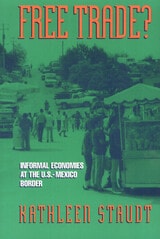
Free Trade
Informal Economies at the U.S.-Mexico BorderKathleen Staudt
Temple University Press, 1998
Residents counter national and international influences to build shelter and incomes, albeit meager. But the political machinery of both the U.S. and Mexico constrains the ability of these quintessential free traders to build political communities and organize around self-sufficient work and housing in visible ways.
Experiences at the border, along the central gateway for capital, job, and labor movement, offer insights to readers as the globalized economy spreads and engulfs the heartlands of both the U.S. and Mexico. People’s everyday victories in countering petty regulations can counter or feed the grand global hegemonies.

Freedom for Publishing, Publishing for Freedom
Timothy Garton Ash
Central European University Press, 1995

Friday Night Fighter
Gaspar "Indio" Ortega and the Golden Age of Television BoxingTroy Rondinone
University of Illinois Press, 2013
Friday Night Fighter relives a lost moment in American postwar history, when boxing ruled as one of the nation's most widely televised sports. During the 1950s and 1960s, viewers tuned in weekly, sometimes even daily, to watch widely recognized fighters engage in primordial battle; the Gillette Cavalcade of Sports Friday Night Fights was the most popular fight show. Troy Rondinone follows the dual narratives of the Friday Night Fights show and the individual story of Gaspar "Indio" Ortega, a boxer who appeared on prime-time network television more than almost any other boxer in history. From humble beginnings growing up poor in Tijuana, Mexico, Ortega personified the phenomenon of postwar boxing at its greatest, appearing before audiences of millions to battle the biggest names of the time, such as Carmen Basilio, Tony DeMarco, Chico Vejar, Benny "Kid" Paret, Emile Griffith, Kid Gavilan, Florentino Fernández, and Luis Manuel Rodriguez.
Rondinone explores the factors contributing to the success of televised boxing, including the rise of television entertainment, the role of a "reality" blood sport, Cold War masculinity, changing attitudes toward race in America, and the influence of organized crime. At times evoking the drama and spectacle of the Friday Night Fights themselves, this volume is a lively examination of a time in history when Americans crowded around their sets to watch the main event.

From Betty Crocker to Feminist Food Studies
Critical Perspectives on Women and FoodArlene Voski Avakian
University of Massachusetts Press, 2005
Applying the insights of feminist scholarship to the study of food, the thirteen essays in this volume are arranged under four headings—the marketplace, histories, representations, and resistances. The editors open the book with a substantial introduction that traces the history of scholarly writing on food and maps the terrain of feminist food studies. In the essays that follow, contributors pay particular attention to the ways in which gender, race, ethnicity, class, colonialism, and capitalism have both shaped and been shaped by the production and consumption of food.
In the first section, four essays analyze the influence of large corporations in determining what came to be accepted as proper meals in the United States, including what mothers were expected to feed their babies. The essays in the second section explore how women have held families together by keeping them nourished, from the routines of an early nineteenth-century New Englander to the plight of women who endured the siege of Leningrad.
The essays in the third section focus on the centrality of gender and race in the formation of identities as enacted through food discourse and practices. These case studies range from the Caribbean to the San Luis Valley of Colorado. The final section documents acts of female resistance within the contexts of national or ethnic oppression. From women in colonial India to Armenian American feminists, these essays show how food has served as a means to assert independence and personal identity.
In addition to the editors, contributors include Amy Bentley, Carole M. Counihan, Darra Goldstein, Nancy Jenkins, Alice P. Julier, Leslie Land, Laura Lindenfield, Beheroze F. Shroff, Sharmila Sen, Laura Shapiro, and Jan Whitaker.

From Printing to Streaming
Cultural Production under CapitalismMichael Chanan
Pluto Press, 2022
A radical and comprehensive analysis of the commodification of artistic creation and the struggle to realize its potential in the digital age.
For mainstream economics, cultural production raises no special questions: creative expression is to be harvested for wealth creation like any other form of labor. As Karl Marx saw it, however, capital is hostile to the arts because it cannot fully control the process of creativity. But while he saw the arts as marginal to capital accumulation, that was before the birth of the mass media.
Engaging with the major issues in Marxist theory around art and capitalism, From Printing to Streaming traces how the logic of cultural capitalism evolved from the print age to digital times, tracking the development of printing, photography, sound recording, newsprint, advertising, film, and broadcasting, exploring the peculiarities of each as commodities, and their recent transformation by digital technology, where everything melts into computer code. Chanan demonstrates how these developments have had profound implications for both cultural creation and consumption.

Futures after Progress
Hope and Doubt in Late Industrial BaltimoreChloe Ahmann
University of Chicago Press, 2024
Factory fires, chemical explosions, and aerial pollutants have inexorably shaped South Baltimore into one of the most polluted places in the country. In Futures after Progress, anthropologist Chloe Ahmann explores the rise and fall of industrial lifeways on this edge of the city and the uncertainties that linger in their wake. Writing from the community of Curtis Bay, where two hundred years of technocratic hubris have carried lethal costs, Ahmann also follows local efforts to realize a good future after industry and the rifts competing visions opened between neighbors.
Examining tensions between White and Black residents, environmental activists and industrial enthusiasts, local elders and younger generations, Ahmann shows how this community has become a battleground for competing political futures whose stakes reverberate beyond its six square miles in a present after progress has lost steam. And yet—as one young resident explains—“that’s not how the story ends.” Rigorous and moving, Futures after Progress probes the deep roots of our ecological predicament, offering insight into what lies ahead for a country beset by dreams deferred and a planet on the precipice of change.