Results by title
748 books match the query 'Influence' and 20 start with f
FEMINIST REALISM AT THE FIN DE SIÈCLE
The Influence of the Late-Victorian Woman’s Press on the Development of the NovelMolly Youngkin
The Ohio State University Press, 2007
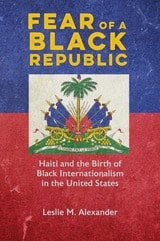
Fear of a Black Republic
Haiti and the Birth of Black Internationalism in the United StatesLeslie M. Alexander
University of Illinois Press, 2023
A bold exploration of Black internationalism’s origins, Fear of a Black Republic links the Haitian revolution to the global Black pursuit of liberation, justice, and social equality.
Figures of Time
Affect and the Television of PreemptionToni Pape
Duke University Press, 2019
Film and Television After 9/11
Edited by Wheeler Winston Dixon
Southern Illinois University Press, 2004
In Film and Television After 9/11, editor Wheeler Winston Dixon and eleven other distinguished film scholars discuss the production, reception, and distribution of Hollywood and foreign films after the terrorist attacks of September 11, 2001, and examine how moviemaking has changed to reflect the new world climate.
While some contemporary films offer escapism, much of mainstream American cinema since 9/11 is centered on the desire for a “just war” in which military reprisals and escalation of warfare appear to be both inevitable and justified. Films of 2002 such as Black Hawk Down, Collateral Damage, and We Were Soldiers demonstrate a renewed audience appetite for narratives of conflict, reminiscent of the wave of filmmaking that surrounded American involvement in World War II.
The attacks on the World Trade Center and the Pentagon galvanized the American public initially, yet film critics wonder how this will play out over time. Film and Television After 9/11 is the first book to provide original insights into topics ranging from the international reception of post-9/11 American cinema, re-viewing films of our shared cinematic past in light of the attacks, and exploring parallels between post-9/11 cinema and World War II-era productions.
Fitzgerald's Mentors
Edmund Wilson, H. L. Mencken, and Gerald MurphyRonald Berman
University of Alabama Press, 2012
Flowers in the Dustbin
Culture, Anarchy, and Postwar EnglandNeil Nehring
University of Michigan Press, 1993

Food Instagram
Identity, Influence, and NegotiationEdited by Emily J. H. Contois and Zenia Kish
University of Illinois Press, 2022
Image by image and hashtag by hashtag, Instagram has redefined the ways we relate to food. Emily J. H. Contois and Zenia Kish edit contributions that explore the massively popular social media platform as a space for self-identification, influence, transformation, and resistance. Artists and journalists join a wide range of scholars to look at food’s connection to Instagram from vantage points as diverse as Hong Kong’s camera-centric foodie culture, the platform’s long history with feminist eateries, and the photography of Australia’s livestock producers. What emerges is a portrait of an arena where people do more than build identities and influence. Users negotiate cultural, social, and economic practices in a place that, for all its democratic potential, reinforces entrenched dynamics of power.
Interdisciplinary in approach and transnational in scope, Food Instagram offers general readers and experts alike new perspectives on an important social media space and its impact on a fundamental area of our lives.
Contributors: Laurence Allard, Joceline Andersen, Emily Buddle, Robin Caldwell, Emily J. H. Contois, Sarah E. Cramer, Gaby David, Deborah A. Harris, KC Hysmith, Alex Ketchum, Katherine Kirkwood, Zenia Kish, Stinne Gunder Strøm Krogager, Jonathan Leer, Yue-Chiu Bonni Leung, Yi-Chieh Jessica Lin, Michael Z. Newman, Tsugumi Okabe, Rachel Phillips, Sarah Garcia Santamaria, Tara J. Schuwerk, Sarah E. Tracy, Emily Truman, Dawn Woolley, and Zara Worth

For Might and Right
Cold War Defense Spending and the Remaking of American DemocracyMichael Brenes
University of Massachusetts Press, 2020
How did the global Cold War influence American politics at home? For Might and Right traces the story of how Cold War defense spending remade participatory politics, producing a powerful and dynamic political coalition that reached across party lines. This “Cold War coalition” favored massive defense spending over social welfare programs, bringing together a diverse array of actors from across the nation, including defense workers, community boosters, military contractors, current and retired members of the armed services, activists, and politicians. Faced with neoliberal austerity and uncertainty surrounding America's foreign policy after the 1960s, increased military spending became a bipartisan solution to create jobs and stimulate economic growth, even in the absence of national security threats.
Using a rich array of archival sources, Michael Brenes draws important connections between economic inequality and American militarism that enhance our understanding of the Cold War's continued impact on American democracy and the resilience of the military-industrial complex, up to the age of Donald Trump.
Forever Vietnam
How a Divisive War Changed American Public MemoryDavid Kieran
University of Massachusetts Press, 2014
Kieran focuses his analysis on the recent remembrance of six events, three of which occurred before the Vietnam War and three after it ended. The first group includes the siege of the Alamo in 1836, the incarceration of Union troops at Andersonville during the Civil War, and the experience of American combat troops during World War II. The second comprises the 1993 U.S. intervention in Somalia, the crash of United Airlines Flight 93 on September 11, 2001, and the Iraq and Afghanistan wars.
In each case a range of actors—military veterans, policymakers, memorial planners, and the general public—used memorial practices associated with the Vietnam War to reinterpret the contemporary significance of past events. A PBS program about Andersonville sought to cultivate a sense of national responsibility for the My Lai massacre. A group of Vietnam veterans occupied the Alamo in 1985, seeing themselves as patriotic heirs to another lost cause. A World War II veteran published a memoir in 1980 that reads like a narrative of combat in Vietnam. Through these and other examples, Forever Vietnam reveals not only the persistence of the past in public memory but also its malleability in the service of the political present.
Foucault and the Kamasutra
The Courtesan, the Dandy, and the Birth of Ars Erotica as Theater in IndiaSanjay K. Gautam
University of Chicago Press, 2016
Gautam shows how closely intertwined the history of erotics in Indian culture is with the history of theater-aesthetics grounded in the discourse of love, and Foucault provides the framework for opening up an intellectual horizon of Indian thought. To do this, Gautam looks to the history of three inglorious characters in classical India: the courtesan and her two closest male companions—her patron, the dandy consort; and her teacher and advisor, the dandy guru. Foucault’s distinction between erotic arts and the science of sexuality drives Gautam’s exploration of the courtesan as a symbol of both sexual-erotic and aesthetic pleasure. In the end, by entwining together Foucault’s works on the history of sexuality in the West and the classical Indian texts on eros, Gautam transforms our understanding of both, even as he opens up new ways of investigating erotics, aesthetics, gender relations, and subjectivity.
Foucault in Iran
Islamic Revolution after the EnlightenmentBehrooz Ghamari-Tabrizi
University of Minnesota Press, 2016
Were the thirteen essays Michel Foucault wrote in 1978–1979 endorsing the Iranian Revolution an aberration of his earlier work or an inevitable pitfall of his stance on Enlightenment rationality, as critics have long alleged? Behrooz Ghamari-Tabrizi argues that the critics are wrong. He declares that Foucault recognized that Iranians were at a threshold and were considering if it were possible to think of dignity, justice, and liberty outside the cognitive maps and principles of the European Enlightenment.
Foucault in Iran centers not only on the significance of the great thinker’s writings on the revolution but also on the profound mark the event left on his later lectures on ethics, spirituality, and fearless speech. Contemporary events since 9/11, the War on Terror, and the Arab Uprisings have made Foucault’s essays on the Iranian Revolution more relevant than ever. Ghamari-Tabrizi illustrates how Foucault saw in the revolution an instance of his antiteleological philosophy: here was an event that did not fit into the normative progressive discourses of history. What attracted him to the Iranian Revolution was precisely its ambiguity.
Theoretically sophisticated and empirically rich, this interdisciplinary work will spark a lively debate in its insistence that what informed Foucault’s writing was not an effort to understand Islamism but, rather, his conviction that Enlightenment rationality has not closed the gate of unknown possibilities for human societies.
Four Decades On
Vietnam, the United States, and the Legacies of the Second Indochina WarScott Laderman and Edwin A. Martini, eds.
Duke University Press, 2013
Contributors. Alex Bloom, Diane Niblack Fox, H. Bruce Franklin, Walter Hixson, Heonik Kwon, Scott Laderman, Mariam B. Lam, Ngo Vinh Long, Edwin A. Martini, Viet Thanh Nguyen, Christina Schwenkel, Charles Waugh

Framing Abuse
Media Influence and Public Understanding of Sexual Violence Against ChildrenJenny Kitzinger
Pluto Press, 2004
Which stories attract attention and why? What strategies do journalists and campaigners use to persuade people and how do we respond? Answering these and other questions, Kitzinger demonstrates how media reporting can impact on people's knowledge of the 'facts', perceptions of risk, sense of appropriate policy responses and even how we interpret our own experiences.
Kitzinger examines feminist initiatives to challenge sexual violence, the emergence of incest as a social problem and the development of new survivor identities. She also explores stereotypes around sex offenders,interrogates protests against 'paedophiles-in-the-community' and presents a detailed analysis of the impact of scandals about disputed abuse accusations.
This book is essential reading for anyone interested in theories of media influence, identity and social change or who wishes to encourage responsible journalism. It is also a key resource for anyone concerned about sexual violence and the protection of children or who is attempting to design intervention strategies.
Framing Faust
Twentieth-Century Cultural StrugglesInez Hedges
Southern Illinois University Press, 2009
In this interdisciplinary cultural history that encompasses film, literature, music, and drama, Inez Hedges follows the thread of the Faustian rebel in the major intellectual currents of the last hundred years. She presents Faust and his counterpart Mephistopheles as antagonistic—yet complementary—figures whose productive conflict was integral to such phenomena as the birth of narrative cinema, the rise of modernist avant-gardes before World War II, and feminist critiques of Western cultural traditions.
Framing Faust: Twentieth-Century Cultural Struggles pursues a dialectical approach to cultural history. Using the probing lens of cultural studies, Hedges shows how claims to the Faustian legacy permeated the struggle against Nazism in the 1930s while infusing not only the search for socialist utopias in Russia, France, and Germany, but also the quest for legitimacy on both sides of the Cold War divide after 1945.
Hedges balances new perspectives on such well-known works as Thomas Mann’s Dr. Faustus and Jack Kerouac’s Dr. Sax with discussions of previously overlooked twentieth-century expressions of the Faust myth, including American film noir and the Faust films of Stan Brakhage. She evaluates musical compositions—Hanns Eisler’s Faust libretto, the opera Votre Faust by Henri Pousseur and Michel Butor, and Alfred Schnittke’s Faust Cantata—as well as works of fiction and drama in French and German, many of which have heretofore never been discussed outside narrow disciplinary confines.
Enhanced by twenty-four illustrations, Framing Faust provides a fascinating and focused narrative of some of the major cultural struggles of the past century as seen through the Faustian prism, and establishes Faust as an important present-day frame of reference.
Frank Lloyd Wright--the Lost Years, 1910-1922
A Study of InfluenceAnthony Alofsin
University of Chicago Press, 1993
"Alofsin has set out to explain the impact of European culture on Wright by integrating its artistic influence with the tumultuous events in his private life. . . . [He] succeeds in this ambitious goal."—Kevin Nute, Architects' Journal
"A convincing and well-documented case that these were in fact crucial and fruitful years in Wright's development as an architect. . . . Absorbing."—Catherine Maclay, San Jose Mercury News
"One of the best."—Robert Fulford, Toronto Globe and Mail
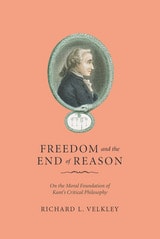
Freedom and the End of Reason
On the Moral Foundation of Kant's Critical PhilosophyRichard L. Velkley
University of Chicago Press, 1989
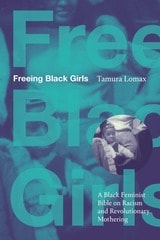
Freeing Black Girls
A Black Feminist Bible on Racism and Revolutionary MotheringTamura Lomax
Duke University Press, 2025
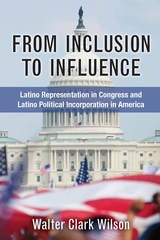
From Inclusion to Influence
Latino Representation in Congress and Latino Political Incorporation in AmericaWalter Clark Wilson
University of Michigan Press, 2017

From Man to Ape
Darwinism in Argentina, 1870-1920Adriana Novoa and Alex Levine
University of Chicago Press, 2010
Upon its publication, The Origin of Species was critically embraced in Europe and North America. But how did Darwin’s theories fare in other regions of the world? Adriana Novoa and Alex Levine offer here a history and interpretation of the reception of Darwinism in Argentina, illuminating the ways culture shapes scientific enterprise.
In order to explore how Argentina’s particular interests, ambitions, political anxieties, and prejudices shaped scientific research, From Man to Ape focuses on Darwin’s use of analogies. Both analogy and metaphor are culturally situated, and by studying scientific activity at Europe’s geographical and cultural periphery, Novoa and Levine show that familiar analogies assume unfamiliar and sometimes startling guises in Argentina. The transformation of these analogies in the Argentine context led science—as well as the interaction between science, popular culture, and public policy—in surprising directions. In diverging from European models, Argentine Darwinism reveals a great deal about both Darwinism and science in general.
Novel in its approach and its subject, From Man to Ape reveals a new way of understanding Latin American science and its impact on the scientific communities of Europe and North America.
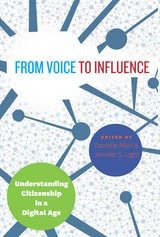
From Voice to Influence
Understanding Citizenship in a Digital AgeEdited by Danielle Allen and Jennifer S. Light
University of Chicago Press, 2015
With From Voice to Influence, Danielle Allen and Jennifer S. Light have brought together a stellar group of political and social theorists, social scientists, and media analysts to explore this transformation. Threading through the contributions is the notion of egalitarian participatory democracy, and among the topics discussed are immigration rights activism, the participatory potential of hip hop culture, and the porous boundary between public and private space on social media. The opportunities presented for political efficacy through digital media to people who otherwise might not be easily heard also raise a host of questions about how to define “good participation:” Does the ease with which one can now participate in online petitions or conversations about current events seduce some away from serious civic activities into “slacktivism?”
Drawing on a diverse body of theory, from Hannah Arendt to Anthony Appiah, From Voice to Influence offers a range of distinctive visions for a political ethics to guide citizens in a digitally connected world.