Results by title
52 books match the query 'International trade' and 3 start with f
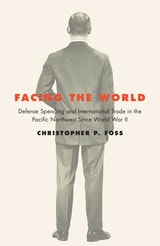
Facing the World
Defense Spending and International Trade in the Pacific Northwest Since World War IIChristopher P. Foss
Oregon State University Press, 2020
Before the Second World War, the states of Washington and Oregon were thinly populated economic backwaters of the United States. Even the major cities of Portland and Seattle were dependent on agricultural industries, especially timber, for their economic health. That all changed during World War II and the Cold War.
By the dawn of the twenty-first century, the Pacific Northwest boasted a more diversified economy. Beer, tourism, and high tech moved in alongside timber and wheat as the region’s mainstay industries. In Washington, especially, a Cold War–driven military and national security state set up shop as an economic behemoth even as debates over the costs and consequences of the new Atomic Age raged.
Facing the World highlights these changes, as well as the politicians, business leaders, and ordinary people who helped bring them about. At the center of the story, Senators Henry Jackson, Wayne Morse, Slade Gorton, and Mark Hatfield; Congressman Tom Foley; and Governor Vic Atiyeh worked diligently for a generation to transform the region from insular and backward to cosmopolitan and forward-looking. Aligning the region with national security and international trade policies, these politicians made the Pacific Northwest economy what it is today.
Through extensive research in congressional and federal archives, historian Christopher P. Foss vividly brings to life the discussions, conflicts, and controversies that shaped this political era. Though it wasn’t perfect, its fading legacy of leadership is a lesson for our own time. Facing the World will prove a valuable resource to historians, political scientists, and civic-minded residents of the Pacific Northwest.
[more]
Fragmenting Globalization
The Politics of Preferential Trade Liberalization in China and the United StatesKa Zeng and Xiaojun Li
University of Michigan Press, 2021
Global supply chain integration is not only a rapidly growing feature of international trade, it is responsible for fundamentally changing trade policy at international and domestic levels. Given that final goods are produced with both domestic and foreign suppliers, Ka Zeng and Xiaojun Li argue that global supply chain integration pits firms and industries that are more heavily dependent on foreign supply chains against those that are less dependent on intermediate goods for domestic production. Hence, businesses whose supply chain would be disrupted as a result of increased trade barriers should lobby for preferential trade liberalization to maintain access to those foreign markets. Moreover, businesses whose products are used in the production of goods in foreign countries should also support preferential trade liberalization to compete with suppliers from other parts of the world.
Fragmenting Globalization uses multiple methods, including time series, cross-sectional analysis of the pattern of Preferential Trade Alliance formation by existing World Trade Organization members, a firm-level survey, and case studies of the pattern of corporate support for regional trade liberalization in both China and the United States. Zeng and Li show that the growing fragmentation of global production, trade, and investment is altering trade policy away from the traditional divide between export-oriented and import-competing industries.
Fragmenting Globalization uses multiple methods, including time series, cross-sectional analysis of the pattern of Preferential Trade Alliance formation by existing World Trade Organization members, a firm-level survey, and case studies of the pattern of corporate support for regional trade liberalization in both China and the United States. Zeng and Li show that the growing fragmentation of global production, trade, and investment is altering trade policy away from the traditional divide between export-oriented and import-competing industries.
[more]

From Here to Free Trade
Essays in Post-Uruguay Round Trade StrategyErnest H. Preeg
University of Chicago Press, 1998
In his new book, Ernest Preeg analyzes international trade and investment in the 1990s and lays out a comprehensive U.S. trade strategy for the uncertain period ahead. He examines the influence of the World Trade Organization (WTO) and argues that economic globalization is beneficial to the U.S. economy in the short- to medium-term while raising important questions about national sovereignty and security over the longer term. Preeg believes regional free trade agreements will soon encompass the majority of world trade, but they can conflict with the WTO's multilateral objectives. The central challenge for U.S. trade strategy, then, is to integrate the now largely separate multilateral and regional tracks of the world trading system.
The first essay assesses U.S. interests in economic globalization, the second examines recent steps toward free trade at the multilateral and regional levels, and the next three offer an in-depth critique of U.S. regional free trade objectives in the Americas, across the Pacific, and possibly with Europe. The final essay presents a multilateral/regional synthesis for going from here to free trade over the coming decade.
The first essay assesses U.S. interests in economic globalization, the second examines recent steps toward free trade at the multilateral and regional levels, and the next three offer an in-depth critique of U.S. regional free trade objectives in the Americas, across the Pacific, and possibly with Europe. The final essay presents a multilateral/regional synthesis for going from here to free trade over the coming decade.
[more]