Results by title
89 books match the query 'Interpersonal relations' and 3 start with f
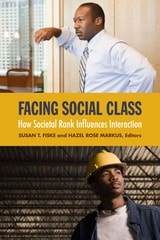
Facing Social Class
How Societal Rank Influences InteractionSusan T. Fiske
Russell Sage Foundation, 2012
Many Americans, holding fast to the American Dream and the promise of equal opportunity, claim that social class doesn't matter. Yet the ways we talk and dress, our interactions with authority figures, the degree of trust we place in strangers, our religious beliefs, our achievements, our senses of morality and of ourselves—all are marked by social class, a powerful factor affecting every domain of life. In Facing Social Class, social psychologists Susan Fiske and Hazel Rose Markus, and a team of sociologists, anthropologists, linguists, and legal scholars, examine the many ways we communicate our class position to others and how social class shapes our daily, face-to-face interactions—from casual exchanges to interactions at school, work, and home. Facing Social Class exposes the contradiction between the American ideal of equal opportunity and the harsh reality of growing inequality, and it shows how this tension is reflected in cultural ideas and values, institutional practices, everyday social interactions, and psychological tendencies. Contributor Joan Williams examines cultural differences between middle- and working-class people and shows how the cultural gap between social class groups can influence everything from voting practices and political beliefs to work habits, home life, and social behaviors. In a similar vein, Annette Lareau and Jessica McCrory Calarco analyze the cultural advantages or disadvantages exhibited by different classes in institutional settings, such as those between parents and teachers. They find that middle-class parents are better able to advocate effectively for their children in school than are working-class parents, who are less likely to challenge a teacher's authority. Michael Kraus, Michelle Rheinschmidt, and Paul Piff explore the subtle ways we signal class status in social situations. Conversational style and how close one person stands to another, for example, can influence the balance of power in a business interaction. Diana Sanchez and Julie Garcia even demonstrate that markers of low socioeconomic status such as incarceration or unemployment can influence whether individuals are categorized as white or black—a finding that underscores how race and class may work in tandem to shape advantage or disadvantage in social interactions. The United States has one of the highest levels of income inequality and one of the lowest levels of social mobility among industrialized nations, yet many Americans continue to buy into the myth that theirs is a classless society. Facing Social Class faces the reality of how social class operates in our daily lives, why it is so pervasive, and what can be done to alleviate its effects.
[more]
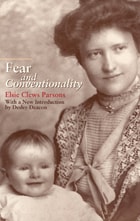
Fear and Conventionality
Elsie Clews Parsons
University of Chicago Press, 1997
Widely admired by the cultural critics and the avant garde in the 1910s, Fear and Conventionality broke new ground for American anthropology. Elsie Clews Parsons—an anthropologist, cultural critic, feminist, and author—turns a cool and ironic eye on the mores and customs of her own upper-class New York society. Influenced by Ruth Benedict and Franz Boas, William James and Havelock Ellis, Parsons's work is informed by a modernist and feminist approach to cultural anthropology and social psychology. Parsons draws on a wide range of cultural texts as well as her own experiences of daily life to argue that the fear of change prompted many social conventions, such as gift-giving, hospitality, and sexual taboos, and to make predictions about American society today, such as the plight to end intolerance.
A modern mind at the turn of the century, Parsons challenged social conventions at a time when it was less than popular to do so. Witty, graceful, and impassioned, this book will be of interest to social and cultural historians and anyone interested in early twentieth-century America.
Elsie Clews Parsons (1874-1941) is the author of many books, including The Family, The Old-Fashioned Woman, Pueblo Indian Religion, and Mitla. Available from the University of Chicago Press is Elsie Clews Parsons: Constructing Sex and Culture in Modernist America, a biography by Desley Deacon.
[more]

Foreplay
Hannah Arendt, the Two Adornos, and Walter BenjaminCarl Djerassi
University of Wisconsin Press, 2011
Hannah Arendt, Walter Benjamin, and Theodor W. Adorno were intellectual giants of the first half of the twentieth century. The drama Foreplay explores their deeply human and psychologically intriguing private lives, focusing on professional and personal jealousies, the mutual dislike of Theodor Adorno and Hannah Arendt, the association between Walter Benjamin and Georges Bataille, and the border between erotica and pornography.
Djerassi’s extensive biographical research brings to light many fascinating details revealed in the dialogues among the characters, including Adorno’s obsession with his dreams, Benjamin’s admiration for Franz Kafka, and the intimate correspondence between Gretel Adorno and Walter Benjamin. The introduction of a fictitious character, Fräulein X, intensifies the complex interplay among the four lead protagonists and allows for a comparison of Adorno’s philandering and the similar behavior of Martin Heidegger, whose affair with Hannah Arendt is well known. Foreplay brims with intrigue and the friction created when strong personalities clash.
[more]