Results by title
167 books match the query 'Iowa' and 6 start with f

Finding Turtle Farm
My Twenty-Acre Adventure in Community-Supported AgricultureAngela Tedesco
University of Minnesota Press, 2022
The story of starting and running an organic farm—told by the woman who owned one of the first Community-Supported Agriculture operations in the Upper Midwest
On a twenty-acre farm in Iowa in 1995, Angela Tedesco planted the seeds (quite literally) of a quiet revolution. While American agriculture had strayed so far afield, her farm would raise food that served the earth and the community as well as the palate. In Finding Turtle Farm, Tedesco recounts this adventure in all its down-and-dirty work and wonder, from plan and plot to harvest, with nods along the way to the vagaries of weather, pests, and human nature.
Introducing Community-Supported Agriculture to Iowa, Tedesco’s Turtle Farm educated its customers along with providing seasonal boxes of produce—an undertaking that continues here, as Tedesco describes what it takes to establish and run an organic operation, bringing to bear all her experience growing up on a family farm, studying chemistry and horticulture, and shepherding a religious education program. From ordering seeds and tending greenhouses to surviving floods and a personal health crisis, Tedesco tells a story of transforming a piece of land and the life within it. She includes practical information about harvesting and preserving food, the discoveries of research conducted on the farm and bonds established between farmers, and even recipes to make delicious use of the produce in your CSA box.
Looking forward to a healthier, happier future when crops are more than mere commodities and food feeds the soul of a community, Finding Turtle Farm is an enlightening, hard-won, and ultimately hopeful account of what it means to meet the most basic of human needs.

Fly in the Buttermilk
The Life Story of Cecil ReedCecil A. Reed
University of Iowa Press, 1993
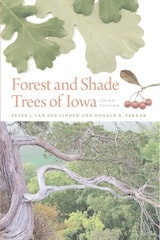
Forest and Shade Trees of Iowa
Peter J. van der Linden
University of Iowa Press, 2011
@font-face { font-family: "Times";}@font-face { font-family: "Palatino";}p.MsoNormal, li.MsoNormal, div.MsoNormal { margin: 0in 0in 0.0001pt; font-size: 12pt; font-family: "Times New Roman"; }div.Section1 { page: Section1; }
Back in print at last in a third edition, the classic Forest and Shade Trees of Iowa now has a wealth of full-color photographs and updated, reorganized information that will please both new and returning readers.
Part 1 of this guide focuses on identification, with user-friendly keys to both summer and winter trees and illustrated descriptions of more than one hundred common species. The trees are arranged according to similarities in foliage; each entry includes a large scan of a leafy branch along with two or three smaller photos of buds, flowers, fruits, and winter twigs. The text contains a description of the species, its geographical distribution, and notes on how to distinguish it from similar species. Part 2 is divided into conifers and flowering trees and includes all trees native to Iowa, trees that are widely planted, invasive species, some less commonly planted trees, and tall native shrubs that might be mistaken for trees. The authors provide information about the natural history of individual trees, their ecological requirements, pests and diseases that affect them, and their usefulness for such different purposes as windbreaks, landscaping, wildlife plantings, fuel, lumber, and food. Following these two main parts, three shorter sections describe the planting and care of trees, Iowa’s forest communities, and good places to see trees in the state; a glossary and a bibliography are also included.
A complete guide to Iowa’s trees, both native and introduced, full of hundreds of color photos, this new edition of Forest and Shade Trees of Iowa will be immensely useful to arborists, foresters, horticulturists, landscape architects, gardeners, and all Iowans and midwesterners who appreciate the beauty and value of trees and want to learn more about them.

From Blue Mills to Columbia
Cedar Falls and the Civil WarKenneth L. Lyftogt
University of Iowa Press, 1993

From Six-on-Six to Full Court Press
A Century of Iowa Girls' BasketballJanice A. Beran
University of Iowa Press, 1993
“From Six-on-Six to Full Court Press is a complete history of Iowa women’s high school, college, and recreational basketball. Beran’s exhaustive research . . . covers legendary players and coaches, changes in rules, stats on Iowa girls’ high school records, alterations in playing styles and uniforms, along with the heart-stopping excitement of the state tournament.”—Hoop Source

Frontier Forts of Iowa
Indians, Traders, and Soldiers, 1682-1862William E. Whittaker
University of Iowa Press, 2009
At least fifty-six frontier forts once stood in, or within view of, what is now the state of Iowa. The earliest date to the 1680s, while the latest date to the Dakota uprising of 1862. Some were vast compounds housing hundreds of soldiers; others consisted of a few sheds built by a trader along a riverbank. Regardless of their size and function—William Whittaker and his contributors include any compound that was historically called a fort, whether stockaded or not, as well as all military installations—all sought to control and manipulate Indians to the advantage of European and American traders, governments, and settlers. Frontier Forts of Iowa draws extensively upon the archaeological and historical records to document this era of transformation from the seventeenth-century fur trade until almost all Indians had been removed from the region.
The earliest European-constructed forts along the Mississippi, Des Moines, and Missouri rivers fostered a complex relationship between Indians and early traders. After the Louisiana Purchase of 1804, American military forts emerged in the Upper Midwest, defending the newly claimed territories from foreign armies, foreign traders, and foreign-supported Indians. After the War of 1812, new forts were built to control Indians until they could be moved out of the way of American settlers; forts of this period, which made extensive use of roads and trails, teamed a military presence with an Indian agent who negotiated treaties and regulated trade. The final phase of fort construction in Iowa occurred in response to the Spirit Lake massacre and the Dakota uprising; the complete removal of the Dakota in 1863 marked the end of frontier forts in a state now almost completely settled by Euro-Americans.
By focusing on the archaeological evidence produced by many years of excavations and by supporting their words with a wealth of maps and illustrations, the authors uncover the past and connect it with the real history of real places. In so doing they illuminate the complicated and dramatic history of the Upper Midwest in a time of enormous change. Past is linked to present in the form of a section on visiting original and reconstructed forts today.
Gayle F. Carlson
Jeffrey T. Carr
Lance M. Foster
Kathryn E. M. Gourley
Marshall B. McKusick
Cindy L. Nagel
David J. Nolan
Cynthia L. Peterson
Leah D. Rogers
Regena Jo Schantz
Christopher M. Schoen
Vicki L. Twinde-Javner
William E. Whittaker