173 books match the query 'Ireland' and 7 start with f
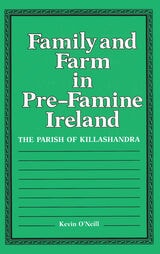
cover of Family and Farm in Pre-Famine Ireland: The Parish of Killashandra

Family and Farm in Pre-Famine Ireland

The Parish of Killashandra

Kevin O'Neill

University of Wisconsin Press, 1985

Now available in paperback, Kevin O’Neill’s highly praised study of rural Ireland in the years leading up to the "Great Hunger" of the 1840s explicates the social, economic, and demographic conditions of the era. He argues that overpopulation and deprivation were inextricably linked to a third variable—the rapid economic development of rural Ireland that was shaped by British interests.
[more]
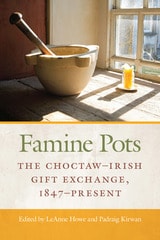
cover of Famine Pots: The Choctaw–Irish Gift Exchange, 1847–Present

Famine Pots

The Choctaw–Irish Gift Exchange, 1847–Present

LeAnne Howe

Michigan State University Press, 2020
The remarkable story of the money sent by the Choctaw to the Irish in 1847 is one that is often told and remembered by people in both nations. This gift was sent to the Irish from the Choctaw at the height of the potato famine in Ireland, just sixteen years after the Choctaw began their march on the Trail of Tears toward the areas west of the Mississippi River. Famine Pots honors that extraordinary gift and provides further context about and consideration of this powerful symbol of cross-cultural synergy through a collection of essays and poems that speak volumes of the empathy and connectivity between the two communities. As well as signaling patterns of movement and exchange, this study of the gift exchange invites reflection on processes of cultural formation within Choctaw and Irish society alike, and sheds light on longtime concerns surrounding spiritual and social identities. This volume aims to facilitate a fuller understanding of the historical complexities that surrounded migration and movement in the colonial world, which in turn will help lead to a more constructive consideration of the ways in which Irish and Native American Studies might be drawn together today.
[more]
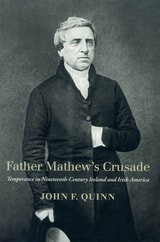
cover of Father Mathew's Crusade: Temperance in Nineteenth-Century Ireland and Irish America

Father Mathew's Crusade

Temperance in Nineteenth-Century Ireland and Irish America

John F. Quinn

University of Massachusetts Press, 2002

For centuries, the Irish have been famed, and often derided, for their attachment to alcohol. Yet in the 1830s and 1840s, Ireland became a temperance stronghold. The man almost singlehandedly responsible for this surprising transformation was Father Theobald Mathew (1790–1856), a popular Franciscan friar. Over a ten-year period, five million Irish men, women, and children took the pledge at his hands, while hundreds of public houses were forced to shut their doors or switch to selling coffee and tea. 

By the end of the 1840s, however, Mathew's “miracle” was already coming undone. The Great Famine was ravaging Ireland and Mathew's years of nonstop campaigning had left him sick, exhausted, and bankrupt. Undeterred, he traveled to the United States in 1849 to generate support and administer the pledge to as many new immigrants as he could find. Failing health forced him to return to Ireland where he died in 1856, leaving behind a weak and fragmented movement. 

In the late nineteenth century, several Irish priests revived Mathew's crusade. In the United States, Irish American bishops supported the Catholic Total Abstinence Union (CTAU) and joined hands with the Women's Christian Temperance Union in their war against liquor. In Ireland, Father James Cullen formed the Pioneers, a total abstinence association for devout Catholics. While the CTAU languished after the United States Congress passed the Prohibition Amendment in 1919, the Pioneers continued to thrive in Ireland into the 1960s. Although the group's membership has declined in recent years, there are still today a large number of Irish teetotalers.
[more]
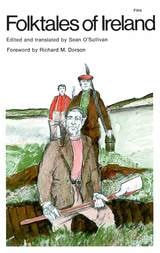
cover of Folktales of Ireland

Folktales of Ireland

Edited by Sean O'Sullivan

University of Chicago Press, 1966
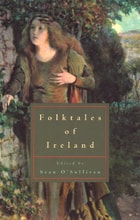
An engrossing collection of unforgettable stories from the rich oral tradition of Ireland
 
Few countries can boast such a plentitude of traditional folktales as Ireland. In 1935, the creation of The Irish Folklore Commission set in motion the first organized efforts of collecting and studying a multitude of folktales, both written as well as those of the Irish oral tradition. The Commission has collected well over a million pages of manuscripts. Folktales of Ireland offers chief archivist Sean O'Sullivan's representation of this awe-inspiring collection. These tales represent the first English language collection of Gaelic folktales.


[more]
cover of Folktales of Ireland

Folktales of Ireland

Edited by Sean O'Sullivan

University of Chicago Press, 1966
An engrossing collection of unforgettable stories from the rich oral tradition of Ireland
 
Few countries can boast such a plentitude of traditional folktales as Ireland. In 1935, the creation of The Irish Folklore Commission set in motion the first organized efforts of collecting and studying a multitude of folktales, both written as well as those of the Irish oral tradition. The Commission has collected well over a million pages of manuscripts. Folktales of Ireland offers chief archivist Sean O'Sullivan's representation of this awe-inspiring collection. These tales represent the first English language collection of Gaelic folktales.


[more]
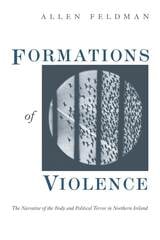
cover of Formations of Violence: The Narrative of the Body and Political Terror in Northern Ireland

Formations of Violence

The Narrative of the Body and Political Terror in Northern Ireland

Allen Feldman

University of Chicago Press, 1991

"A sophisticated and persuasive late-modernist political analysis that consistently draws the reader into the narratives of the author and those of the people of violence in Northern Ireland to whom he talked. . . . Simply put, this book is a feast for the intellect"—Thomas M. Wilson, American Anthropologist

"One of the best books to have been written on Northern Ireland. . . . A highly imagination and significant book. Formations of Violence is an important addition to the literature on political violence."—David E. Schmitt, American Political Science Review
[more]
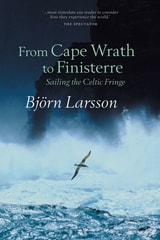
cover of From Cape Wrath to Finisterre: Sailing the Celtic Fringe

From Cape Wrath to Finisterre

Sailing the Celtic Fringe

Bjorn Larsson

Haus Publishing, 2005

From Cape Wrath to Finisterre is a travelogue and an homage to Celtic lands and waters, from their northern to their south western landfalls. Cape Wrath points towards the Arctic Circle at Scotland's furthest northerly limit. "Perhaps I was looking for a homeland, perhaps not, or at any rate a place where it would be worth trying to live for a while as well as one can for as long as it lasts." Finisterre, the furthest point in Galicia in northern Spain, was so named for being "The End of the Earth," Larsson's contemplative musings on life as seen from the cockpit and deck of his yacht enliven this journey from Denmark around Scotland, through the Irish Sea and onwards to Brittany and Spain. "Yes, I admit to rootlessness and impermanence," he admits. "But restlessness, on the other hand, is a scourge. It and its modern variant, stress, the futility of running round in circles, are to be avoided at all costs. It is far from certain, of course, that this way of life would suit everybody, but if it instils in someone the desire to experiment with alternatives. I shall be happy."
[more]