Results by title
477 books match the query 'Italy' and 23 start with f
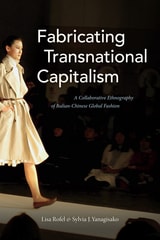
Fabricating Transnational Capitalism
A Collaborative Ethnography of Italian-Chinese Global FashionLisa Rofel and Sylvia J. Yanagisako
Duke University Press, 2018
Farewell to Russia
Memories of When I Was KolaNikolai Prestia
Rutgers University Press, 2026
Growing up in 1990s Russia in a family marked by poverty, substance abuse, and neglect, Kola and his sister are eventually admitted into the orphanage system. Here, Kola comes face to face with a different but equally daunting challenge: navigating an unfamiliar and sometimes hostile world haunted by the absence of his mother. The ensuing journey, which eventually culminates in the adoption by an Italian family, alternates moments of both trauma and deliverance, while asking fundamental questions about our ability to reconcile ourselves with unfathomable loss.
Harrowing yet lyrical, Nikolai Prestia’s prize-winning 2021 novel is a testament to the duality of memory in its ability to both hurt and heal, and to the transformative power of those figures, adults and peers alike, who contribute to a child’s development. Translated into English as part of a collaboration between the author and a mother-daughter translator duo, the novel serves up a wrenching glimpse into the back stories that often precede the adoption of an older child.
Farewell, Mama Odessa
A NovelEmil Draitser
Northwestern University Press, 2020
Set in the summer of 1979 at the height of the movement to free Soviet Jewry, Farewell, Mama Odessa is an autobiographical novel whose intertwined storylines follow a variety of people—dissidents, victims of ethnic discrimination, and black marketeers among them—as they bid farewell to their beloved hometown of Odessa, Ukraine, and make their way to the West. At the book’s center is Boris, a young writer thwarted by state censorship and antisemitism. With an Angora kitten for his companion and together with other émigrés, he puts the old country in his rear-view mirror and sets out on a journey that will take him to Bratislava, Vienna, Rome, and New York on his way to Los Angeles. Will Boris be able to rekindle his creative passion and inspiration in the West? Will other Jewish émigrés fit into the new society, so much different than the one they left behind? With humor and compassion, Farewell, Mama
Odessa describes the émigrés’ attempts at adjustment to the free world.
Fascist Virilities
Rhetoric, Ideology, and Social Fantasy in ItalyBarbara Spackman
University of Minnesota Press, 1996

Fate and Honor, Family and Village
Demographic and Cultural Change in Rural Italy Since 1800Rudolph M. Bell
University of Chicago Press, 1979
Fortuna is the cultural wellspring of Italian peasant society, the world view from which all social life flows. The concept of fortuna does not refer to philosophical questions, predestination, or value judgments. Rather, fortuna is the sum total of all explanations of outcomes perceived to be beyond human control. Thus, in Bell's view, high mortality does not lead peasants to a resigned acceptance of their fate; instead, they rely on honor, reciprocal exchanges of favors, and marriage to forge new links in their familial and social networks. With thorough documentation in graphs and tables, the author evaluates peasant reactions to time, work, family, space, migration, and protest to portray rural Italians as active, flexible, and shrewd, participating fully in shaping their destinies.
Bell asserts that the real problem of the Mezzogiorno is not one of resistance to technology, of high birth rates, or even of illiteracy. It is one of solving technical questions in ways that foster dependency. The historical and sociological practice of treating peasant culture as backward, secondary, and circumscribed only encourages disruption and ultimately blocks the road to economic and political justice in a postmodern world.

Feminine Feminists
Cultural Practices in ItalyGiovanna Miceli Jeffries, Editor
University of Minnesota Press, 1994
Feminine Feminists was first published in 1994. Minnesota Archive Editions uses digital technology to make long-unavailable books once again accessible, and are published unaltered from the original University of Minnesota Press editions.
What does it mean to be a woman today in Italy, a country with the lowest birthrate in the world and the heaviest maternal stereotype? Does being a feminist exclude practices of cultural femininity? What are Italian women's cultural productions? These questions are at the center of this volume, which looks at how feminism and femininity are embedded in a broad spectrum of Italian cultural practices.
In recent years, several books have introduced the American public to Italian women's voices. This volume goes beyond others in its range of theoretical topics and modes, considering cultural practices not only in their popular, material appearance, but also in the disciplines and forms of knowledge that order information and circumscribe behavior.The essays, all by well-known scholars in Italian studies, reflect the authors' specific critical interests in cinema, fashion, literary texts, feminist theory, and popular culture, past and present. Some address the culture of everyday life, while others examine feminism and femininity in the context of philosophy, ethics, or national identity within a global culture. Some begin with the conviction that performing "femininity"—whether in appearance or in nurturing practices—can be culturally liberating. Others put this notion to the critical test. By situating the problem of femininity within the discussion of feminism, this volume takes on larger issues within feminist discourse. Its bold examination of the component of femininity within the context of women's experiences offers readers rare insight into Italian women's culture and into the multicultural possibilities of feminism.Contributors: Beverly Allen,
Serena Anderlini-D'Onofrio, Lucia Chiavola Birnbaum, Renate Holub, Carol Lazzaro-Weis, Maria Marotti, Áine O'Healy, Graziella Parati, Eugenia Paulicelli, Robin Pickering-Iazzi, Maurizio Viano.Giovanna Miceli Jeffries is a lecturer in the department of French and Italian at the University of Wisconsin, Madison.

Festival of the Poor
Fertility Decline and the Ideology of ClassJane C. Schneider
University of Arizona Press, 1996
By examining population changes in a single community between 1860 and 1980, the authors offer an extended review and critique of existing models of fertility decline in Europe, proposing a new interpretation that emphasizes historical context and class relations. They show how the spread of capitalism in Sicily induced an unprecedented rate of population growth, with boom-and-bust cycles creating the class experiences in which "reputational networks" came to redefine family life; how Sicilians began to control their fertility in response to class-mediated ideas about gender relations and respectable family size; and how the town's gentry, artisan, and peasant classes adopted family planning methods at different times in response to different pressures.
Jane and Peter Schneider's anthropologically oriented political-economy perspective challenges the position of Western Europe as a model for fertility decline on which every other case should converge, looking instead at the diversity of cultural ideals and practices--such as those found in Sicily--that influence the spread and form of birth control. Combining anthropological, oral historical, and archival methods in new and insightful ways, the authors' synthesis of a particular case study with a broad historical and theoretical discussion will play a major role in the ongoing debates over the history of European fertility decline and point the way toward integrating the analysis of demographic upheaval with the study of class formation and ideology.
Few Returned
Twenty-eight Days on the Russian Front, Winter 1942-1943Eugenio Corti, Translated by Peter Edward Levy, & Foreword by Carlo D'Este
University of Missouri Press, 1997
After World War II more than one hundred books appeared that dealt with the experience of the Italian army in Russia, and particularly the terrible winter retreat of 1942-1943. Few Returned (I piu' non ritornano) is the only one of these that is still regularly reissued in Italy.
Eugenio Corti, who was a twenty-one-year-old second lieutenant at the time, found himself, together with 30,000 Italians and a smaller contingent of Germans, encircled on the banks of the River Don by enemy forces who far outnumbered them. To break out of this encirclement, these men undertook a desperate march across the snow, with constant engagements and in temperatures ranging from -20 to -30 degrees Fahrenheit. Whereas supplies were air-dropped to the Germans, the predicament of the Italians was far more difficult: lacking gasoline, they were compelled to abandon their vehicles and to proceed without heavy arms, equipment, ammunition, or provisions. Even the wounded had to be abandoned, though it was well known that the soldiers of the Red Army"enraged by the brutality of the German invasion"killed all the enemy wounded who fell into their hands. After twenty-eight days of encirclement, only 4,000 of the 30,000 Italians made it out of the pocket.
Why is it that Corti's book, which was first published in 1947, continues after fifty years to be reprinted in Italy? Because, as Mario Apollonio of the University of Milan said, when the book first appeared: "It is a chronicle . . . but it is much more than that: behind the physical reality, there is the truth" about man at his most tragic hour. Apollonio adds: "The power of the writing immediately transforms the document into drama"; the result is a "novel-poem-drama-history." The philosopher Benedetto Croce found in Corti's book "the not infrequent gleam of human goodness and nobility." Few Returned is a classic of war literature that succeeds in bringing home the full hatefulness of war.
Eugenio Corti began writing his diary at a military hospital immediately after being repatriated from the Russian front. When in September 1943 Italy found itself cut in two by the Armistice, Corti, loyal to his officer's oath, joined up with what remained of the Italian army in the south and with those few troops participated in driving the Germans off Italian soil, fighting at the side of the British Eighth and the American Fifth Armies.

Field Guide to the Wild Flowers of the Western Alps
France, Italy and SwitzerlandChristopher Grey-Wilson
Royal Botanic Gardens, Kew, 2025
The Western Alps, a large region of dramatic scenery and varied habitats, is noted for its biodiversity and beauty. From woodlands and forests, through colorful hay meadows, to the higher alpine elevations, the region boasts one of the most diverse and colorful mountain floras found anywhere on earth. This book is a celebration of the great biological diversity found in one of the most beautiful and inviting regions of Europe.
This comprehensive guide features the fascinating flora to be found across the region in the French Alps, the Massif Central and Cevennes, the Swiss Jura Mountains and the Italian Alps east to Como and Bergamo. Illustrated throughout with over 2000 photographs, each species profile includes nomenclature, description, dimensions, habitat, flowering times, and distribution.
Fighting the Plague in Seventeenth-Century Italy
Carlo M. Cipolla
University of Wisconsin Press, 1981
After the great pandemic of 1348, the plague became endemic in Europe, affecting life at every level for more than three hundred years. In attempting to fight the dread enemy, the North Italian states had developed, by the early sixteenth century, a highly sophisticated system of public health. Special permanent magistracies combining legislative and executive powers were established to administer all public health matters.
In this volume, Carlo M. Cipolla throws new light on the subject, utilizing newly uncovered and significant archival material.
In the first essay, the author analyzes the complex set of interrelationships that existed between theory and practice in Renaissance epidemiology. The significance of this essay goes beyond the history of public health and extends to the larger history of science.
In the second essay, Cipolla studies a case in which health matters became the object of intense diplomatic activity. In that instance, fully sovereign states envisaged interstate controls and relinquished discretionary powers for the sake of the “common health.” Although the concerted effort was short-lived, it does represent an attempt at international health cooperation that was unmatched for another two centuries, until the first International Sanitary Conference, held in Paris in 1851.
In the third essay, unusually detailed statistical documentation allows the author to analyze in detail the demographic, economic, and social aspects of the fight against the plague in a Tuscan city—Pistoia—during the epidemic of 1630–31.
A richly documented appendix, forming an essay in itself, illustrates present knowledge of the clinical, pathological, and epidemiological features of the plague in the sixteenth and seventeenth centuries in Europe.
First Impressions
Sefer Hasidim and Early Modern Hebrew PrintingJoseph A. Skloot
Brandeis University Press, 2023
In 1538, a partnership of Jewish silk makers in the city of Bologna published a book entitled Sefer Hasidim, a compendium of rituals, stories, and religious instruction that primarily originated in medieval Franco-Germany. How these men, of Italian and Spanish descent, came to produce a book that would come to shape Ashkenazic culture, and Jewish culture more broadly, over the next four centuries is the basis of this kaleidoscopic study of the history of Hebrew printing in the sixteenth century.
During these early years of printing, the classic works of ancient and medieval Hebrew and Jewish literature became widely available to Jewish (and non-Jewish) readers for the first time. Printing, though, was not merely the duplication and distribution of pre-existing manuscripts, it was the creative adaptation and transformation of those manuscripts by printers. Ranging from Catholic Bologna to Protestant Basel to the Jewish heartland of the Polish-Lithuanian Commonwealth, Joseph A. Skloot uncovers the history of that creativity by examining the first two print editions of Sefer Hasidim. Along the way, he demonstrates how volumes that were long thought to be eternal and unchanging were in fact artifacts of historical agency and contingency, created by and for human beings.
Flood in Florence, 1966
A Fifty-Year RetrospectivePaul Conway and Martha O’Hara Conway
Michigan Publishing Services, 2018

Florence in the Forgotten Centuries, 1527-1800
A History of Florence and the Florentines in the Age of the Grand DukesEric Cochrane
University of Chicago Press, 1976
Eric Cochrane shows that the Florentines maintained their creativity long after they had lost their position as the cultural leaders of Europe. When their political philosophy and historiography ran dry, they turned to the practical problems of civil administration. When their artists finally yielded to outside influence, they turned to music and the natural sciences. Even during the darkest days of the great economic depression of the late seventeenth and early eighteenth centuries, they succeeded in preserving—almost alone in Europe—the blessings of external peace and domestic tranquility.

Florentine Essays
Selected Writings of Marvin B. BeckerMarvin B. Becker
University of Michigan Press, 2002
In the capital of humanism, he initiated what was to be a lifelong examination of the Western civil tradition. In Florence he could study the interplay of ideas and action in what he was to call the "public world." The rise of this world out of the private, feudal and corporate structures of the medieval commune, its functioning and its eventual subversion by the authoritarian structures of the early modern state were, he thought, valuable information for modern political cultures. In the 1950s and 1960s, Becker produced approximately twenty papers dealing with a wide variety of themes and issues raised by the work of other scholars such as Davidson, Salvemini, Ottokar, Panella, Rodolico, Barbadoro, Baron, and others. He also introduced his own formulations on a range of subjects including the political role of Florence's minor guilds, usury, taxation, public debt, popular heresy, church-state relations, the city's chroniclers, the influence of "new men" upon Florentine government and changing mentalities.
These papers, in their originality, their richness of documentation and their suggestiveness, are still relevant for current scholarship. The editors of this volume have chosen the papers for the convenience of readers who may know Becker only through his books, or from the myriad of footnotes of other scholars who have drawn so much from his work. This volume will be of interest to scholars, students, and others interested in Renaissance history, whether it be social or political.
Marvin B. Becker is Professor Emeritus in the Department of History, University of Michigan. James Banker is Professor of History, North Carolina State University. Carol Lansing is Professor of History, University of California, Santa Barbara.
Folklore by the Fireside
Text and Context of the Tuscan VegliaBy Alessandro Falassi
University of Texas Press, 1980
For centuries, social life in rural Tuscany has centered around the veglia, an evening gathering of family and friends at the hearth. Folklore by the Fireside is a thorough and insightful study of this custom—from the tales, riddles, lullabies, and folk prayers performed as the small children are put to bed to the courtship songs and dances later in the evening to the anti-veglia male gossip, card games, and protest songs originating in the tavern.
Alessandro Falassi skillfully correlates the veglia to the rites of passage and family values of an agrarian society. Although the impact of mass media and other factors has tended to weaken the tradition, even today Tuscan children are taught to behave and adolescents are guided along the conventional path to adulthood, courtship, and marriage through veglia folklore.
This is the first work to deal systematically with Tuscan folklore from a semiotic and structural viewpoint and to examine the veglia as a means of handing down traditional values. It is important not only for its careful, detailed description but also for its rigorous methodology and theoretical richness.
Foodways in Roman Republican Italy
Laura M. Banducci
University of Michigan Press, 2021
Foodways in Roman Republican Italy explores the production, preparation, and consumption of food and drink in Republican Italy to illuminate the nature of cultural change during this period. Traditionally, studies of the cultural effects of Roman contact and conquest have focused on observing changes in the public realm: that is, changing urban organization and landscape, and monumental construction. Foodways studies reach into the domestic realm: How do the daily behaviors of individuals express their personal identity, and How does this relate to changes and expressions of identity in broader society? Laura M. Banducci tracks through time the foodways of three sites in Etruria from about the third century BCE to the first century CE: Populonia, Musarna, and Cetamura del Chianti. All were established Etruscan sites that came under Roman political control over the course of the third and second centuries BCE. The book examines the morphology and use wear of ceramics used for cooking, preparing, and serving food in order to deduce cooking methods and the types of foods being prepared and consumed. Change in domestic behaviors was gradual and regionally varied, depending on local social and environmental conditions, shaping rather than responding to an explicitly “Roman” presence.
Forbidden Knowledge
Medicine, Science, and Censorship in Early Modern ItalyHannah Marcus
University of Chicago Press, 2020
Forbidden Knowledge explores the censorship of medical books from their proliferation in print through the prohibitions placed on them during the Counter-Reformation. How and why did books banned in Italy in the sixteenth century end up back on library shelves in the seventeenth? Historian Hannah Marcus uncovers how early modern physicians evaluated the utility of banned books and facilitated their continued circulation in conversation with Catholic authorities.
Through extensive archival research, Marcus highlights how talk of scientific utility, once thought to have begun during the Scientific Revolution, in fact, began earlier, emerging from ecclesiastical censorship and the desire to continue to use banned medical books. What’s more, this censorship in medicine, which preceded the Copernican debate in astronomy by sixty years, has had a lasting impact on how we talk about new and controversial developments in scientific knowledge. Beautiful illustrations accompany this masterful, timely book about the interplay between efforts at intellectual control and the utility of knowledge.
Francesca Caccini at the Medici Court
Music and the Circulation of PowerSuzanne G. Cusick
University of Chicago Press, 2009
Suzanne G. Cusick argues that Caccini’s career depended on the usefulness of her talents to the political agenda of Grand Duchess Christine de Lorraine, Tuscany’s de facto regent from 1606 to 1636. Drawing on Classical and feminist theory, Cusick shows how the music Caccini made for the Medici court sustained the culture that enabled Christine’s power, thereby also supporting the sexual and political aims of its women.
In bringing Caccini’s surprising story so vividly to life, Cusick ultimately illuminates how music making functioned in early modern Italy as a significant medium for the circulation of power.

Frederick II
The Wonder of the WorldRichard Bressler
Westholme Publishing, 2010
One of the most remarkable personalities of the Middle Ages, Frederick II of Hohenstaufen was born in 1194. His parents—the reigning Holy Roman Emperor and the heiress to the Kingdom of Sicily—belonged to two of the leading ruling families in medieval Europe. The lands controlled by these two families extended from southern Denmark to Sicily, from modern Belgium to Bohemia. Frederick II eventually ruled the joint kingdom, and the story of how he gained and maintained this status is the primary thread running through his life. As a child in Sicily, Frederick was a ward of Pope Innocent III. When he came of age, he sought to be crowned Holy Roman Emperor but only succeeded in 1220 after many years of negotiations with the Vatican, which was reluctant to give up or share power. Resenting the influence and pressure from the papacy, Frederick became its leading opponent. As a result, the new pope, Gregory IX, condemned Frederick as the Antichrist. However, Frederick believed he was a sincere Christian, and led the Sixth Crusade to the Holy Land while under excommunication.

From Anzio to the Alps
An American Soldier's StoryLloyd M. Wells
University of Missouri Press, 2019
From Arcadia to Revolution
The Neapolitan Monitor and Other WritingsEleonora Fonseca Pimentel
Iter Press, 2019
The Other Voice in Early Modern Europe: The Toronto Series, Volume 67
Frontinus' Legacy
Essays on Frontinus' de aquis urbis RomaeDeane R. Blackman and A. Trevor Hodge, Editors
University of Michigan Press, 2001

Furnishing Fascism
Modernist Design and Politics in ItalyIgnacio G. Galán
University of Minnesota Press, 2025
The role of modernist interior design in the construction of Italian nationalism
Along with the rise of Mussolini’s fascist regime, the interwar years in Italy also saw the widespread development of its modernist interior design and furnishing practices. While the regime’s politics were overtly manifest in monumental government architecture, Furnishing Fascism examines the subtler yet effective role of household goods and decor in the cultivation of Italy’s exclusionary sense of national identity.
Presenting a fresh look at the work of various architects and designers, including iconic figures such as Gio Ponti and Carlo Enrico Rava, Ignacio G. Galán explores how seemingly neutral products of everyday life contributed to the propagation of fascist ideology. Through extensive promotion in popular magazines and department stores, on the film sets of Cinecittà Studios, and throughout the country’s colonial territories, Italy’s modernist design practices were part of a larger political project that aimed to produce a totalizing image of cultural hegemony.
Interweaving design theory, architectural history, and media scholarship, Furnishing Fascism reexamines the period’s so-called minor arts to reveal the political entanglement of modernism in early twentieth-century Italy and offers valuable insight into the complications of cultural production under the auspices of authoritarian power.
Retail e-book files for this title are screen-reader friendly with images accompanied by short alt text and/or extended descriptions.