Results by title
84 books match the query 'Jameson, Fredric' and 5 start with f
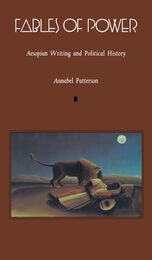
Fables of Power
Aesopian Writing and Political HistoryAnnabel Patterson
Duke University Press, 1991
Patterson begins with an analysis of the legendary Life of Aesop, its cultural history and philosophical implications, a topic that involves such widely separated figures as La Fontaine, Hegel, and Vygotsky. The myth’s origin is recovered here in the saving myth of Aesop the Ethiopian, black, ugly, who began as a slave but become both free and influential, a source of political wisdom. She then traces the early modern history of the fable from Caxton, Lydgate, and Henryson through the eighteenth century, focusing on such figures as Spenser, Sidney, Lyly, Shakespeare, and Milton, as well as the lesser-known John Ogilby, Sir Roger L’Estrange, and Samuel Croxall.
Patterson discusses the famous fable of The Belly and the Members, which, because it articulated in symbolic terms some of the most intransigent problems in political philosophy and practice, was still going strong as a symbolic text in the mid-nineteenth century, where it was focused on industrial relations by Karl Marx and by George Eliot against electoral reform.
Figures of Resistance
Language, Poetry, and Narrating in The Tale of the Genji and Other Mid-Heian TextsH. Richard Okada
Duke University Press, 1991
Okada develops a highly original and sophisticated reading strategy that demonstrates how readers might understand texts belonging to a different time and place without being complicit in their assimilation to categories derived from Western literary traditions. The author’s reading stratgey is based on the texts’ own resistance to modes of analysis that employ such Western canonical terms as novel, lyric, and third-person narrative. Emphasis is also given to the distinctive cultural circles, as well as socio-political and genealogical circumstances that surrounded the emergence of the texts.
Indispensable readings for specialists in literature, cultural studies, and Japanese literature and history, Figures of Resistance will also appeal to general readers interested in the problems and complexities of studying another culture.
Fredric Jameson and Film Theory
Marxism, Allegory, and Geopolitics in World CinemaKeith B. Wagner
Rutgers University Press, 2022

Fredric Jameson
The Project of Dialectical CriticismRobert T. Tally
Pluto Press, 2014
Fredric Jameson is the most important Marxist critic in the world today. While consistently operating at the cutting edge of literary and cultural studies, Jameson has remained committed to seemingly old-fashioned philosophical discourses, most notably dialectical criticism and utopian thought.
In Fredric Jameson: The Project of Dialectical Criticism, Robert Tally surveys Jameson’s entire oeuvre, from his early studies of Sartre and formal criticism through his engagements with postmodernism and globalisation to his recent readings of Hegel, Marx and the valences of the dialectic.
The book is both a comprehensive critical guide to Jameson’s theoretical project and itself a convincing argument for the power of dialectical criticism to understand the world today.
Full Metal Apache
Transactions Between Cyberpunk Japan and Avant-Pop AmericaTakayuki Tatsumi
Duke University Press, 2006
Full Metal Apache introduces English-language readers to a vast array of Japanese writers and performers and considers their work in relation to the output of William Gibson, Thomas Pynchon, H. G. Wells, Jack London, J. G. Ballard, and other Westerners. Tatsumi moves from the poetics of metafiction to the complex career of Madame Butterfly stories and from the role of the Anglo-American Lafcadio Hearn in promoting Japanese folklore within Japan during the nineteenth century to the Japanese monster Godzilla as an embodiment of both Japanese and Western ideas about the Other. Along the way, Tatsumi develops original arguments about the self-fashioning of “Japanoids” in the globalist age, the philosophy of “creative masochism” inherent within postwar Japanese culture, and the psychology of “Mikadophilia” indispensable for the construction of a cyborg identity. Tatsumi’s exploration of the interplay between Japanese and American cultural productions is as electric, ebullient, and provocative as the texts and performances he analyzes.