Results by title
356 books match the query 'Jewish Studies' and 14 start with f
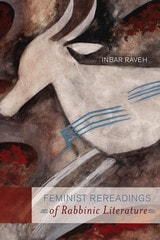
Feminist Rereadings of Rabbinic Literature
Inbar Raveh
Brandeis University Press, 2014
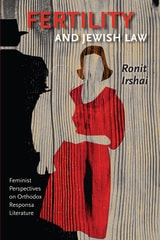
Fertility and Jewish Law
Feminist Perspectives on Orthodox Responsa LiteratureRonit Irshai
Brandeis University Press, 2012

First Person Jewish
Alisa S. Lebow
University of Minnesota Press, 2008
Documentaries have increasingly used the first person, with a number of prominent filmmakers finding critical and commercial success with this intimate approach. Jewish filmmakers have particularly thrived in this genre, using it to explore disparate definitions of the self in relation to the larger groups of family and community.
In First Person Jewish, Alisa S. Lebow examines more than a dozen films from Jewish artists to reveal how the postmodern impulse to turn the lens inward intersects provocatively (and at times unwittingly) with historical tropes and stereotypes of the Jew. Focusing her efforts on Jewish filmmakers working on the margins, Lebow analyzes the work of Jonathan Caouette, Chantal Akerman, and Alan Berliner, among others, also including a discussion of her own first person film Treyf (1998), made with Cynthia Madansky. The filmmakers in this study, Lebow argues, are confronting a desire to both define and reimagine contemporary Jewishness.
Using a multidisciplinary approach to first person films, Lebow shows how this form of self-expression is challenging both autobiography and documentary and, in the process, changing the art of cinema and recording the cultural shifts of our time.
Alisa S. Lebow is a filmmaker and lecturer in film and TV studies at Brunel University.
Follow My Footprints
Changing Images of Women in American Jewish FictionEdited by Sylvia Barack Fishman
Brandeis University Press, 1992
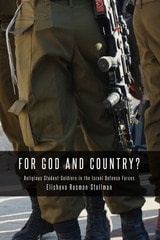
For God and Country?
Religious Student-Soldiers in the Israel Defense ForcesBy Elisheva Rosman-Stollman
University of Texas Press, 2014
In many modern armies the religious soldier is suspect. Civilians and officers alike wonder if such a soldier might represent a potential fifth column. This concern is especially prominent in the public discourse over the presence of religious Orthodox Jews serving in the Israel Defense Forces. Will they obey their commanding officer or their rabbi? With research collected over almost a decade, including hundreds of hours of interviews, Elisheva Rosman examines this question of loyalties and reveals how religious soldiers negotiate a place for themselves in an institution whose goals and norms sometimes conflict with those of Orthodox Judaism.
For God and Country? focuses on the pre-service study programs available to religious conscripts. Many journalists and scholars in Israel are suspicious of the student-soldiers who participate in these programs, but in fact, as Rosman’s research demonstrates, the pre-service study programs serve as mediating structures between the demands of Religious Zionism and the demands of the Israel Defense Forces and do not encourage their students to disobey orders. This was especially apparent during the disengagement from Gaza in 2005. Many in Israeli society predicted student-soldiers would defy their orders, per the instruction of their religious leaders, but this did not happen as expected. In high profile cases such as this and in matters encountered daily by religious soldiers—the mixing of the sexes, for instance—Rosman has discovered that the pre-service study programs can successfully serve as agents of civil society, both able to curb the military’s efforts to meddle in civilian affairs and vice versa.

For Zion's Sake
The Judeo-Christian Tradition in American CultureFuad Sha'ban
Pluto Press, 2005
This book explores the role of religion, especially religious extremism, in American culture. In particular, it examines the development of the Judeo-Christian tradition, its impact on America's self-image, and the way it has influenced America's attitude to the Arab World.
The Christian Right has become a very powerful force in American politics. Its basic belief in Christian Zionism has resulted in a steadfast commitment to the establishment of the state of Israel and to its aggressive expansion, and has made Zionism a central part of government policy, for both Republicans and Democrats.
Fuad Sha'ban shows how this is not a new phenomenon: what he terms the 'Vision of Zion' in American life has its roots in literature, the arts and internal politics from colonial times until today. Looking in detail at a wealth of resources, including religious and literary texts, as well as official political statements, he pieces together a subtle account of how America's Puritan roots have fostered a specifically religious political culture that encourages hatred and suspicion of the Muslim World in domestic and foreign policy.
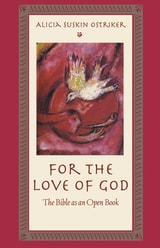
For the Love of God
The Bible as an Open BookOstriker, Alicia Suskin
Rutgers University Press, 2009
For the Love of God is a provocative and inspiring re-interpretation of six essential Biblical texts: The Song of Songs, the Book of Ruth, Psalms, Ecclesiastes, Jonah, and Job. In prose that is personal and probing, analytically acute and compellingly readable, Ostriker sees these writings as “counter-texts,” deviating from convention yet deepening and enriching the Bible, our images of God, and our own potential spiritual lives. Attempting to understand “some of the wildest, strangest, most splendid writing in Western tradition,” she shows how the Bible embraces sexuality and skepticism, boundary crossing and challenges to authority, how it illuminates the human psyche and mirrors our own violent times, and how it asks us to make difficult choices in the quest for justice.
For better or worse, our society is wedded to the Bible. But according to Talmud, “There is always another interpretation.” Ostriker demonstrates that the Bible, unlike its reputation, offers a plenitude of surprises.
Forsaken
The Menstruant in Medieval Jewish MysticismSharon Faye Koren
Brandeis University Press, 2011
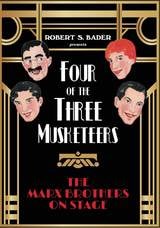
Four of the Three Musketeers
The Marx Brothers on StageRobert S. Bader
Northwestern University Press, 2022
An updated paperback version of the book heralded as “a new benchmark in Marx scholarship” by the Los Angeles Times
Before film made them international comedy legends, the Marx Brothers developed their comic skills on stage for twenty-five years. In Four of the Three Musketeers: The Marx Brothers on Stage, Robert S. Bader offers the first comprehensive history of the foursome’s hardscrabble early years honing their act in front of live audiences.
From Groucho’s debut in 1905 to their final live performances of scenes from A Night in Casablanca in 1945, the brothers’ stage career shows how their characters and routines evolved before their arrival in Hollywood. Four of the Three Musketeers draws on an unmatched array of sources, many not referenced elsewhere. Bader’s detailed portrait of the struggling young actors both brings to vivid life a typical night on the road for the Marx Brothers and illuminates the inner workings of the vaudeville business, especially during its peak in the 1920s.
As Bader traces the origins of the characters that would later come to be beloved by filmgoers, he also skillfully scrapes away the accretion of rumors and mythology perpetuated not only by fans and writers but by the Marx Brothers themselves. Revealing, vital, and entertaining, Four of the Three Musketeers has taken its place as an essential reference for this legendary American act. Now, the updated edition adds newly discovered performances—some submitted by readers—and additional information provided by descendants of long-departed vaudevillians mentioned in the book.
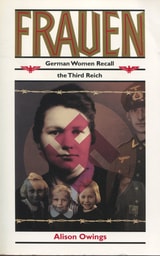
Frauen
German Women Recall the Third ReichOwings, Alison
Rutgers University Press, 1995
What were the women of Germany doing during the Third Reich? What were they thinking? And what do they have to say a half century later?
In Frauen we hear their voices––most for the first time. Alison Owings interviewed and here records the words of twenty-nine German women who were there: Working for the Resistance. Joining the Nazi Party. Outsmarting the Gestapo. Disliking a Jewish neighbor. Hiding a Jewish friend. Witnessing "Kristallnacht." Witnessing the firebombing of Dresden. Shooting at Allied planes. Welcoming Allied troops. Being a prisoner. And being a guard. The women recall their own and others' enthusiasm, doubt, fear, fury, cowardice, guilt, and anguish.
Alison Owings, in her pursuit of such memories, was invited into the homes of these women. Because she is neither Jewish nor German, and because she speaks fluent colloquial German, many of the women she interviewed felt comfortable enough with her to unlock the past. What they have to say will surprise Americans, just as they surprised the women themselves.
Not since Marcel Ophuls's controversial film The Sorrow and the Pity have we been on such intimate terms with "the enemy." In this case, the story is that of the women, those who did not make policy but were forced to participate in its effects and to witness its results. What they did and did not do is not just a reflection on them and their country––it also leads us to question what actions we might have taken in their place. The interviews do not allow for easy, smug answers.
From Text to Context
The Turn to History in Modern JudaismIsmar Schorsch
Brandeis University Press, 1994

From Text to Context
The Turn to History in Modern JudaismIsmar Schorsch
University Press of New England, 2003

From that Place and Time
A Memoir, 1938-1947Dawidowicz, Lucy
Rutgers University Press, 2008
Nancy Sinkoff's new introduction explores the historical forces, particularly the dynamic world of secular Yiddish culture, which shaped Dawidowicz's decision to journey to Poland and her reassessment of those forces in the last years of her life.
From the Jewish Heartland
Two Centuries of Midwest FoodwaysEllen F. Steinberg and Jack H. Prost
University of Illinois Press, 2013