Results by title
59 books match the query 'Joseph, Gilbert M.' and 6 start with f
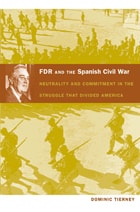
FDR and the Spanish Civil War
Neutrality and Commitment in the Struggle that Divided AmericaDominic Tierney
Duke University Press, 2007
Between 1936 and 1939, Roosevelt’s perceptions of the Spanish Civil War were transformed. Initially indifferent toward which side won, FDR became an increasingly committed supporter of the leftist government. He believed that German and Italian intervention in Spain was part of a broader program of fascist aggression, and he worried that the Spanish Civil War would inspire fascist revolutions in Latin America. In response, Roosevelt tried to send food to Spain as well as illegal covert aid to the Spanish government, and to mediate a compromise solution to the civil war. However unsuccessful these initiatives proved in the end, they represented an important stage in Roosevelt’s emerging strategy to aid democracy in Europe.
Financial Missionaries to the World
The Politics and Culture of Dollar Diplomacy, 1900-1930Emily S. Rosenberg
Duke University Press, 2003
Financial Missionaries to the World establishes the broad scope and significance of "dollar diplomacy"—the use of international lending and advising—to early-twentieth-century U.S. foreign policy. Combining diplomatic, economic, and cultural history, the distinguished historian Emily S. Rosenberg shows how private bank loans were extended to leverage the acceptance of American financial advisers by foreign governments. In an analysis striking in its relevance to contemporary debates over international loans, she reveals how a practice initially justified as a progressive means to extend “civilization” by promoting economic stability and progress became embroiled in controversy. Vocal critics at home and abroad charged that American loans and financial oversight constituted a new imperialism that fostered exploitation of less powerful nations. By the mid-1920s, Rosenberg explains, even early supporters of dollar diplomacy worried that by facilitating excessive borrowing, the practice might induce the very instability and default that it supposedly worked against.
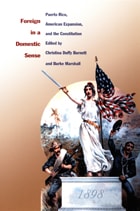
Foreign in a Domestic Sense
Puerto Rico, American Expansion, and the ConstitutionChristina Duffy Burnett and Burke Marshall, eds.
Duke University Press, 2001
More than four million U.S. citizens currently live in five “unincorporated” U.S. territories. The inhabitants of these vestiges of an American empire are denied full representation in Congress and cannot vote in presidential elections. Focusing on Puerto Rico, the largest and most populous of the territories, Foreign in a Domestic Sense sheds much-needed light on the United States’ unfinished colonial experiment and its legacy of racially rooted imperialism, while insisting on the centrality of these “marginal” regions in any serious treatment of American constitutional history. For one hundred years, Puerto Ricans have struggled to define their place in a nation that neither wants them nor wants to let them go. They are caught in a debate too politicized to yield meaningful answers. Meanwhile, doubts concerning the constitutionality of keeping colonies have languished on the margins of mainstream scholarship, overlooked by scholars outside the island and ignored by the nation at large.
This book does more than simply fill a glaring omission in the study of race, cultural identity, and the Constitution; it also makes a crucial contribution to the study of American federalism, serves as a foundation for substantive debate on Puerto Rico’s status, and meets an urgent need for dialogue on territorial status between the mainland and the territories.
Contributors. José Julián Álvarez González, Roberto Aponte Toro, Christina Duffy Burnett, José A. Cabranes, Sanford Levinson, Burke Marshall, Gerald L. Neuman, Angel R. Oquendo, Juan Perea, Efrén Rivera Ramos, Rogers M. Smith, E. Robert Statham Jr., Brook Thomas, Richard Thornburgh, Juan R. Torruella, José Trías Monge, Mark Tushnet, Mark Weiner
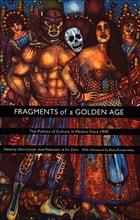
Fragments of a Golden Age
The Politics of Culture in Mexico Since 1940Gilbert M. Joseph, Anne Rubenstein, and Eric Zolov, eds.
Duke University Press, 2001
Each essay in its own way addresses the fragmentation of a cultural consensus that prevailed during the “golden age” of post–revolutionary prosperity, a time when the state was still successfully bolstering its power with narratives of modernization and shared community. Combining detailed case studies—both urban and rural—with larger discussions of political, economic, and cultural phenomena, the contributors take on such topics as the golden age of Mexican cinema, the death of Pedro Infante as a political spectacle, the 1951 “caravan of hunger,” professional wrestling, rock music, and soap operas.
Fragments of a Golden Age will fill a particular gap for students of modern Mexico, Latin American studies, cultural studies, political economy, and twentieth century history, as well as to others concerned with rethinking the cultural dimensions of nationalism, imperialism, and modernization.
Contributors. Steven J. Bachelor, Quetzil E. Castañeda, Seth Fein, Alison Greene, Omar Hernández, Jis & Trino, Gilbert M. Joseph, Heather Levi, Rubén Martínez, Emile McAnany, John Mraz, Jeffrey M. Pilcher, Elena Poniatowska, Anne Rubenstein, Alex Saragoza, Arthur Schmidt, Mary Kay Vaughan, Eric Zolov
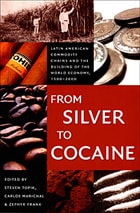
From Silver to Cocaine
Latin American Commodity Chains and the Building of the World Economy, 1500-2000Steven Topik, Carlos Marichal, and Zephyr Frank, eds.
Duke University Press, 2006
By focusing on changing patterns of production and consumption over time, the contributors reconstruct complex webs of relationships and economic processes, highlighting Latin America’s central and interactive place in the world economy. They show how changes in coffee consumption habits, clothing fashions, drug usage, or tire technologies in Europe, Asia, and the Americas reverberate through Latin American commodity chains in profound ways. The social and economic outcomes of the continent’s export experience have been mixed. By analyzing the dynamics of a wide range of commodities over a five-hundred-year period, From Silver to Cocaine highlights this diversity at the same time that it provides a basis for comparison and points to new ways of doing global history.
Contributors. Marcelo Bucheli, Horacio Crespo, Zephyr Frank, Paul Gootenberg, Robert Greenhill, Mary Ann Mahony, Carlos Marichal, David McCreery, Rory Miller, Aldo Musacchio, Laura Nater, Ian Read, Mario Samper, Steven Topik, Allen Wells
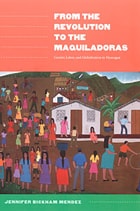
From the Revolution to the Maquiladoras
Gender, Labor, and Globalization in NicaraguaJennifer Bickham Mendez
Duke University Press, 2005
Mendez draws on interviews with leaders and program participants, including maquiladora workers; her participant observation while she worked as a volunteer within the organization; and analysis of the public statements, speeches, and texts written by mec members. She provides a sense of the day-to-day operations of the group as well as its strategies. By exploring the tension between mec and transnational feminist, labor, and solidarity networks, she illustrates how mec women’s outlooks are shaped by both their revolutionary roots within the Sandinista regime and their exposure to global discourses of human rights and citizenship. The complexities of the women’s labor movement analyzed in From the Revolution to the Maquiladoras speak to social and economic justice movements in the many locales around the world.