92 books match the query 'Judges' and 3 start with f

cover of Fifty-Eight Lonely Men: Southern Federal Judges and School Desegregation

Fifty-Eight Lonely Men

Southern Federal Judges and School Desegregation

J. W. Peltason

University of Illinois Press, 1971

Originally published in 1961, this still timely book illustrates the role of the judiciary in the solution of a social and political problem. It is unequaled in its description of the plight of federal judges who are charged with carrying out the decisions of the Supreme Court against segregation but who are under constant pressure--social, political, and personal--to speak for the white South. Some have been ostracized by their communities as traitors; others have joined their state legislatures and local school boards in developing elaborate delay strategy to circumvent the Supreme Court's decisions. In his introduction to the first edition former Senator Paul H. Douglas wrote: ". . . a clear and comprehensive account of the legal struggles in the federal courts over segregation and desegregation in the public schools of the nation. It gets behind the newspaper headlines and gives a play-by-play account. . . . This book is indeed full proof of the delays and difficulties of the law and the pressures of local public opinion."
[more]
cover of Frank Murphy: The Detroit Years

Frank Murphy

The Detroit Years

Sidney Fine

University of Michigan Press, 1975
The second son of a close-knit Irish-American family, a charismatic politician who championed the underdog yet enjoyed the company of the rich, Frank Murphy was for thirty years an influential figure on the American scene. As Recorder’s Court judge, mayor of Detroit during the Great Depression, governor-general of and high commissioner to the Philippines, governor of Michigan, United States attorney general, and justice of the United States Supreme Court, he played a dramatic role in some of the most significant events of our era. This first volume of what will surely be the definitive account of the life and times of Frank Murphy focuses on the Detroit years, when Murphy brought his courtroom skills to bear on landmark legal battles of the period, forged a New Deal type of coalition that altered the structure of political power in Detroit, and led the city through the darkest days of the Depression. By stressing the interaction between the man and his times, the book presents not only a fully rounded portrait of a fascinating personality but also provides the first detailed coverage of the work of the Detroit Recorder’s Court and an unequaled account of the Depression years in Detroit and the state of Michigan.
[more]
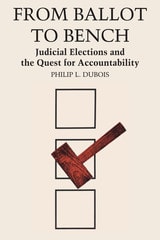
cover of From Ballot to Bench: Judicial Elections and the Quest for Accountability

From Ballot to Bench

Judicial Elections and the Quest for Accountability

By Philip L. Dubois

University of Texas Press, 1980

Over several decades, many U.S. states abandoned the practice of selecting their judges by direct popular election and adopted the Missouri Plan of judicial selection. In From Ballot to Bench, Philip L. Dubois subjects the various criticisms raised against judicial elections to a more searching scrutiny than previously has been attempted.

Dubois carefully reviews the three central counts on which judicial elections have been faulted: for lowering the quality of the bench, for impairing judicial independence, and for failing to secure judicial accountability. After concluding that the potential for judicial elections to hold judges popularly accountable is what might commend them over alternative selection methods, Dubois concentrates on the analysis of empirical evidence to evaluate judicial elections as mechanisms of accountability.

The study examines all the statewide partisan and nonpartisan elections for state supreme court justices in non-southern states from 1948 to 1974. Included is a detailed examination of voter participation, electoral competition, the behavior of judicial electorates, and the patterns of gubernatorial vacancy appointments. An analysis of decision making on eight state supreme courts also tests the relationship between different selection systems and judicial behavior.

Dubois finds that partisan elections maximize voter participation, meaningfully structure voter choices, minimize accession to the bench by appointment, and allow popular control over gubernatorial appointments. Additional evidence on the extent of partisan voting by judges selected under different methods leads Dubois to conclude that partisan elections are superior to both nonpartisan elections and nonelective selection methods as instruments of accountability.

The importance of the questions addressed, the breadth of the data collected, and the unorthodox conclusions offered make this a significant book for political scientists, judges, lawyers, and public officials.

[more]