527 books match the query 'Labor' and 13 start with f
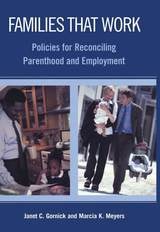
cover of Families That Work: Policies for Reconciling Parenthood and Employment

Families That Work

Policies for Reconciling Parenthood and Employment

Janet C. Gornick

Russell Sage Foundation, 2003

Parents around the world grapple with the common challenge of balancing work and child care. Despite common problems, the industrialized nations have developed dramatically different social and labor market policies—policies that vary widely in the level of support they provide for parents and the extent to which they encourage an equal division of labor between parents as they balance work and care. In Families That Work, Janet Gornick and Marcia Meyers take a close look at the work-family policies in the United States and abroad and call for a new and expanded role for the U.S. government in order to bring this country up to the standards taken for granted in many other Western nations. In many countries in Europe and in Canada, family leave policies grant parents paid time off to care for their young children, and labor market regulations go a long way toward ensuring that work does not overwhelm family obligations. In addition, early childhood education and care programs guarantee access to high-quality care for their children. In most of these countries, policies encourage gender equality by strengthening mothers' ties to employment and encouraging fathers to spend more time caregiving at home. In sharp contrast, Gornick and Meyers show how in the United States—an economy with high labor force participation among both fathers and mothers—parents are left to craft private solutions to the society-wide dilemma of "who will care for the children?" Parents—overwhelmingly mothers—must loosen their ties to the workplace to care for their children; workers are forced to negotiate with their employers, often unsuccessfully, for family leave and reduced work schedules; and parents must purchase care of dubious quality, at high prices, from consumer markets. By leaving child care solutions up to hard-pressed working parents, these private solutions exact a high price in terms of gender inequality in the workplace and at home, family stress and economic insecurity, and—not least—child well-being. Gornick and Meyers show that it is possible–based on the experiences of other countries—to enhance child well-being and to increase gender equality by promoting more extensive and egalitarian family leave, work-time, and child care policies. Families That Work demonstrates convincingly that the United States has much to learn from policies in Europe and in Canada, and that the often-repeated claim that the United States is simply "too different" to draw lessons from other countries is based largely on misperceptions about policies in other countries and about the possibility of policy expansion in the United States.
[more]
cover of Fantasies of Hong Kong Disneyland: Attempted Indigenizations of Space, Labor, and Consumption

Fantasies of Hong Kong Disneyland

Attempted Indigenizations of Space, Labor, and Consumption

Jenny Banh

Rutgers University Press, 2025
Fantasies of Hong Kong Disneyland: Attempted Indigenizations of Space, Labor, and Consumption examines the attempt to transplant Disney's "happiest place on Earth" ethos to Hong Kong—with unhappy results. Focusing on the attempted localization/indigenization of this idea in a globalized transnational park, the book delves into the three-way dynamics of an American culture-corporation's intentions, Hong Kong, China's government investment and Hong Konger audience, and the Hong Kong Chinese locale. The triple actors introduce an especially complex case as two of the world's most powerful entities, the nominally Communist state of China and corporate behemoth Disney, come together for a project in the third space of Hong Kong. The situation poses special challenges for Disney's efforts to manage space, labor, and consumption to achieve local adaptation and business success. 
[more]
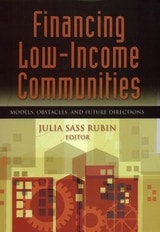
cover of Financing Low Income Communities

Financing Low Income Communities

Julia Sass Rubin

Russell Sage Foundation, 2007
Access to capital and financial services is crucial for healthy communities.  However, many impoverished individuals and neighborhoods are routinely ignored by mainstream financial institutions.  This neglect led to the creation of community development financial institutions (CDFIs), which provide low-income communities with financial services and act as a conduit to conventional financial organizations and capital markets. Edited by Julia Sass Rubin, Financing Low-Income Communities brings together leading experts in the field to assess what we know about the challenges of bringing financial services and capital to poor communities, map out future lines of research, and propose policy reforms to make these efforts more effective. The contributors to Financing Low-Income Communities distill research on key topics related to community development finance. Daniel Schneider and Peter Tufano examine the obstacles that make saving and asset accumulation difficult for low-income households—such as the fact that tens of millions of low-income and minority adults don't have a bank account—and consider solutions, like making it easier for low-wage workers to enroll in 401(K) plans. Jeanne Hogarth, Jane Kolodinksy, and Marianne Hilgert review evidence showing that community-based financial education programs can be effective in changing families' saving and budgeting patterns.  Lisa Servon proposes strategies for addressing the challenges facing the microenterprise field in the United States.  Julia Sass Rubin discusses ways community loan and venture capital funds have adapted in response to the decreased availability of funding, and considers potential sources of new capital, such as state governments and public pension funds.  Marva Williams explores the evolution and recent performance of community development banks and credit unions.  Kathleen Engel and Patricia McCoy document the proliferation of predatory lenders, who market loans at onerous interest rates to financially vulnerable families and the devastating effects of such lending on communities—from increased crime to falling home values and lower tax revenues. Rachel Bratt reviews the policies and programs used to make rental and owned housing financially accessible.  Rob Hollister proposes a framework for evaluating the contributions of community development financial institutions. Despite the many accomplishments of CDFIs over the last four decades, changing political and economic conditions make it imperative that they adapt in order to survive.  Financing Low-Income Communities charts out new directions for public and private organizations which aim to end the financial exclusion of marginalized neighborhoods.
[more]
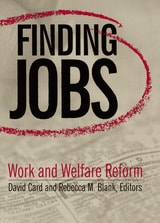
cover of Finding Jobs: Work and Welfare Reform

Finding Jobs

Work and Welfare Reform

David Card

Russell Sage Foundation, 2000

Do plummeting welfare caseloads and rising employment prove that welfare reform policies have succeeded, or is this success due primarily to the job explosion created by today's robust economy? With roughly one to two million people expected to leave welfare in the coming decades, uncertainty about their long-term prospects troubles many social scientists. Finding Jobs offers a thorough examination of the low-skill labor market and its capacity to sustain this rising tide of workers, many of whom are single mothers with limited education. Each chapter examines specific trends in the labor market to ask such questions as: How secure are these low-skill jobs, particularly in the event of a recession? What can these workers expect in terms of wage growth and career advancement opportunities? How will a surge in the workforce affect opportunities for those already employed in low-skill jobs? Finding Jobs offers both good and bad news about work and welfare reform. Although the research presented in this book demonstrates that it is possible to find jobs for people who have traditionally relied on public assistance, it also offers cautionary evidence that today's strong economy may mask enduring underlying problems. Finding Jobs shows that the low-wage labor market is particularly vulnerable to economic downswings and that lower skilled workers enjoy less job stability. Several chapters illustrate why financial incentives, such as the Earned Income Tax Credit (EITC), are as essential to encouraging workforce participation as job search programs. Other chapters show the importance of including provisions for health insurance, and of increasing subsidies for child care to assist the large population of working single mothers affected by welfare reform. Finding Jobs also examines the potential costs of new welfare restrictions. It looks at how states can improve their flexibility in imposing time limits on families receiving welfare, and calls into question the cutbacks in eligibility for immigrants, who traditionally have relied less on public assistance than their native-born counterparts. Finding Jobs is an informative and wide-ranging inquiry into the issues raised by welfare reform. Based on comprehensive new data, this volume offers valuable guidance to policymakers looking to design policies that will increase work, raise incomes, and lower poverty in changing economic conditions.
[more]
cover of Fires on the Border: The Passionate Politics of Labor Organizing on the Mexican Frontera

Fires on the Border

The Passionate Politics of Labor Organizing on the Mexican Frontera

Rosemary Hennessy

University of Minnesota Press, 2013

The history of the maquiladoras has been punctuated by workers’ organized resistance to abysmal working and living conditions. Over years of involvement in such movements, Rosemary Hennessy was struck by an elusive but significant feature of these struggles: the extent to which organizing is driven by attachments of affection and antagonism, belief, betrayal, and identification.

What precisely is the “affective” dimension of organizing for justice? Are affects and emotions the same? And how can their value be calculated? Fires on the Border takes up these questions of labor and community organizing—its “affect-culture”—on Mexico’s northern border from the early 1970s to the present day. Through these campaigns, Hennessy illuminates the attachments and identifications that motivate people to act on behalf of one another and that bind them to a common cause. The book’s unsettling, even jarring, narratives bring together empirical and ethnographic accounts—of specific campaigns, the untold stories of gay and lesbian organizers, love and utopian longing—in concert with materialist theories of affect and the critical good sense of Mexican organizers.

Teasing out the integration of affect-culture in economic relations and cultural processes, Hennessy provides evidence that sexuality and gender as strong affect attractors are incorporated in the harvesting of surplus labor. At the same time, workers’ testimonies confirm that the capacities for bonding and affective attachment, far from being entirely at the service of capital, are at the very heart of social movements devoted to sustaining life.
[more]
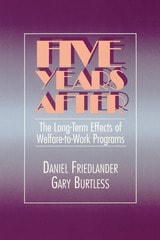
cover of Five Years After: The Long-Term Effects of Welfare-to-Work Programs

Five Years After

The Long-Term Effects of Welfare-to-Work Programs

Daniel Friedlander

Russell Sage Foundation, 1995
Friedlander and Burtless teach us why welfare reform will not be easy. Their sobering assessment of job training programs willenlighten a debate too often dominated by wishful thinking and political rhetoric. Look for their findings to be cited for many years to come. —Douglas Besharov, American Enterprise Institute A methodologically astute study that sheds considerable light on the potential for and limits to raising the employment and earnings of welfare recipients and provides benchmarks against which the impacts of later programs can be compared. —Journal of Economic Literature With welfare reforms tested in almost every state and plans for a comprehensive federal overall on the horizon, it is increasingly important for Americans to understand how policy changes are likely to affect the lives of welfare recipients. Five Years After tells the story of what happened to the welfare recipients who participated in the influential welfare-to-work experiments conducted by several states in the mid-1980s.The authors review the distinctive goals and procedures of evaluations performed in Arkansas, Baltimore, San Diego, and Virginia, and then examine five years of follow-up data to determine whether the initial positive impact on employment, earnings, and welfare costs held up over time. The results were surprisingly consistent. Low-cost programs that saved money by getting individuals into jobs quickly did little to reduce poverty in the long run. Only higher-cost educational programs enabled welfare recipients to hold down jobs successfully and stay off welfare. Five Years After ends speculation about the viability of the first generation of employment programs for welfare recipients, delineates the hard choices that must be made among competing approaches, and provides a well-documented foundation for building more comprehensive programs for the next generation. A sobering tale for welfare reformers of all political persuasions, this book poses a serious challenge to anyone who promises to end welfare dependency by cutting welfare budgets.
[more]
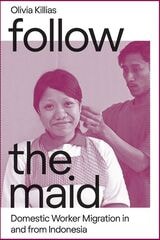
cover of Follow the Maid: Domestic Worker Migration from Indonesia

Follow the Maid

Domestic Worker Migration from Indonesia

Olivia Killias

National University of Singapore Press, 2017

This fascinating study unveils the workings of the Indonesian migration regime, one that sends hundreds of thousands of women abroad as domestic workers each year. Drawing on extended ethnographic research since 2007, the book literally follows migrant women from one particular village in Central Java and tracks the moral, social, economic and legal processes by which they are turned into ‘maids’. From recruitment by local brokers to the ‘training’ received in secluded camps in Jakarta, employment in gated middle-class homes in Malaysia and back home again, Olivia Killias highlights the implications of the migration process on gendered practices of labour mobility (and immobilisation). She also reveals the disciplinary power that states, recruitment agencies and employers exercise over migrant domestic workers as well as highlighting frictions within the system. Killias’s analysis demonstrates that ironically, the “legalisation” of the migration industry, under the joint pressures of the Indonesian migration bureaucracy and international humanitarian agencies, does not automatically improve the situation of the women who embark on the migration adventure. Rather, Killias unmasks the gendered moralizing discourses on “illegal” migration and “trafficking” as legitimizing indentured labour and constraining migrant mobility. By exploring the workings of the Indonesian state’s overseas legal labour migration regime for migrants, she brings the reader directly into the nerve-racking lives of migrant village women, and reveals the richness and ambiguity of their experiences, going beyond stereotypical representations of them as “victims of trafficking”.
[more]
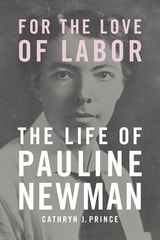
cover of For the Love of Labor: The Life of Pauline Newman

For the Love of Labor

The Life of Pauline Newman

Cathryn J. Prince

University of Illinois Press, 2026

From her start as one of the youngest activists in US history, Pauline Newman helped shape the International Ladies' Garment Workers’ Union (ILGWU) into a dominant force in industrial America. Cathryn J. Prince tells the story of a self-educated Jewish immigrant who dedicated herself to a legion of causes and lifelong battles against sexism and classism.

Prince follows Newman’s life from a youth split between Lithuania and New York City sweatshops to her work as an advisor to New Deal–era labor secretary Frances Perkins. Newman’s long hours at the Triangle Shirtwaist Factory informed her entrée into labor activism. In the following years, she tirelessly advocated for workers, ran for New York Secretary of State as a socialist, and became the first woman to serve as the ILGWU general organizer. Her interest in the health of workers led to service on the Joint Board of Sanitary Control and a decades-long term as education director of the ILGWU health center. Membership in Eleanor Roosevelt’s circle opened doors to government positions and advisory roles that continued into the postwar era. Prince also weaves in the details of Newman’s fifty-year relationship with a woman, her struggles with her sexual identity, and her final years.

Engaging and panoramic, For the Love of Labor is the first major biography of an important figure in labor and women’s history.
[more]
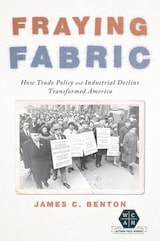
cover of Fraying Fabric: How Trade Policy and Industrial Decline Transformed America

Fraying Fabric

How Trade Policy and Industrial Decline Transformed America

James C. Benton

University of Illinois Press, 2022

The decline of the U.S. textile and apparel industries between the 1940s and 1970s helped lay the groundwork for the twenty-first century's potent economic populism in America. James C. Benton looks at how shortsighted trade and economic policy by labor, business, and government undermined an employment sector that once employed millions and supported countless communities. Starting in the 1930s, Benton examines how the New Deal combined promoting trade with weakening worker rights. He then moves to the ineffective attempts to aid textile and apparel workers even as imports surged, the 1974 pivot by policymakers and big business to institute lowered trade barriers, and the deindustrialization and economic devastation that followed. Throughout, Benton provides the often-overlooked views of workers, executives, and federal officials who instituted the United States’ policy framework in the 1930s and guided it through the ensuing decades. Compelling and comprehensive, Fraying Fabric explains what happened to textile and apparel manufacturing and how it played a role in today's politics of anger.
[more]
cover of Free Time: The Forgotten American Dream

Free Time

The Forgotten American Dream

Benjamin Hunnicutt

Temple University Press, 2013

Has the "American Dream" become an unrealistic utopian fantasy, or have we simply forgotten what we are working for? In his topical book, Free Time, Benjamin Kline Hunnicutt examines the way that progress, once defined as more of the good things in life as well as more free time to enjoy them, has come to be understood only as economic growth and more work, forevermore.

Hunnicutt provides an incisive intellectual, cultural, and political history of the original "American Dream" from the colonial days to the present. Taking his cue from Walt Whitman's "higher progress," he follows the traces of that dream, cataloging the myriad voices that prepared for and lived in an opening "realm of freedom."

Free Time reminds Americans of the forgotten, best part of the "American Dream"-that more and more of our lives might be lived freely, with an enriching family life, with more time to enjoy nature, friendship, and the adventures of the mind and of the spirit.
[more]
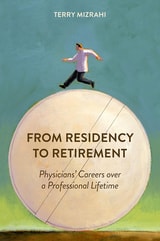
cover of From Residency to Retirement: Physicians' Careers over a Professional Lifetime

From Residency to Retirement

Physicians' Careers over a Professional Lifetime

Terry Mizrahi

Rutgers University Press, 2021

From Residency to Retirement tells the stories of twenty American doctors over the last half century, which saw a period of continuous, turbulent, and transformative changes to the U.S. health care system. The cohort’s experiences are reflective of the generation of physicians who came of age as presidents Carter and Reagan began to focus on costs and benefits of health services.
 
Mizrahi observed and interviewed these physicians in six timeframes ending in 2016. Beginning with medical school in the mid-1970s, these physicians reveal the myriad fluctuations and uncertainties in their professional practice, working conditions, collegial relationships, and patient interactions. In their own words, they provide a “view from the front lines” both in academic and community settings. They disclose the satisfactions and strains in coping with macro policies enacted by government and insurance companies over their career trajectory.
 
They describe their residency in internal medicine in a large southern urban medical center as a “siege mentality” which lessened as they began their careers, in Getting Rid of Patients, the title of Mizrahi’s first book (1986). As these doctors moved on in their professional lives more of their experiences were discussed in terms of dissatisfaction with financial remuneration, emotional gratification, and intellectual fulfillment. Such moments of career frustration, however, were also interspersed with moments of satisfaction at different stages of their medical careers. Particularly revealing was whether they were optimistic about the future at each stage of their career and whether they would recommend a medical career to their children. Mizrahi's subjects also divulge their private feelings of disillusionment and fear of failure given the malpractice epidemic and lawsuits threatened or actually brought against so many doctors. Mizrahi’s work, covering almost fifty years, provides rarely viewed insights into the lives of physicians over a professional life span.
[more]
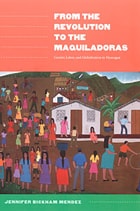
cover of From the Revolution to the Maquiladoras: Gender, Labor, and Globalization in Nicaragua

From the Revolution to the Maquiladoras

Gender, Labor, and Globalization in Nicaragua

Jennifer Bickham Mendez

Duke University Press, 2005

From the Revolution to the Maquiladoras is a major contribution to the study of globalization, labor, and women’s movements. Jennifer Bickham Mendez presents a detailed ethnographic account of the Nicaraguan Working and Unemployed Women’s Movement, “María Elena Cuadra” (mec), which emerged as an autonomous organization in 1994. Most of its efforts revolve around organizing women workers in Nicaragua’s free trade zones and working to improve conditions in maquiladora factories. Mendez examines the structural and cultural elements of mec in order to demonstrate how globalization affects grassroots advocacy for social and economic justice. She argues that globalization has created opportunities for new forms of organizing among those local populations that suffer its effects and that mec, which has forged vital links with transnational feminist and labor groups, exemplifies the possibilities—and pitfalls—of this new type of organizing.

Mendez draws on interviews with leaders and program participants, including maquiladora workers; her participant observation while she worked as a volunteer within the organization; and analysis of the public statements, speeches, and texts written by mec members. She provides a sense of the day-to-day operations of the group as well as its strategies. By exploring the tension between mec and transnational feminist, labor, and solidarity networks, she illustrates how mec women’s outlooks are shaped by both their revolutionary roots within the Sandinista regime and their exposure to global discourses of human rights and citizenship. The complexities of the women’s labor movement analyzed in From the Revolution to the Maquiladoras speak to social and economic justice movements in the many locales around the world.
[more]
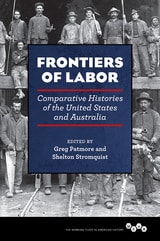
cover of Frontiers of Labor: Comparative Histories of the United States and Australia

Frontiers of Labor

Comparative Histories of the United States and Australia

Edited by Greg Patmore and Shelton Stromquist

University of Illinois Press, 2018

Alike in many aspects of their histories, Australia and the United States diverge in striking ways when it comes to their working classes, labor relations, and politics.

Greg Patmore and Shelton Stromquist curate innovative essays that use transnational and comparative analysis to explore the two nations’ differences. The contributors examine five major areas: World War I’s impact on labor and socialist movements; the history of coerced labor; patterns of ethnic and class identification; forms of working-class collective action; and the struggles related to trade union democracy and independent working-class politics. Throughout, many essays highlight how hard-won transnational ties allowed Australians and Americans to influence each other’s trade union and political cultures.

Contributors: Robin Archer, Nikola Balnave, James R. Barrett, Bradley Bowden, Verity Burgmann, Robert Cherny, Peter Clayworth, Tom Goyens, Dianne Hall, Benjamin Huf, Jennie Jeppesen, Marjorie A. Jerrard, Jeffrey A. Johnson, Diane Kirkby, Elizabeth Malcolm, Patrick O’Leary, Greg Patmore, Scott Stephenson, Peta Stevenson-Clarke, Shelton Stromquist, and Nathan Wise

[more]