75 books match the query 'Latin' and 5 start with f
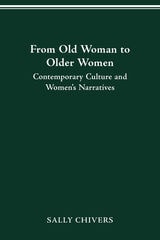
cover of FROM OLD WOMAN TO OLDER WOMEN: Contemporary Culture and Women’s Narratives

FROM OLD WOMAN TO OLDER WOMEN

Contemporary Culture and Women’s Narratives

Sally Chivers

The Ohio State University Press, 2003

Sally Chivers provides a fascinating look at and challenge to how North American popular culture has portrayed old age as a time of disease, decline, and death. Within contemporary Canadian literary and film production, a tradition of articulate central elderly female characters challenges what the aging body has come to signify in a broader cultural context. Rather than seek positive images of aging, which can do their own prescriptive damage, the author focuses on constructive depictions that provide a basis on which to create new stories and readings of growing old. This type of humanities approach to the study of aging promises neither to fixate on nor avoid consideration of the role of the body in the much broader process of getting older. The progression implied in the title from the solitary symbol of The Old Woman toward a community of older women, indicates not a move toward euphemism, but rather an increasing and necessary awareness of the social and cultural dimensions of aging.

[more]
cover of Fasciculus Moralitatis: Omelie Morales de Infantia Saluatoris

Fasciculus Moralitatis

Omelie Morales de Infantia Saluatoris

Caesarius of Heisterbach

Karolinum Press, 2023

The first critical edition of Caesarius’ Omelie morales de infantia Saluatoris—Homilies on Jesus’ Childhood.

Primarily known as the author of the Dialogus miraculorum—a collection of exemplary stories that secured his reputation as the master of Cistercian storytelling—Caesarius of Heisterbach was also the author of several sermons and homilies. Although they are not as well known today, his Homilies on Jesus’ Childhood are exceptional in many ways. Readers will immediately notice Caesarius’s versatility as he employs an impressive array of persuasive techniques: quoting scholarly works, interpreting Hebrew names and letters, delving into etymology and numerology, and including numerous examples to instruct both the learned and the common person.
[more]
cover of Florentine Codex: Book 1: Book 1: The Gods

Florentine Codex

Book 1: Book 1: The Gods

Bernardino de Sahagun

University of Utah Press, 1981

Two of the world’s leading scholars of the Aztec language and culture have translated Sahagún’s monumental and encyclopedic study of native life in Mexico at the time of the Spanish Conquest. This immense undertaking is the first complete translation into any language of Sahagún’s Nahuatl text, and represents one of the most distinguished contributions in the fields of anthropology, ethnography, and linguistics.

Written between 1540 and 1585, the Florentine Codex (so named because the manuscript has been part of the Laurentian Library’s collections since at least 1791) is the most authoritative statement we have of the Aztecs’ lifeways and traditions—a rich and intimate yet panoramic view of a doomed people.

The Florentine Codex is divided by subject area into twelve books and includes over 2,000 illustrations drawn by Nahua artists in the sixteenth century.

Book One describes in detail the gods of the Aztec people, including Uitzilopochtli, Tlatoc, and Quetzalcoatl. This colorful and clear translation brings to life characteristics of each god, describing such items as clothing or adornment worn by individual gods, as well as specific personality traits.
[more]
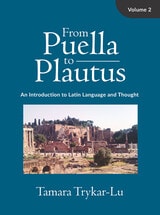
cover of From Puella to Platus: An Introduction to Latin Language and Thought, Volume 2

From Puella to Platus

An Introduction to Latin Language and Thought, Volume 2

Tamara Trykar-Lu

Catholic University of America Press, 2019
Whether to enlarge your general education, improve your English, or just because you are curious about the society that has had such a lasting influence on our history, our language, our thoughts, and our culture, you should and can learn Latin. Tamara Trykar-Lu's charming and delightful introduction to Latin, From Puella to Plautus, Part I, is designed for beginning to intermediate Latin study, at the high school or college level, either with the aid of a teacher and classroom or simply for personal enjoyment and enrichment. A thorough review of English grammar with detailed explanations makes it easy for the reader to grasp new concepts in Latin. Learning Latin vocabulary becomes manageable once you realize how much ‘Latin’ vocabulary there is in English. You will quickly learn to read Latin with short stories and, gradually, more demanding selections. Readers will translate the story of Romulus and Remus and the founding of Rome, but also the tale of Nivea -- Snow White -- and some parts of Shakespeare's plays. Short sections show how English developed, how Latin influenced it, and where they both belong in the world of languages. Each chapter ends with a brief outline of some aspect of Roman culture, such as housing, fauna and flora, games, crafts, water supply, and cooking – with recipes. And last but not least there are informative tidbits, drawings, cartoons, jokes, riddles, crossword puzzles, and, of course, pictures distributed throughout the book. For while foreign-language study should be logical, coherent, and rigorous, it need not be heavy-handed or pedantic, and certainly not dull. Ideal for use in courses or for brushing up your language skills, From Puella to Plautus is a lively and engaging book about the Latin language and life in the Roman Empire.
[more]
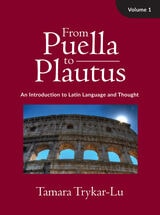
cover of From Puella to Plautus: An Introduction to Latin Language and Thought, Volume 1

From Puella to Plautus

An Introduction to Latin Language and Thought, Volume 1

Tamara Trykar-Lu

Catholic University of America Press, 2019

Whether to enlarge your general education, improve your English, or just because you are curious about the society that has had such a lasting influence on our history, our language, our thoughts, and our culture, you should and can learn Latin. Tamara Trykar-Lu's charming and delightful introduction to Latin, From Puella to Plautus, Part I, is designed for beginning to intermediate Latin study, at the high school or college level, either with the aid of a teacher and classroom or simply for personal enjoyment and enrichment. A thorough review of English grammar with detailed explanations makes it easy for the reader to grasp new concepts in Latin. Learning Latin vocabulary becomes manageable once you realize how much ‘Latin’ vocabulary there is in English. You will quickly learn to read Latin with short stories and, gradually, more demanding selections. Readers will translate the story of Romulus and Remus and the founding of Rome, but also the tale of Nivea -- Snow White -- and some parts of Shakespeare's plays. Short sections show how English developed, how Latin influenced it, and where they both belong in the world of languages. Each chapter ends with a brief outline of some aspect of Roman culture, such as housing, fauna and flora, games, crafts, water supply, and cooking – with recipes. And last but not least there are informative tidbits, drawings, cartoons, jokes, riddles, crossword puzzles, and, of course, pictures distributed throughout the book. For while foreign-language study should be logical, coherent, and rigorous, it need not be heavy-handed or pedantic, and certainly not dull. Ideal for use in courses or for brushing up your language skills, From Puella to Plautus is a lively and engaging book about the Latin language and life in the Roman Empire.
[more]