Results by title
320 books match the query 'Legal status, laws, etc' and 10 start with f
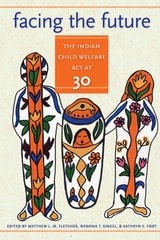
Facing the Future
The Indian Child Welfare Act at 30Matthew L.M. Fletcher
Michigan State University Press, 2009
The U.S. Congress is charged with responsibility for the protection and preservation of American Indian tribes, including Indian children. In 1978, Congress enacted the Indian Child Welfare Act (ICWA), with the intent to "protect the best interests of Indian children and to promote the stability and security of Indian tribes and families." ICWA sets federal requirements that apply to state child custody proceedings involving an Indian child who is a member of or eligible for membership in a federally recognized tribe. ICWA also sets out federal requirements regarding removal of Indian children and their placement in foster or adoptive homes, and it allows the child's tribe to intervene in the case.
The history of the Act is a tangle of legal, social, and emotional complications. Some state courts have found unusual legal arguments to avoid applying the law, while some states have gone beyond the terms of the Act to provide greater protections for Indian people. This collection brings together for the first time a multidisciplinary assessment of the law—with scholars, practitioners, lawyers, and social workers all offering perspectives on the value and importance of the Indian Child Welfare Act.
Faith in Paper
The Ethnohistory and Litigation of Upper Great Lakes Indian TreatiesCharles E. Cleland
University of Michigan Press, 2011
Fetal Rights, Women's Rights
Gender Equality in the WorkplaceSuzanne U. Samuels
University of Wisconsin Press, 1995
In the late 1970s and throughout the 1980s, many private employers in the United States enacted fetal protection policies that barred fertile women—that is, women who had not been surgically sterilized—from working in jobs that might expose fetuses to toxins. In Fetal Rights, Women’s Rights, Suzanne Samuels analyzes these policies and the ambiguous responses to them by federal and state courts, legislatures, administrative agencies, litigants, and interest groups. She poses provocative questions about the implicit links between social welfare concerns and paternalism in the workplace, including: are women workers or wombs?
Placing the fetal protection controversy within the larger societal debate about gender roles, Samuels argues that governmental decision-makers confuse sex, which is based solely on biological characteristics, with gender, which is based on societal conceptions. She contends that the debate about fetal protection policies brought this ambiguity into stark relief, and that the response of policy-makers was rooted in assumptions about gender roles. Judges, legislators, and regulators used gender as a proxy, she argues, to sidestep the question of whether fetal protection policies could be justified by the biological differences between women and men.
The fetal protection controversy raises a number of concerns about women's role in the workplace. Samuels discusses the effect on governmental policies of the ongoing controversy over abortion rights and the debates between egalitarian and relational feminists about the treatment of women at work. A timely and engrossing study, Fetal Rights, Women's Rights details the pattern of gender politics in the United States and demonstrates the broader ramifications of gender bias in the workplace.
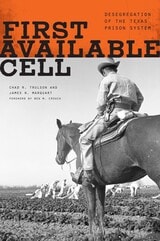
First Available Cell
Desegregation of the Texas Prison SystemBy Chad R. Trulson and James W. Marquart
University of Texas Press, 2009
Decades after the U.S. Supreme Court and certain governmental actions struck down racial segregation in the larger society, American prison administrators still boldly adhered to discriminatory practices. Not until 1975 did legislation prohibit racial segregation and discrimination in Texas prisons. However, vestiges of this practice endured behind prison walls. Charting the transformation from segregation to desegregation in Texas prisons—which resulted in Texas prisons becoming one of the most desegregated places in America—First Available Cell chronicles the pivotal steps in the process, including prison director George J. Beto's 1965 decision to allow inmates of different races to co-exist in the same prison setting, defying Southern norms.
The authors also clarify the significant impetus for change that emerged in 1972, when a Texas inmate filed a lawsuit alleging racial segregation and discrimination in the Texas Department of Corrections. Perhaps surprisingly, a multiracial group of prisoners sided with the TDC, fearing that desegregated housing would unleash racial violence. Members of the security staff also feared and predicted severe racial violence. Nearly two decades after the 1972 lawsuit, one vestige of segregation remained in place: the double cell. Revealing the aftermath of racial desegregation within that 9 x 5 foot space, First Available Cell tells the story of one of the greatest social experiments with racial desegregation in American history.

First, Do No Harm
Power, Oppression, and Violence in HealthcareEdited by Nancy L. Diekelmann
University of Wisconsin Press, 2002
First, Do No Harm shows how health care professionals, with the best intentions of providing excellent, holistic health care, can nonetheless perpetuate violence against vulnerable patients. The essays investigate the need to rethink contemporary healthcare practices in ways that can bring the art and science of medicine back into sorely needed balance.
These ground-breaking studies by noted scholars question commonly held assumptions in contemporary healthcare that underlie oppressive power dynamics and even violence for patients and their families. The contributors discuss such topics as women and violence, life-support technologies, and healthcare professionals’ own experiences as patients. First, Do No Harm opens the discourse for reaching new understandings, from reassessing the meaning of "quality of life" to questioning the appropriateness of the very language used by healthcare professionals. It will be welcomed by healthcare workers and by scholars in nursing, medicine, and the allied health sciences.

Freeman's Challenge
The Murder That Shook America's Original Prison for ProfitRobin Bernstein
University of Chicago Press, 2024
An award-winning historian tells a gripping, morally complicated story of murder, greed, race, and the true origins of prison for profit.
In the early nineteenth century, as slavery gradually ended in the North, a village in New York State invented a new form of unfreedom: the profit-driven prison. Uniting incarceration and capitalism, the village of Auburn built a prison that enclosed industrial factories. There, “slaves of the state” were leased to private companies. The prisoners earned no wages, yet they manufactured furniture, animal harnesses, carpets, and combs, which consumers bought throughout the North. Then one young man challenged the system.
In Freeman’s Challenge, Robin Bernstein tells the story of an Afro-Native teenager named William Freeman who was convicted of a horse theft he insisted he did not commit and sentenced to five years of hard labor in Auburn’s prison. Incensed at being forced to work without pay, Freeman demanded wages. His challenge triggered violence: first against him, then by him. Freeman committed a murder that terrified and bewildered white America. And white America struck back—with aftereffects that reverberate into our lives today in the persistent myth of inherent Black criminality. William Freeman’s unforgettable story reveals how the North invented prison for profit half a century before the Thirteenth Amendment outlawed slavery “except as a punishment for crime”—and how Frederick Douglass, Harriet Tubman, and other African Americans invented strategies of resilience and resistance in a city dominated by a citadel of unfreedom.
Through one Black man, his family, and his city, Bernstein tells an explosive, moving story about the entangled origins of prison for profit and anti-Black racism.
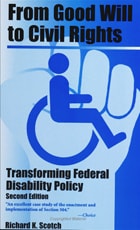
From Good Will To Civil Rights
Transforming Federal Disability PolicyRichard K. Scotch
Temple University Press, 2001
The first edition of From Good Will to Civil Rights traced the changes in federal disability policy, focusing on the development and implementation of Section 504 of the Rehabilitation Act of 1973. Richard K. Scotch's extensive interviews with policymakers, leaders of the disability rights movement, and other advocates, supplemented the sketchy official history of the legislation with the detailed, behind-the-scenes story, illuminating the role of the disability rights movement in shaping Section 504. Charting the shifts in policy and activist agendas through the 1990's, this new edition surveys the effects and disappointments associated with the Americans with Disabilities Act, passed in 1990, in the context of the continuing movement to secure civil rights for disabled people.

From Threatening Guerrillas to Forever Illegals
US Central Americans and the Cultural Politics of Non-BelongingYajaira M. Padilla
University of Texas Press, 2022
The experience of Central Americans in the United States is marked by a vicious contradiction. In entertainment and information media, Salvadorans, Guatemalans, Nicaraguans, and Hondurans are hypervisible as threatening guerrillas, MS-13 gangsters, maids, and “forever illegals.” Central Americans are unseen within the broader conception of Latinx community, foreclosing avenues to recognition.
Yajaira M. Padilla explores how this regime of visibility and invisibility emerged over the past forty years—bookended by the right-wing presidencies of Ronald Reagan and Donald Trump—and how Central American immigrants and subsequent generations have contested their rhetorical disfiguration. Drawing from popular films and TV, news reporting, and social media, Padilla shows how Central Americans in the United States have been constituted as belonging nowhere, imagined as permanent refugees outside the boundaries of even minority representation. Yet in documentaries about cross-border transit through Mexico, street murals, and other media, US Central Americans have counteracted their exclusion in ways that defy dominant paradigms of citizenship and integration.

From good will to civil rights
transforming federal disability policyRichard K. Scotch
Temple University Press, 1984
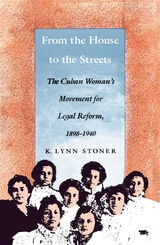
From the House to the Streets
The Cuban Woman's Movement for Legal Reform, 1898-1940K. Lynn Stoner
Duke University Press, 1991
Stoner draws on rich primary sources—texts, personal letters, journal essays, radio broadcasts, memoirs from women’s congresses—which allow these women to speak in their own voices. In reconstructing the mentalité of Cuban feminists, who came primarily from a privileged social status, Stoner shows how feminism drew from traditional notions of femininity and a rejection of gender equality to advance a cause that assumed women’s expanded roles were necessary for social progress. She also examines the values of the progressive male politicians who supported feminists and worked to change Cuban laws.