85 books match the query 'Literature and history' and 5 start with f
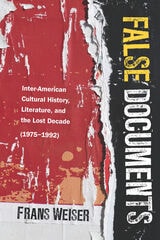
cover of False Documents: Inter-American Cultural History, Literature, and the Lost Decade (1975–1992)

False Documents

Inter-American Cultural History, Literature, and the Lost Decade (1975–1992)

Frans Weiser

The Ohio State University Press, 2020

False Documents: Inter-American Cultural History, Literature, and the Lost Decade (1975–1992) examines the “return of history” that swept across the Americas during the final two decades of the Cold War as Latin American nations redemocratized and US multiculturalism responded to the conservative bicentennial backlash. Revising the predominantly economic and isolationist accounts of the era, Frans Weiser examines the work of journalists and academics from Hispanic America, Brazil, and the United States who adopted fiction to document recent national discord, repositioning challenges to self-determination in a postnational context.
After deconstructing economic accounts of the “two Americas" model of the hemisphere, including the lost decade (1981–1992) and the “end of history” (1975–1992), Weiser considers six case studies during the same period that reach very different conclusions by drawing on cultural history, including works by Tomás Eloy Martínez, Laura Antillano, Ana Maria Machado, Silviano Santiago, John Updike, and Jay Cantor. In order to expose how governments controlled and misrepresented recent events, these writers created false documents, or fake historical texts, that presented themselves as legitimate eyewitness accounts or archival documents. Weiser establishes how this alternative to postmodern irony more effectively galvanized citizen responses. As the first book to contextualize the parallel, hemispheric evolutions of postwar literary criticism and cultural historiography, False Documents responds to the methodological impasse between Latin American and American studies as well as the antagonism between history and literature, arguing that collaboration and synthesis are particularly vital at a moment when the humanities is increasingly under attack.
 
[more]
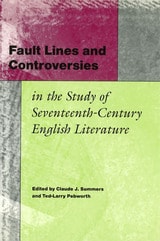
cover of Fault Lines and Controversies in the Study of Seventeenth-Century English Literature

Fault Lines and Controversies in the Study of Seventeenth-Century English Literature

Edited & Intro Claude J. Summers & Ted-Lary Pebworth

University of Missouri Press, 2002
Written by various experts in the field, this volume of thirteen original essays explores some of the most significant theoretical and practical fault lines and controversies in seventeenth-century English literature. The turn into the twenty-first century is an appropriate time to take stock of the state of the field, and, as part of that stock-taking, the need arises to assess both where literary study of the early modern period has been and where it might desirably go. Hence, many of the essays in this collection look both backward and forward. They chart the changes in the field over the past half century, while also looking forward to more change in the future.
            Some of the essays collected here explore the points of friction, vulnerability, and division that have emerged in literary study of all periods at the end of the twentieth century, such as theory, gender, sexuality, race, and religion. Others are more narrowly focused on fault lines and controversies peculiar to the study of Renaissance and seventeenth-century literature. At the same time nearly all of these essays examine and illuminate particular works of literature. They engage theory, but they also illustrate their points concretely by enacting practical criticism of works by authors ranging from Bacon to Milton. What emerges from the collection is a sense of the field’s dynamism and vitality. The dominant mood of the essays is a cautious optimism, and, while the contributors are by no means complacent, they all share a belief that the fault lines that have emerged in the field are variously and valuably instructive. 
By exposing these fault lines the essayists seek a means of acknowledging differences and disagreements without covering them up. They also constructively suggest ways of addressing the issues as a prerequisite to bridging them. By broaching some of the most significant questions that animate the study of early modern literature at the turn into a new century, this volume will be of great value to any student or scholar of seventeenth-century literature.
[more]
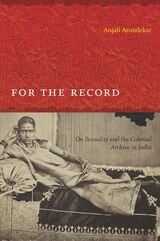
cover of For the Record: On Sexuality and the Colonial Archive in India

For the Record

On Sexuality and the Colonial Archive in India

Anjali Arondekar

Duke University Press, 2009

Anjali Arondekar considers the relationship between sexuality and the colonial archive by posing the following questions: Why does sexuality (still) seek its truth in the historical archive? What are the spatial and temporal logics that compel such a return? And conversely, what kind of “archive” does such a recuperative hermeneutics produce? Rather than render sexuality’s relationship to the colonial archive through the preferred lens of historical invisibility (which would presume that there is something about sexuality that is lost or silent and needs to “come out”), Arondekar engages sexuality’s recursive traces within the colonial archive against and through our very desire for access.

The logic and the interpretive resources of For the Record arise out of two entangled and minoritized historiographies: one in South Asian studies and the other in queer/sexuality studies. Focusing on late colonial India, Arondekar examines the spectacularization of sexuality in anthropology, law, literature, and pornography from 1843 until 1920. By turning to materials and/or locations that are familiar to most scholars of queer and subaltern studies, Arondekar considers sexuality at the center of the colonial archive rather than at its margins. Each chapter addresses a form of archival loss, troped either in a language of disappearance or paucity, simulacrum or detritus: from Richard Burton’s missing report on male brothels in Karáchi (1845) to a failed sodomy prosecution in Northern India, Queen Empress v. Khairati (1884), and from the ubiquitous India-rubber dildos found in colonial pornography of the mid-to-late nineteenth century to the archival detritus of Kipling’s stories about the Indian Mutiny of 1857.
[more]
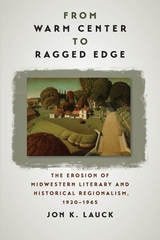
cover of From Warm Center to Ragged Edge: The Erosion of Midwestern Literary and Historical Regionalism, 1920-1965

From Warm Center to Ragged Edge

The Erosion of Midwestern Literary and Historical Regionalism, 1920-1965

Jon K. Lauck

University of Iowa Press, 2017

During the half-century after the Civil War, intellectuals and politicians assumed the Midwest to be the font and heart of American culture. Despite the persistence of strong currents of midwestern regionalism during the 1920s and 1930s, the region went into eclipse during the post–World War II era. In the apt language of Minnesota’s F. Scott Fitzgerald, the Midwest slid from being the “warm center” of the republic to its “ragged edge.”

This book explains the factors that triggered the demise of the Midwest’s regionalist energies, from anti-midwestern machinations in the literary world and the inability of midwestern writers to break through the cultural politics of the era to the growing dominance of a coastal, urban culture. These developments paved the way for the proliferation of images of the Midwest as flyover country, the Rust Belt, a staid and decaying region. Yet Lauck urges readers to recognize persisting and evolving forms of midwestern identity and to resist the forces that squelch the nation’s interior voices.
[more]
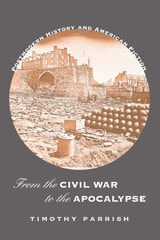
cover of From the Civil War to the Apocalypse: Postmodern History and American Fiction

From the Civil War to the Apocalypse

Postmodern History and American Fiction

Timothy Parrish

University of Massachusetts Press, 2008

Why don't we read novels as if they were histories and histories as if they were novels? Recent postmodern theorists such as Hayden White and Linda Hutcheon have argued that since history is a narrative art, it must be understood as a form of narrative representation analogous to fiction. Yet, contrary to the fears of some historians, such arguments have not undermined the practice of history as a meaningful enterprise so much as they have highlighted the appeal history has as a narrative craft.

In addressing the postmodernist claim that history works no differently than fiction, Timothy Parrish rejects the implication that history is dead or hopelessly relativistic. Rather, he shows how the best postmodern novelists compel their readers to accept their narratives as true in the same way that historians expect their readers to accept their narratives as true. These novelists write history as a form of fiction.

If the great pre-modernist American historians are Francis Parkman, George Bancroft, and Henry Adams, who are the great modernist or postmodernist historians? In the twentieth century, Parrish argues, the most powerful works of American history were written by William Faulkner, Toni Morrison, Thomas Pynchon, Don DeLillo, Joan Didion, and Cormac McCarthy. What survives a reading of these novels is the sense that writers otherwise identified as multicultural or postmodern share the view that nothing matters more than history and what one believes its possibilities to be. In other words, Parrish concludes, history, not identity, is the ground of postmodern American fiction.
[more]