Results by title
58 books match the query 'Margins' and 3 start with f

Feelings at the Margins
Dealing with Violence, Stigma and Isolation in IndonesiaEdited by Birgitt Röttger-Rössler and Thomas Stodulka
Campus Verlag, 2014
Feelings at the Margins offers a uniquely interdisciplinary take on the contemporary phenomenon of marginalization in Indonesia and its emotional impact on affected individuals and groups. By combining anthropological, political, and historical perspectives on Indonesian particularities with more universal conclusions, this volume is sure to attract not only scholars with a regional interest in the archipelago, but also researchers more broadly concerned with the interplay between stigma, marginality, culture, and emotion. Moreover, the book’s vivid ethnographic case studies—detailing recurring acts of violence against communities based on their ethnicity, gender, sexuality, descent, and religion—and discussion of significant sociocultural and political developments in early twenty-first-century Indonesia will make it a valuable resource for scholars of social and political activism.
[more]
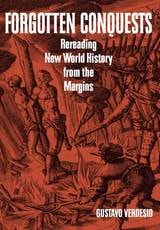
Forgotten Conquests
Rereading New World History from the MarginsGustavo Verdesio
Temple University Press, 2001
Borrowing from the old adage, we might say that to the victor belongs the history. One of the privileges gained in colonizing the New World was the power to tell the definitive stories of the struggle. The heroic texts depicting the discovery of territories, early encounters with indigenous peoples, and the ultimate subjection of land and cultures to European nation-states all but erase the vanquished. In Forgotten Conquests, Gustavo Verdesio argues that these master narratives represent only one of many possible histories and suggests a way of reading them in order to discover the colonial subjects who did not produce documents.
Verdesio read the key texts relating to the struggles for possession of River Plate's northern shore -- present-day Uruguay. He probes them for traces of conflicts in meaning and the agency of Amerindians, gauchos, Africans, and women -- the subjected peoples that the texts try to silence. The narrators, speaking for their culture, assume the role of knowing subject, repressing all other voices, epistemologies, and acts of resistance. Verdesio's tasks are to listen for those that the Europeans represented as an unintelligible Other, to draw them into the foreground, and to decolonize their histories.
By unpacking these texts, Verdesio shows that from the European point of view, the colonial encounter draws the New World into historical time and ushers in a new concept of knowledge. For the first time, the historian's role is to discover, to interpret eyewitness testimonies and first-hand experience, to write 'a new history of admirable things.' Even in this reconstruction of historical truth, Old World ideology drives the narratives, whose chief purpose is to justify conquest. Forgotten Conquests lays bare the discursive strategies that generated the founding texts of Latin American history and engulfed its subjected peoples in silence for 500 years.
[more]
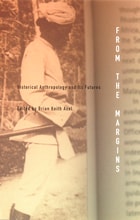
From the Margins
Historical Anthropology and Its FuturesBrian Keith Axel, ed.
Duke University Press, 2002
Historical anthropology: critical exchange between two decidedly distinct disciplines or innovative mode of knowledge production? As this volume’s title suggests, the essays Brian Keith Axel has gathered in From the Margins seek to challenge the limits of discrete disciplinary epistemologies and conventions, gesturing instead toward a transdisciplinary understanding of the emerging relations between archive and field.
In original articles encompassing a wide range of geographic and temporal locations, eminent scholars contest some of the primary preconceptions of their fields. The contributors tackle such topics as the paradoxical nature of American Civil War monuments, the figure of the “New Christian” in early seventeenth-century Peru, the implications of statistics for ethnography, and contemporary South Africa's “occult economies.” That anthropology and history have their provenance in—and have been complicit with—colonial formations is perhaps commonplace knowledge. But what is rarely examined is the specific manner in which colonial processes imbue and threaten the celebratory ideals of postcolonial reason or the enlightenment of today’s liberal practices in the social sciences and humanities.
By elaborating this critique, From the Margins offers diverse and powerful models that explore the intersections of historically specific local practices with processes of a world historical order. As such, the collection will not only prove valuable reading for anthropologists and historians, but also for scholars in colonial, postcolonial, and globalization studies.
Contributors. Talal Asad, Brian Keith Axel, Bernard S. Cohn, Jean Comaroff, John L. Comaroff, Nicholas B. Dirks, Irene Silverblatt, Paul A. Silverstein, Teri Silvio, Ann Laura Stoler, Michel-Rolph Trouillot
[more]