Results by title
50 books match the query 'Marine Biology' and 4 start with f
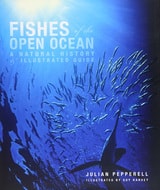
Fishes of the Open Ocean
A Natural History and Illustrated GuideJulian Pepperell
University of Chicago Press, 2010
Between the surface of the sea and depths of two hundred meters lies a remarkable range of fish, generally known as pelagics, or open-ocean dwellers. These creatures are among the largest, fastest, highest-leaping, and most migratory fish on the entire planet. Beautifully adapted to their world, they range from tiny drift fish and plankton-straining whale sharks to more streamlined predators such as tuna, marlin, sailfish, and wahoo.
Fishes of the Open Ocean, from leading marine biologist and world authority on the subject Julian Pepperell, is the first book to comprehensively describe these fishes and explore the complex and often fragile world in which they live. In what will be the definitive book on the subject for years to come—and, with over three hundred color images, the most lavishly produced as well—Pepperell details the environment and biology of every major species of fish that inhabits the open ocean, an expanse that covers 330 million cubic miles and is the largest aquatic habitat on the Earth. The first section of the book introduces the various evolutionary forms these fish have taken, as well as the ways in which specific species interact and coevolve with others in the food web. A chapter on commercial and sport fisheries explores the human element in this realm and considers such issues as sustainability, catch-and-release initiatives, and the risks of extinction.
The second section of the book provides species accounts of open ocean dwellers organized by group, with overviews and general descriptions that are inclusive of range and distribution, unique physiological and morphological attributes, and the role of each species within its ecosystem. Global distribution maps, original illustrations from renowned artist and scientist Guy Harvey, and truly stunning images from some of the world’s leading underwater photographers round out this copiously illustrated volume.
Fishing Lessons
Artisanal Fisheries and the Future of Our OceansKevin M. Bailey
University of Chicago Press, 2018
Bailey knows these waters, the artisanal fisheries, and their relationship with larger ocean ecology intimately. In a series of place-based portraits, he shares stories of decline and success as told by those at the ends of the long lines and hand lines, channeling us through the changing dynamics of small-scale fisheries and the sustainability issues they face—both fiscal and ecological. We encounter Paolo Vespoli and his tiny boat, the Giovanni Padre,in the Gulf of Naples; Wenche, a sea Sámi, one of the indigenous fisherwomen of Norway; and many more. From salmon to abalone, the Bay of Fundy to Monterey and the Amazon, Bailey’s catch is no fish tale. It is a global story, casting a net across waters as vast and distinct as Puget Sound and the Chilean coast. Sailing across the world, Bailey explores the fast-shifting current of how we gather food from the sea, what we gain and what we lose with these shifts, and potential solutions for the murky passage ahead.
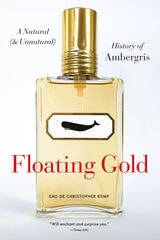
Floating Gold
A Natural (and Unnatural) History of AmbergrisChristopher Kemp
University of Chicago Press, 2012
A fascinating natural history of an incredibly curious substance.
“Preternaturally hardened whale dung” is not the first image that comes to mind when we think of perfume, otherwise a symbol of glamour and allure. But the key ingredient that makes the sophisticated scent linger on the skin is precisely this bizarre digestive by-product—ambergris. Despite being one of the world’s most expensive substances (its value is nearly that of gold and has at times in history been triple it), ambergris is also one of the world’s least known. But with this unusual and highly alluring book, Christopher Kemp promises to change that by uncovering the unique history of ambergris.
A rare secretion produced only by sperm whales, which have a fondness for squid but an inability to digest their beaks, ambergris is expelled at sea and floats on ocean currents for years, slowly transforming, before it sometimes washes ashore looking like a nondescript waxy pebble. It can appear almost anywhere but is found so rarely, it might as well appear nowhere. Kemp’s journey begins with an encounter on a New Zealand beach with a giant lump of faux ambergris—determined after much excitement to nothing more exotic than lard—that inspires a comprehensive quest to seek out ambergris and its story. He takes us from the wild, rocky New Zealand coastline to Stewart Island, a remote, windswept island in the southern seas, to Boston and Cape Cod, and back again. Along the way, he tracks down the secretive collectors and traders who populate the clandestine modern-day ambergris trade.
Floating Gold is an entertaining and lively history that covers not only these precious gray lumps and those who covet them, but presents a highly informative account of the natural history of whales, squid, ocean ecology, and even a history of the perfume industry. Kemp’s obsessive curiosity is infectious, and eager readers will feel as though they have stumbled upon a precious bounty of this intriguing substance.
Future Sea
How to Rescue and Protect the World’s OceansDeborah Rowan Wright
University of Chicago Press, 2020
The world’s oceans face multiple threats: the effects of climate change, pollution, overfishing, plastic waste, and more. Confronted with the immensity of these challenges and of the oceans themselves, we might wonder what more can be done to stop their decline and better protect the sea and marine life. Such widespread environmental threats call for a simple but significant shift in reasoning to bring about long-overdue, elemental change in the way we use ocean resources. In Future Sea, ocean advocate and marine-policy researcher Deborah Rowan Wright provides the tools for that shift. Questioning the underlying philosophy of established ocean conservation approaches, Rowan Wright lays out a radical alternative: a bold and far-reaching strategy of 100 percent ocean protection that would put an end to destructive industrial activities, better safeguard marine biodiversity, and enable ocean wildlife to return and thrive along coasts and in seas around the globe.
Future Sea is essentially concerned with the solutions and not the problems. Rowan Wright shines a light on existing international laws intended to keep marine environments safe that could underpin this new strategy. She gathers inspiring stories of communities and countries using ocean resources wisely, as well as of successful conservation projects, to build up a cautiously optimistic picture of the future for our oceans—counteracting all-too-prevalent reports of doom and gloom. A passionate, sweeping, and personal account, Future Sea not only argues for systemic change in how we manage what we do in the sea but also describes steps that anyone, from children to political leaders (or indeed, any reader of the book), can take toward safeguarding the oceans and their extraordinary wildlife.