Results by title
80 books match the query 'Medical (incl. Patients)' and 6 start with f
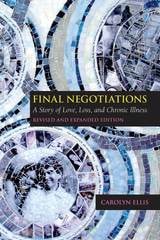
Final Negotiations
A Story of Love, Loss, and Chronic IllnessCarolyn Ellis
Temple University Press, 2018
Taking an autoethnographic perspective, Ellis focuses on her feeling and thinking self in relationships, narrating particular lived experiences that offer a gateway into understanding interpersonal and cultural life. In her new epilogue, “From New Endings to New Beginnings,” Ellis describes her changed identity and how Final Negotiations informs her life and her understanding of how she and her current partner grow older together. She hopes her book provides companionship and comfort to readers who also will suffer loss in their lives.
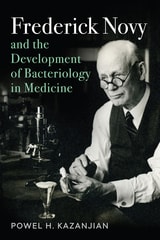
Frederick Novy and the Development of Bacteriology in Medicine
Kazanjian, Powel H
Rutgers University Press, 2017
In Frederick Novy and the Development of Bacteriology in Medicine, medical historian, medical researcher, and clinician Powel H. Kazanjian uses Novy’s archived letters, laboratory notebooks, lecture notes, and published works to examine medical research and educational activities at the University of Michigan and other key medical schools during a formative period in modern medical science.

Frontier Doctor
Observations on Central Oregon and the Changing WestUrling C. Coe
Oregon State University Press, 1996
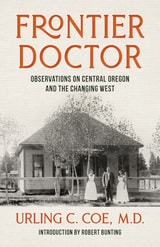
Frontier Doctor
Observations on Central Oregon and the Changing WestUrling C. Coe
Oregon State University Press, 1940
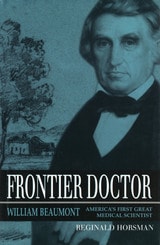
Frontier Doctor
William Beaumont, America's First Great Medical ScientistReginald Horsman
University of Missouri Press, 1996
In Frontier Doctor, Reginald Horsman provides the first modern, scholarly biography of a colorful backwoods doctor whose pioneering research on human digestion gained him international renown as a physiologist. Before William Beaumont's work, there was still considerable controversy as to the nature of human digestion; his research established beyond a doubt that digestion is a chemical process.
Beaumont received his medical training as an apprentice in a small town in Vermont and served as a surgeon's mate in the War of 1812. After the war, he practiced in Plattsburgh, New York, before making his career as an army surgeon. His chance for fame came in 1822, when he was serving at the lonely post of Fort Mackinac in Michigan Territory. A Canadian voyageur--Alexis St. Martin--was accidentally shot in the stomach at close range, and his wound healed in such a way as to leave a permanent opening. This enabled Beaumont to insert food directly into the stomach, to siphon gastric juice, and to experiment on the process of digestion both inside and outside the stomach.
Because Beaumont had considerable difficulty in persuading St. Martin to stay with him so he could continue his research, his study was carried out sporadically over a number of years. In the early 1830s, with the support of Joseph Lovell, the surgeon general of the army, Beaumont and St. Martin went to the East Coast, where additional experiments were carried out. In 1833, Beaumont published Experiments and Observations on the Gastric Juice and the Physiology of Digestion, a book based upon his research on St. Martin and the work upon which his reputation primarily rests. His observations revealed more about digestion in the human stomach than had ever before been known, and his work was immediately praised in both the United States and Europe.
After he left the army, Beaumont established a successful private practice in St. Louis, Missouri, where he spent the latter part of his life. Beaumont, a fascinating, argumentative character, was often engaged in public controversy. He was also good friends with several notable men, including the young Robert E. Lee.
Frontier Doctor sheds welcome new light on the state of medicine both inside and outside the army in the early nineteenth century and provides absorbing information on the early experi-ments that set the research into human digestion irrevocably on the right course.
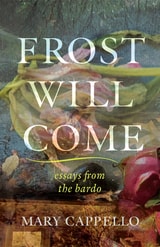
Frost Will Come
Essays from the BardoMary Cappello
University of Wisconsin Press, 2026
When her octogenarian poet mother was diagnosed with terminal ovarian cancer, Mary Cappello and her wife moved into the living room of Rosemary’s one-bedroom apartment in Philadelphia to help fulfill her wish to live out her life at home. A memoir in the form of lyric essays—with her mother’s own writing interspersed—Frost Will Come is a daughter’s tribute to her mother’s months-long transition from a deeply lived life to a difficult, beautiful, and uneasy death.
Cappello renders an immersive and emotionally honest portrait of modern caregiving in a prose style that is the very definition of candor. While paying homage to expert caregivers and medical professionals, Cappello also brings her signature razor-sharp analysis to all the things that fall outside the realm of (medical) knowledge—from platitudes around the time death takes to the defiance of a “peaceful death” as a sign of a moral failing. More than a memoir of grief, Frost Will Come is a rare reckoning with the very fundamentals of existence: how we come into being, how we care, and how we die.