Results by title
237 books match the query 'Medicine' and 12 start with f
Faith In The Future
Healthcare, Aging and the Role of ReligionHarold Koenig
Templeton Press, 2012
After an interview in Newsweek about his book Spirituality in Patient Care and his research in religion and health, Dr. Harold Koenig became the international voice on spirituality, health, and aging. In this book, Faith in the Future, he is joined by two other experts on aging and human development. They present a compelling look at one of the most severe issues in today’s society: health care in America.
How will we provide quality healthcare to older adults needing it during the next thirty to fifty years? Who will provide this care? How will it be funded? How can we establish systems of care now to be in place as demographic and health-related economic pressures mount?
Alongside the sobering reality of our country’s challenges, there are reasons for optimism. Innovative programs created and maintained by volunteers and religious congregations are emerging as pivotal factors in meeting healthcare needs. Summarizing decades of scientific research and providing numerous inspirational examples and role models, the authors present practical steps that individuals and institutions may emulate for putting faith into action.
<
Feminism in Twentieth-Century Science, Technology, and Medicine
Edited by Angela N. H. Creager, Elizabeth Lunbeck, and Londa Schiebinger
University of Chicago Press, 2001
Contributors:
Ruth Schwartz Cowan
Linda Marie Fedigan
Scott Gilbert
Evelynn M. Hammonds
Evelyn Fox Keller
Pamela E. Mack
Michael S. Mahoney
Emily Martin
Ruth Oldenziel
Nelly Oudshoorn
Carroll Pursell
Karen Rader
Alison Wylie
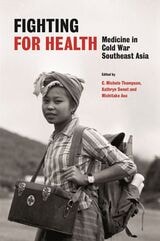
Fighting for Health
Medicine in Cold War Southeast AsiaEdited by C. Michele Thompson, Kathryn Sweet, and Michitake Aso
National University of Singapore Press, 2024
For far too long, Southeast Asia has been treated as a static backdrop for the exploits and discoveries of Western biomedical doctors. Yet, Southeast Asians have been vital to the significant developments in the prevention and treatment of diseases that have taken place in the region and beyond. Many of the institutions and people that shaped subsequent responses to outbreaks, epidemics, and pandemics first began their work in Southeast Asia during the Cold War. The diversity of approaches to health and medicine during that era also reminds us of the possibilities, and limits, of human intervention in the face of political, social, economic, and microbial realities. The people and places of Southeast Asia have provided clinical trials for different health regimes. Fighting for Health highlights new perspectives and methods that have evolved from research presented at regional conferences, including the History of Medicine in Southeast Asia (HOMSEA) series. These insights serve to challenge dominant models of the medical humanities.
Folk Practices in North Mexico
Birth Customs, Folk Medicine, and Spiritualism in the Laguna ZoneBy Isabel Kelly
University of Texas Press, 1965
The Mexican folkways described in this monograph, of scientific interest to anthropologists, will fascinate laypeople as well. Isabel Kelly collected these notes in the 1950s, as a diversion when official field work was not feasible, in the vicinity of Torreón and particularly in the nearby village of El Cuije, in northern Mexico. She recounts folk customs and habits, focusing on beliefs and practices related to health and healing and on notions concerning magic. These form, Kelly believes, a core of folk culture which has survived tenaciously in the rural areas and on the outskirts of the cities, among mestizo families of scant education and limited economic resources.
These people are well acquainted with simple, matter-of-fact illnesses which result from natural causes and which respond to treatment by herbal and other home remedies or by modern medicines. But they also recognize the evil eye and the emotional upset known as “fright.” They are thoroughly familiar with the ever-present danger of ailments which are not “natural” and God-sent, but which are deliberately inflicted by an enemy, through the artifice of a sorcerer or a spiritualist. Such “instigated” illnesses may take any form, from a cold in the head to a false pregnancy. If a person suspects that poor health results from such malevolence, he or she spurns Western medicine and looks instead to the witch or to the spiritualist as the only hope of a cure.
El Cuije pays an annual quota from community funds to make available modern health services provided by the government. But community funds are similarly drawn upon to provide “medical” attention for those who repair to the sorcerers. Once a week the village truck takes all presumed witchcraft victims to a nearby town, where they receive clinical treatment from professional sorcerers.
Kelly sees little that is genuinely indigenous in the beliefs and practices described; many of them demonstrably result from infiltration from the Old World in the years following the Spanish Conquest. She considers spiritualistic curing—important in northern Mexico and many other parts of Latin America—in some detail, but the specific outlines of its history in northern Mexico still awaited clarification at the time of her research.
For All of Humanity
Mesoamerican and Colonial Medicine in Enlightenment GuatemalaMartha Few
University of Arizona Press, 2015
For All of Humanity examines the first public health campaigns in Guatemala, southern Mexico, and Central America in the eighteenth and early nineteenth centuries. Martha Few pays close attention to Indigenous Mesoamerican medical cultures, which not only influenced the shape and scope of those regional campaigns but also affected the broader New World medical cultures. The author reconstructs a rich and complex picture of the ways colonial doctors, surgeons, Indigenous healers, midwives, priests, government officials, and ordinary people engaged in efforts to prevent and control epidemic disease.
Few’s analysis weaves medical history and ethnohistory with social, cultural, and intellectual history. She uses prescriptive texts, medical correspondence, and legal documents to provide rich ethnographic descriptions of Mesoamerican medical cultures, their practitioners, and regional pharmacopeia that came into contact with colonial medicine, at times violently, during public health campaigns.
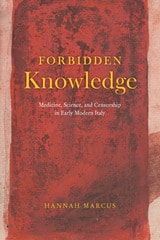
Forbidden Knowledge
Medicine, Science, and Censorship in Early Modern ItalyHannah Marcus
University of Chicago Press, 2020
Forbidden Knowledge explores the censorship of medical books from their proliferation in print through the prohibitions placed on them during the Counter-Reformation. How and why did books banned in Italy in the sixteenth century end up back on library shelves in the seventeenth? Historian Hannah Marcus uncovers how early modern physicians evaluated the utility of banned books and facilitated their continued circulation in conversation with Catholic authorities.
Through extensive archival research, Marcus highlights how talk of scientific utility, once thought to have begun during the Scientific Revolution, in fact, began earlier, emerging from ecclesiastical censorship and the desire to continue to use banned medical books. What’s more, this censorship in medicine, which preceded the Copernican debate in astronomy by sixty years, has had a lasting impact on how we talk about new and controversial developments in scientific knowledge. Beautiful illustrations accompany this masterful, timely book about the interplay between efforts at intellectual control and the utility of knowledge.
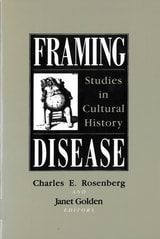
Framing Disease
Studies in Cultural HistoryRosenberg, Charles E
Rutgers University Press, 1992
"In some ways disease does not exist until we have agreed that it does, by perceiving, naming, and responding to it, " writes Charles E. Rosenberg in his introduction to this stimulating set of essays. Disease is both a biological event and a social phenomenon. Patient, doctor, family, and social institutions—including employers, government, and insurance companies—all find ways to frame the biological event in terms that make sense to them and serve their own ends.
Many diseases discussed here—endstage renal disease, rheumatic fever, parasitic infectious diseases, coronary thrombosis—came to be defined, redefined, and renamed over the course of several centuries. As these essays show, the concept of disease has also been used to frame culturally resonant behaviors: suicide, homosexuality, anorexia nervosa, chronic fatigue syndrome. Disease is also framed by public policy, as the cases of industrial disability and of forensic psychiatry demonstrate. Medical institutions, as managers of people with disease, come to have vested interests in diagnoses, as the histories of facilities to treat tuberculosis or epilepsy reveal. Ultimately, the existence and conquest of disease serves to frame a society's sense of its own "healthiness" and to give direction to social reforms.
The contributors include Steven J. Peitzman, Peter C. English, John Farley, Christopher Lawrence, Michael MacDonald, Bert Hansen, Joan Jacobs Brumberg, Robert A. Aronowitz, Gerald Markowitz, David Rosner, Janet A. Tighe, Barbara Bates, Ellen Dwyer, John M. Eyler, and Elizabeth Fee. For any student of disease and society, this book is essential, compelling reading.
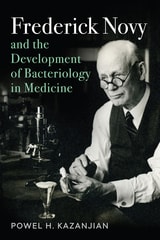
Frederick Novy and the Development of Bacteriology in Medicine
Kazanjian, Powel H
Rutgers University Press, 2017
In Frederick Novy and the Development of Bacteriology in Medicine, medical historian, medical researcher, and clinician Powel H. Kazanjian uses Novy’s archived letters, laboratory notebooks, lecture notes, and published works to examine medical research and educational activities at the University of Michigan and other key medical schools during a formative period in modern medical science.
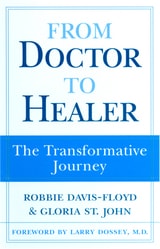
From Doctor to Healer
The Transformative JourneySt. John, Gloria
Rutgers University Press, 1998
Why would a successful physician who has undergone seven years of rigorous medical training take the trouble to seek out and learn to practice alternative methods of healing such as homeopathy and Chinese medicine? From Doctor to Healer answers this question as it traces the transformational journeys of physicians who move across the philosophical spectrum of American medicine from doctor to healer. Robbie Davis-Floyd and Gloria St. John conducted extensive interviews to discover how and why physicians make the move to alternative medicine, what sparks this shift, and what beliefs they abandon or embrace in the process.
After outlining the basic models of American health care-the technocratic, humanistic, and holistic-the authors follow the thoughts and experiences of forty physicians as they expand their horizons in order to offer effective patient care. The book focuses on the radical shift from one end of the spectrum to the other-from the technocratic approach to holism-made by most of the interviewees. Because many American physicians find such a drastic change too threatening, the authors also address the less radical transition to humanism-a movement toward compassionate care arising from within the medical system.
From Humors to Medical Science
A HISTORY OF AMERICAN MEDICINEJohn Duffy
University of Illinois Press, 1993
John Duffy's classic history, formerly titled The Healers, has
been thoroughly revised and updated for this second edition, which includes
new chapters on women and minorities in medicine and on the challenges
currently facing the health care field.
"This remains the only comprehensive history of American medicine.
The treatment of the emergence of modern medicine and the flowering of
surgery is especially fresh and well done. As one of the respected scholars
in our profession, John Duffy has again demonstrated his wide knowledge
of the subject."
-- Thomas N. Brunner, author of To the Ends of the Earth: Women's
Search for Education in Medicine
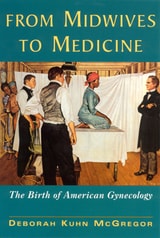
From Midwives to Medicine
The Birth of American GynecologyMcGregor, Deborah K
Rutgers University Press, 1998
Using patient records and archival material from the female governors and administrators at the hospital, From Midwives to Medicine shows how a new medical practice developed out of the changing patterns and historical experiences of childbirth, as well as out of the context of the social relations f the sexes. Sim's patients were slave women in the antebellum South, poor Irish immigrants in the industrial North, and upper-class white. Protestant, Manhattan socialites who sought help for their "hysterical" symptoms. During his career, which began in the South and flourished at the Women's Hospital in New York. Sims performed and perfected his technique to "cure" vesico-vaginal fistulas, the tears of childbirth, from which so many women suffered. But Sims achieved these successes on the operating table only after years of practicing his "silver suture" technique on unanesthetized slave women, who he believed "by the nature of their race... had a specific physiological tolerance for pain unknown to whites."
From Popular Medicine to Medical Populism
Doctors, Healers, and Public Power in Costa Rica, 1800–1940Steven Palmer
Duke University Press, 2003
Steven Palmer breaks with the view of popular and professional medicine as polar opposites—where popular medicine is seen as representative of the authentic local community and as synonymous with oral tradition and religious and magical beliefs and professional medicine as advancing neocolonial interests through the work of secular, trained academicians. Arguing that there was significant and formative overlap between these two forms of medicine, Palmer shows that the relationship between practitioners of each was marked by coexistence, complementarity, and dialogue as often as it was by rivalry. Palmer explains that while the professionalization of medical practice was intricately connected to the nation-building process, the Costa Rican state never consistently displayed an interest in suppressing the practice of popular medicine. In fact, it persistently found both tacit and explicit ways to allow untitled healers to practice. Using empirical and archival research to bring people (such as the famous healer or curandero Professor Carlos Carbell), events, and institutions (including the Rockefeller Foundation) to life, From Popular Medicine to Medical Populism demonstrates that it was through everyday acts of negotiation among agents of the state, medical professionals, and popular practitioners that the contours of Costa Rica’s modern, heterogeneous health care system were established.